
Introduction to ISO 14001:2026
About Course
Early access: Module 1 is open now
This course opens in stages. Module 1 is available from the day you enrol. The remaining modules, the knowledge checks, the final assessment and the certificate are released as each one is completed and reviewed, and they are included in the price you pay today. New modules appear in your dashboard as they are released.
Introduction to ISO 14001:2026
| Course code | Price | Duration | Level |
|---|---|---|---|
| FS56 | R1 495 | About 6 hours, self paced | Foundation |
About this course
The auditor stops at the wash bay, looks at the yellow drain cover and asks you where that drain goes. Then she asks what you would do if the caustic tote split on a Friday night. You know the plant. You were never told that those two questions are clause 6.1.2 and clause 8.2, or that your answer decides whether the site gets a finding.
That is the gap this course closes. Most people who work inside an environmental management system were never taught what the system is, what it asks of them, or why a register they have never seen decides how they should handle a drum of used oil. ISO 14001:2026, the fourth edition published in April 2026, makes the gap more visible: it now expects sites to think about environmental conditions such as climate change, biodiversity and water availability, to determine emergency situations alongside their aspects, and to plan changes before they are made.
In about six hours, on your phone or laptop, you learn every clause in plain words, the South African laws that sit behind the system, what changed from the 2015 edition, and what an auditor will ask you about your own job. It is a standalone course. It is not Module 1 of the Implementation course.
Who it is for
Supervisors, team leaders, operators who handle waste, chemicals or effluent, QA and SHEQ staff, administrators, new environmental coordinators, and any manager who will be interviewed by an auditor. Everyone who works inside the system but does not build it.
What you finish with
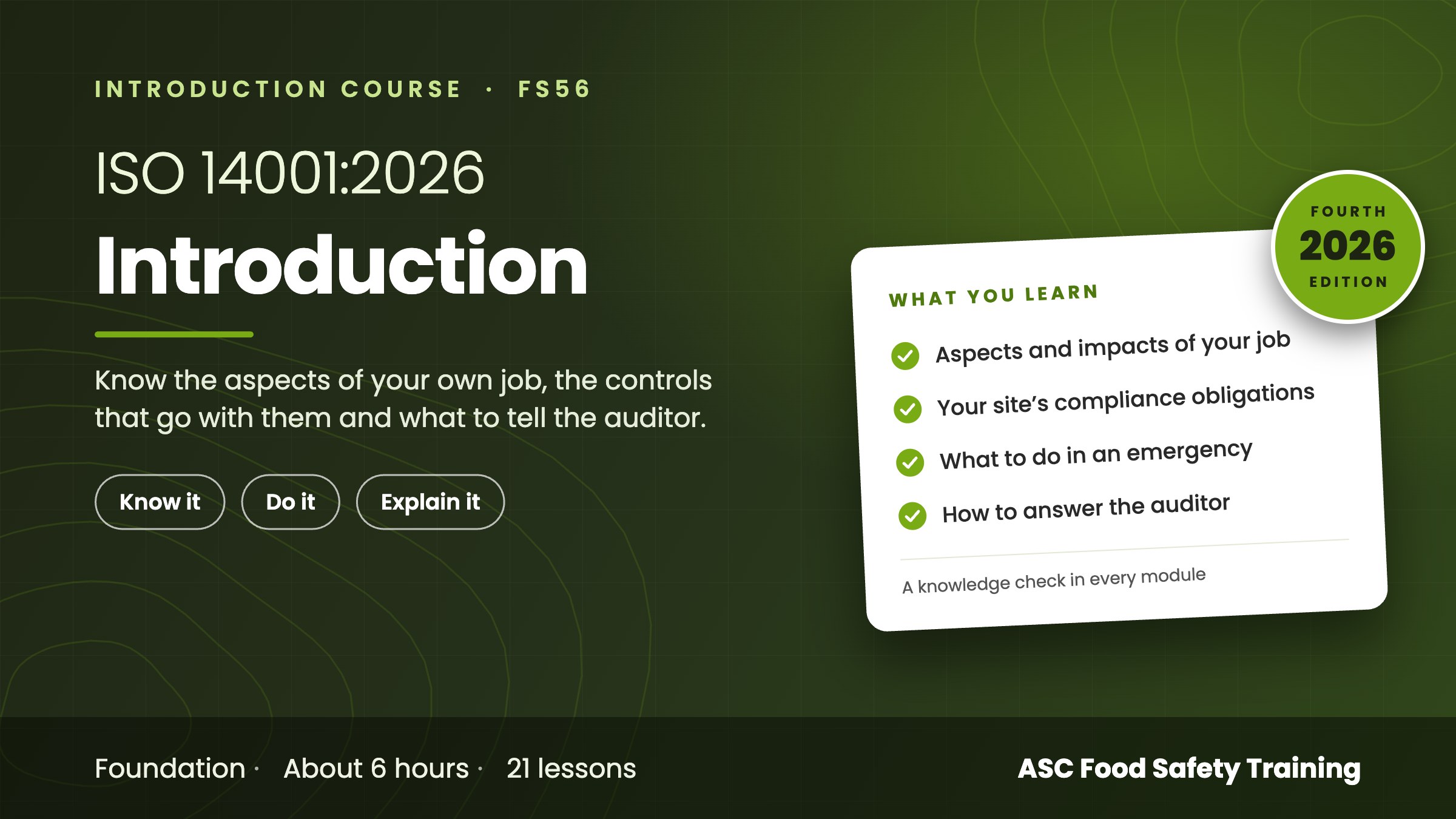
You finish able to name the significant aspects of your own job, the controls that go with them, what to do in an environmental emergency, and how to answer an auditor.
Curriculum
3 modules, 21 lessons and sittings.
Module 1: Environmental management, and why ISO 14001 exists
- Lesson 1.1: What an environmental management system is, and what ISO 14001 is for
- Lesson 1.2: Aspects and impacts, the two words the whole standard rests on
- Lesson 1.3: Compliance obligations: South African environmental law in one lesson
- Lesson 1.4: Clauses 4 to 10 on the Plan Do Check Act cycle
- Lesson 1.5: The 2026 edition: what changed from 2015, and what it means on your site
- Lesson 1.6: Who does what: top management, the EMS lead, contractors and you
Module 2: A tour of the requirements, clauses 4 to 7
- Lesson 2.1: Context and environmental conditions (4.1)
- Lesson 2.2: Interested parties and compliance obligations (4.2)
- Lesson 2.3: Scope, the life cycle and the system itself (4.3 and 4.4)
- Lesson 2.4: Leadership and the environmental policy (5)
- Lesson 2.5: Aspects, significance and emergency situations (6.1.2)
- Lesson 2.6: Risks, opportunities and planning action (6.1.4 and 6.1.5)
- Lesson 2.7: Objectives and planning of changes (6.2 and 6.3)
- Lesson 2.8: Competence, awareness, communication and documents (7)
Module 3: Operation, performance, improvement, and your part in the audit
- Lesson 3.1: Operational control and externally provided processes (8.1)
- Lesson 3.2: Life cycle controls: design, procurement and contractors (8.1)
- Lesson 3.3: Emergency preparedness and response (8.2)
- Lesson 3.4: Monitoring, measurement and evaluation of compliance (9.1)
- Lesson 3.5: Internal audit and management review (9.2 and 9.3)
- Lesson 3.6: Nonconformity, corrective action and continual improvement (10)
- Lesson 3.7: Answering an auditor about your own job
How you are assessed
Each module ends with a knowledge check drawn from a question bank, and there is a final assessment. The pass mark on every assessment is 70 percent, with three attempts on each, and every failed attempt tells you which lesson to go back to.
What you need
A phone, tablet or laptop with an internet connection. You do not need a site of your own: every practical task runs on a case site with the data supplied and a model answer, or on your own site if you have permission to use its information. You will find it useful to have your own licensed copy of ISO 14001:2026, which is sold by ISO and through national standards bodies such as the SABS. The course paraphrases the requirements and does not reproduce the standard.
Certificate
On passing you receive an ASC Food Safety Training certificate of completion that names the course, the code and the date, with a verification code an employer can check.
ISO 14001:2026 is a standard published by ISO. This course is an independent training product and is not approved or endorsed by ISO or by any certification body.
See all four ISO 14001:2026 courses and which one fits your job at ascfoodsafetytraining.com/iso-14001/.
Course Content
Module 1: Environmental management, and why ISO 14001 exists
-
Lesson 1.1: What an environmental management system is, and what ISO 14001 is for
-
Lesson 1.2: Aspects and impacts, the two words the whole standard rests on
-
Lesson 1.3: Compliance obligations: South African environmental law in one lesson
-
Lesson 1.4: Clauses 4 to 10 on the Plan Do Check Act cycle
-
Lesson 1.5: The 2026 edition: what changed from 2015, and what it means on your site
-
Lesson 1.6: Who does what: top management, the EMS lead, contractors and you
Module 2: A tour of the requirements, clauses 4 to 7
Module 3: Operation, performance, improvement, and your part in the audit
Student Ratings & Reviews
