
ISO 14001:2026 Understanding and Implementation
About Course
Early access: Module 1 is open now
This course opens in stages. Module 1 is available from the day you enrol. The remaining modules, the knowledge checks, the final assessment and the certificate are released as each one is completed and reviewed, and they are included in the price you pay today. New modules appear in your dashboard as they are released.
ISO 14001:2026 Understanding and Implementation
| Course code | Price | Duration | Level |
|---|---|---|---|
| FS57 | R4 800 | About 24 hours, self paced | Intermediate to Advanced |
About this course
A retailer sends a supplier sustainability questionnaire. Line 14 asks whether the site holds ISO 14001 certification or has a plan to certify. The municipality has written about the trade effluent results. The engineering manager wants to install a new spiral freezer next quarter. Somebody has to turn all of that into a system that works and passes a certification audit. If that somebody is you, this is your course.
ISO 14001:2026 Understanding and Implementation takes you through the fourth edition at the depth you need to build, upgrade or run an environmental management system. It covers every clause, with the changes from 2015 and Amendment 1:2024 built into each lesson: environmental conditions in 4.1, life cycle control and influence in 4.3, aspects under normal, abnormal and emergency conditions in 6.1.2, the new risks and opportunities sub-clause 6.1.4, planning of changes in 6.3, externally provided processes in 8.1, audit objectives in 9.2.2 and the restructured management review.
Every lesson ties the requirement to South African law: NEMA, the Waste Act, the Air Quality Act, the National Water Act, the Climate Change Act and the by-laws your municipality enforces. You work on your own site or on one of three case sites, a ready meals plant, a citrus packhouse and a restaurant group, with the data supplied and a model answer behind every task.
Who it is for
SHEQ and environmental managers, EMS coordinators, QA managers who are taking on environment, internal auditors, consultants, and operations or engineering managers who own processes with significant aspects. The people who have to build, upgrade or run the system.
What you finish with
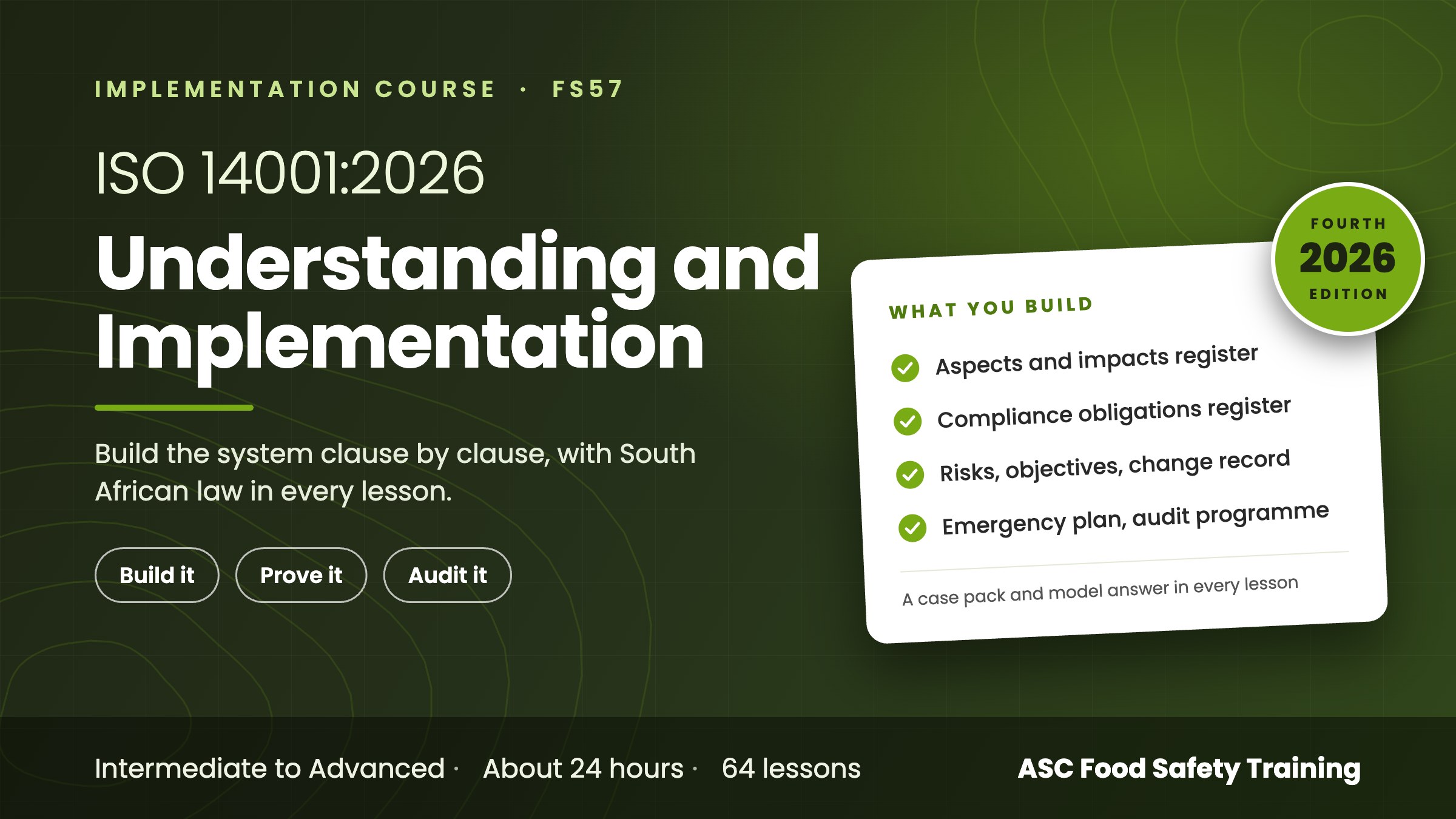
You finish with your own context and environmental conditions register, interested party register, aspects and impacts register with significance criteria, compliance obligations register, risk and opportunity register, objectives, change record, emergency plan, monitoring plan, audit programme and management review pack.
Curriculum
6 modules, 67 lessons and sittings.
Module 1: Foundations, what changed, and the implementation project
- Lesson 1.1: What an EMS is meant to achieve: the three intended outcomes
- Lesson 1.2: The fourth edition: every change from 2015 and Amendment 1:2024
- Lesson 1.3: The harmonized structure, and joining ISO 14001 to ISO 9001, ISO 45001 and ISO 22000
- Lesson 1.4: The South African compliance landscape: NEMA and the specific environmental management Acts
- Lesson 1.5: Reading the standard: shall, consider, take into account, and available as documented information
- Lesson 1.6: The gap assessment: where your site stands today
- Lesson 1.7: Planning the implementation project: team, budget and a twelve month plan
- Lesson 1.8: The documented information an EMS actually needs, and what it does not
- Lesson 1.9: Certification: choosing a certification body and what the audits look like
- Lesson 1.10: Meet the case sites: a ready meals plant, a citrus packhouse and a restaurant group
Module 2: Context and leadership, clauses 4 and 5
- Lesson 2.1: External and internal issues, and environmental conditions (4.1)
- Lesson 2.2: Climate change, biodiversity and ecosystem health as context, not slogans
- Lesson 2.3: Building the context register
- Lesson 2.4: Interested parties: who matters, and what they require (4.2)
- Lesson 2.5: When a need becomes a compliance obligation
- Lesson 2.6: Scope and boundaries, without excluding what is significant (4.3)
- Lesson 2.7: Control and influence over the life cycle
- Lesson 2.8: Processes and their interactions (4.4)
- Lesson 2.9: What top management must actually do (5.1)
- Lesson 2.10: Writing an environmental policy that commits to something real (5.2)
- Lesson 2.11: Roles, responsibilities and authorities (5.3)
- Lesson 2.12: Clinic: the context and leadership evidence pack
Module 3: Planning: aspects, obligations, risks, objectives and change, clause 6
- Lesson 3.1: The planning processes and how they connect (6.1.1)
- Lesson 3.2: Identifying aspects: activities, products and services
- Lesson 3.3: Normal, abnormal and emergency conditions
- Lesson 3.4: A life cycle perspective without a full life cycle assessment
- Lesson 3.5: Significance criteria that hold up at audit
- Lesson 3.6: Building the aspects and impacts register
- Lesson 3.7: Compliance obligations: finding them and showing how they apply (6.1.3)
- Lesson 3.8: Permits, licences, by-laws and voluntary commitments
- Lesson 3.9: Risks and opportunities, the new 6.1.4
- Lesson 3.10: Climate and other environmental conditions as risks to the organisation
- Lesson 3.11: Planning action and integrating it into the business (6.1.5)
- Lesson 3.12: Environmental objectives and indicators (6.2.1)
- Lesson 3.13: Planning to achieve objectives (6.2.2)
- Lesson 3.14: Planning of changes, the new 6.3
- Lesson 3.15: Clinic: the planning registers, checked line by line
Module 4: Support and operation, clauses 7 and 8
- Lesson 4.1: Resources, including natural resources and infrastructure (7.1)
- Lesson 4.2: Competence for people whose work can cause a significant impact (7.2)
- Lesson 4.3: Awareness that changes behaviour on the floor (7.3)
- Lesson 4.4: Internal and external communication (7.4)
- Lesson 4.5: Responding to complaints, regulators and neighbours
- Lesson 4.6: Documented information: creating, updating and control (7.5)
- Lesson 4.7: Operational planning and control: operating criteria (8.1)
- Lesson 4.8: Effluent, emissions and waste: controls that work
- Lesson 4.9: Energy, water and refrigerants
- Lesson 4.10: Chemicals and hazardous substances: storage, handling and spills
- Lesson 4.11: Externally provided processes, products and services
- Lesson 4.12: Design, procurement and downstream information over the life cycle
- Lesson 4.13: Contractors on site
- Lesson 4.14: Emergency preparedness and response, and testing it (8.2)
- Lesson 4.15: Clinic: an operational control walk
Module 5: Performance evaluation, improvement and certification
- Lesson 5.1: What to monitor, measure, analyse and evaluate (9.1.1)
- Lesson 5.2: Indicators and environmental performance evaluation
- Lesson 5.3: Calibration and valid results
- Lesson 5.4: Evaluation of compliance (9.1.2)
- Lesson 5.5: The internal audit programme, with audit objectives (9.2)
- Lesson 5.6: Management review inputs (9.3.2)
- Lesson 5.7: Management review results that are decisions (9.3.3)
- Lesson 5.8: Nonconformity and corrective action (10.2)
- Lesson 5.9: Continual improvement (10.1)
- Lesson 5.10: Preparing for stage 1 and stage 2
- Lesson 5.11: After certification: surveillance and keeping the system alive
- Lesson 5.12: Clinic: the management review pack
Module 6: Workshop, marked assignment and final assessment
- Workshop sitting 1: context, aspects and compliance obligations
- Workshop sitting 2: risks, objectives, operational control and emergencies
- Workshop sitting 3: monitoring, audit and management review
How you are assessed
Each module has a knowledge check drawn from a question bank. The workshop runs over three sittings and ends in a marked implementation workbook, and there is a final assessment. The pass mark on every assessment is 70 percent, with three attempts on each, and feedback that names what to fix and which lesson to reread.
What you need
A phone, tablet or laptop with an internet connection. You do not need a site of your own: every practical task runs on a case site with the data supplied and a model answer, or on your own site if you have permission to use its information. You will find it useful to have your own licensed copy of ISO 14001:2026, which is sold by ISO and through national standards bodies such as the SABS. The course paraphrases the requirements and does not reproduce the standard.
Certificate
On passing you receive an ASC Food Safety Training certificate of completion that names the course, the code and the date, with a verification code an employer can check.
ISO 14001:2026 is a standard published by ISO. This course is an independent training product and is not approved or endorsed by ISO or by any certification body.
See all four ISO 14001:2026 courses and which one fits your job at ascfoodsafetytraining.com/iso-14001/.
Course Content
Module 1: Foundations, what changed, and the implementation project
-
Lesson 1.1: What an EMS is meant to achieve: the three intended outcomes
-
Lesson 1.2: The fourth edition: every change from 2015 and Amendment 1:2024
-
Lesson 1.3: The harmonized structure, and joining ISO 14001 to ISO 9001, ISO 45001 and ISO 22000
-
Lesson 1.4: The South African compliance landscape: NEMA and the specific environmental management Acts
-
Lesson 1.5: Reading the standard: shall, consider, take into account, and available as documented information
-
Lesson 1.6: The gap assessment: where your site stands today
-
Lesson 1.7: Planning the implementation project: team, budget and a twelve month plan
-
Lesson 1.8: The documented information an EMS actually needs, and what it does not
-
Lesson 1.9: Certification: choosing a certification body and what the audits look like
-
Lesson 1.10: Meet the case sites: a ready meals plant, a citrus packhouse and a restaurant group
Module 2: Context and leadership, clauses 4 and 5
Module 3: Planning: aspects, obligations, risks, objectives and change, clause 6
Module 4: Support and operation, clauses 7 and 8
Module 5: Performance evaluation, improvement and certification
Module 6: Workshop, marked assignment and final assessment
Student Ratings & Reviews
