
ISO 9001:2026 Lead Auditor (Quality Management Systems)
About Course
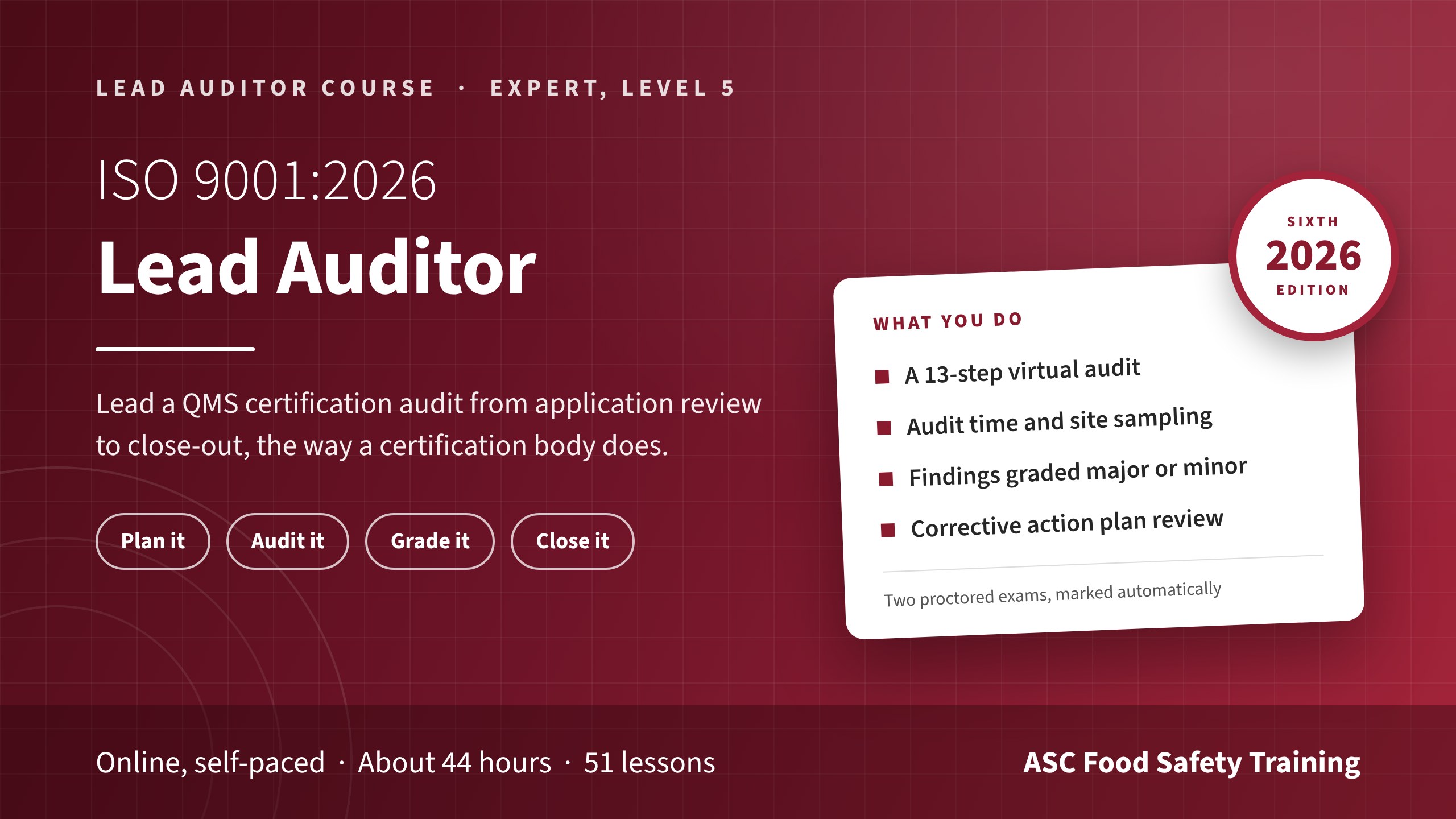
Lead an ISO 9001:2026 certification audit from the application review to the close-out
This is an expert-level, fully online ISO 9001:2026 lead auditor course, recognised by Exemplar Global, for people who already know ISO 9001 and now need to audit it the way a certification body does. In the virtual audit you run a full certification audit of one company, from the application review to the corrective action review, and each of its 11 stage quizzes is marked the moment you submit.
| Price | Duration | Level | Access |
|---|---|---|---|
| USD 999 (R16 595 at checkout, no VAT added) | About 44 hours, self-paced | Expert, Level 5 | 12 months |
The virtual audit at ASC Flexible Packaging
ASC Flexible Packaging is a training case built from real audit patterns. It is a rotogravure printer, laminator and pouch maker in Hammarsdale, KwaZulu-Natal, and it has applied for initial certification to ISO 9001:2026. In the virtual audit you review its application and work out the audit time, read its Stage 1 documents and decide whether it is ready, pick the team and plan Stage 2, interview its people from the managing director to the night shift laboratory technician, test its records, walk the site, run a trace test against the clock, write and grade the findings, hold the closing meeting under pressure, write the report and decide whether its corrective action plans are good enough to accept. That is 13 steps, about 13 hours on the step pages and about 3 more on the 11 timed stage quizzes that close steps 1 to 11.
Built on the current editions
- ISO 9001:2026, the sixth edition published on 16 September 2026, audited clause by clause, with every change from the 2015 edition and what evidence an auditor should expect for it, including the climate change decision, quality culture and ethical behaviour, risks and opportunities as separate work, the strengthened planning of changes and the new management review inputs.
- ISO 9000:2026 for the fundamentals and vocabulary.
- ISO 19011:2026, the fourth edition, for audit principles, audit programmes, the conduct of the audit and auditor competence, including its expanded guidance on remote auditing.
- ISO/IEC 17021-1:2015 and ISO/IEC 17021-3:2017 for third-party certification, auditor competence and grading nonconformities major or minor.
- The Global ACI documents that took over from the IAF in 2026, for audit time (Global ACI-TECH-3-004, formerly IAF MD 5), multi-site (TECH-3-001, formerly IAF MD 1), remote auditing (TECH-3-003, formerly IAF MD 4) and the ISO 9001:2026 transition (Global ACI-TECH-3-TR).
The audit skills you practise
- Reviewing an application for scope, IAF code, risk category, effective number of personnel, audit time and impartiality.
- Testing a “not applicable” claim, including the design and development claim that so many converters and contract manufacturers make.
- Planning the audit hour by hour across shifts, sites and outsourced processes, and choosing a team with the right codes.
- Running the opening and closing meetings, including the operations director who asks you to leave the pouch unit for a later audit and the managing director who asks you to downgrade a major.
- Interviewing at every level, following trails from a customer complaint back to the cause, and telling evidence from assertion.
- Writing findings that survive challenge, and grading them major or minor. In this course a nonconformity that affects allergen information, legal or regulatory compliance, or chemical contamination, including migration from packaging, is graded major.
- Judging corrective action plans, and knowing when a root cause of “operator error” is no root cause at all.
What you walk away with
- One ASC Certificate of Achievement covering the three units, QM, AU and TL, when you have passed all three.
- Your own audit workbook from the virtual audit, with your checklists, trails, findings, report and corrective action review, exported as an Excel file.
- A model answer for every case pack in the course, to compare with your own work.
- The list in Lesson 8.5 of the records to keep, including your audit logs, before you apply to a personnel certification body.
How the course works
A short start-up section, eight modules and the virtual audit. Part A, Modules 1 to 4, takes ISO 9001:2026 through an auditor’s eyes. Part B, Modules 5 to 8, takes ISO 19011:2026 and third-party certification. Self-paced with no live sessions, and 12 months of access. Most lead auditor courses run as four or five fixed days in a classroom or on a live call. This one fits around your own audits and your job. At four hours a week, that is about eleven weeks.
| Part | What it covers | Hours |
|---|---|---|
| Before you start | How the course is built and assessed, the standards you need, and an entry check | 0.5 |
| Module 1 | ISO 9001:2026 through an auditor’s eyes: principles, structure, the words that decide findings, every 2026 change, scope and applicability, legal requirements, integrated audits and the transition | 2.6 |
| Module 2 | Auditing context, leadership and planning, clauses 4 to 6, with a top management interview | 2.3 |
| Module 3 | Auditing support and the front end of operation, clauses 7 to 8.4, including design and development and external providers | 2.8 |
| Module 4 | Auditing operation, performance and improvement, clauses 8.5 to 10, with a timed trace test | 2.7 |
| Module 5 | Audit principles, audit programmes and third-party certification: accreditation, audit time, multi-site and impartiality | 2.2 |
| Module 6 | Planning the audit: Stage 1, the audit plan, the team, work documents, and remote and hybrid audits | 2.4 |
| Module 7 | Conducting the audit: meetings, sampling, interviewing, trails, difficult situations, writing and grading findings | 2.8 |
| Module 8 | Concluding the audit: the closing meeting, the report, follow-up, the certification decision, transition audits and auditor competence | 2.1 |
| Virtual audit | ASC Flexible Packaging, 13 steps with the Audit Workbench and 11 timed stage quizzes | 16 |
| Checks, games and practice tests | Eight knowledge checks, eight audit games, seven activity checks and two practice tests | 4 |
| Exams | Exam A in two sections and Exam B in three, video proctored | 3.1 |
Every module from 2 to 8 has a compulsory activity on ASC Flexible Packaging or another case site and a module case study at a different company and country. The case studies are set at a cold-chain logistics company in Kenya, an electronics contract manufacturer in Malaysia, a wiring harness supplier in Morocco, a multi-site cement group in Nigeria, a pharmaceutical glass vial maker in India, a furniture manufacturer in Poland and an IT managed services company in Uganda. Every lesson has worked cases with model answers and questions to think through before you reveal the answer.
How you are assessed
- Three units, QM (Quality Management Systems), AU (Auditing Management Systems) and TL (Leading Management System Audit Teams). When you have passed all three, you receive one ASC Certificate of Achievement that covers them.
- Exam A on quality management systems, in two sections, and Exam B on auditing and audit team leadership, in three sections, the third in two parts on writing and grading findings and on judging corrective action responses. Both are online and proctored by webcam with photo identification. You may use your own clean copy of ISO 9001:2026, and nothing else.
- The virtual audit’s 11 stage quizzes, each set on the evidence in its step.
- You need 70 percent in every section of every assessment. You have three attempts, and each attempt draws a different set of questions.
- Everything is marked automatically the moment you submit, with feedback that names the lesson to go back to. Nobody waits for a marker.
A course certificate is evidence of training, not personnel certification as an auditor. Certification as a QMS auditor or lead auditor is a separate step with a personnel certification body, on its own criteria. Exemplar Global adds its Work Style Assessment, and the CQI and IRCA ask for logged audits. Module 8 explains that route.
Who it is for
Quality managers who lead internal or supplier audits, consultants who prepare clients for certification, second-party auditors, and certification body auditors moving into QMS lead auditing, in any sector. You need a working knowledge of ISO 9001. Try this before you enrol. A company that builds electrical switchboards has three customer complaints in one quarter about loose terminals, and each corrective action reads “operator retrained”. Which clause of ISO 9001:2026 applies, what is the difference between the correction and the corrective action, and is “operator retrained” a root cause? If you can answer all three in a line each without looking anything up, you are ready. If you are new to the standard, start with ISO 9001:2026 Understanding and Implementation. If you are new to auditing, start with ISO 9001:2026 Internal Auditor.
Who wrote it
Written by Mthokozisi Nkosi, founder of ASC Food Safety Consultants and a registered lead auditor with Exemplar Global and IRCA, and reviewed by ASC’s publication panel before it went live. ISO 9001:2026 is published by ISO. This course is independent training and is not approved or endorsed by ISO or by any management system certification body.
What you need
Your own copies of ISO 9001:2026, ISO 9000:2026, ISO 19011:2026, ISO/IEC 17021-1:2015 and ISO/IEC 17021-3:2017. ISO/IEC TS 17012:2024 is useful but optional. Standards are copyright works, so they are not included. Buy them from ISO or your national standards body, such as the SABS. The Global ACI documents are free from global-aci.org. You also need a laptop or desktop with a webcam for the proctored exams.
Frequently asked questions
Is this ISO 9001 lead auditor course suitable for beginners?
No. It is an expert course for people who already know ISO 9001 and now need to lead audits. If you are new to the standard, start with ISO 9001:2026 Understanding and Implementation. If you are new to auditing, start with ISO 9001:2026 Internal Auditor.
Is the course written for ISO 9001:2026 or ISO 9001:2015?
ISO 9001:2026, published on 16 September 2026. Lesson 1.5 covers every change from the 2015 edition, Lesson 1.9 covers auditing a transition and Module 8 covers transition audits. If you already hold an ISO 9001:2015 lead auditor certificate and only need the changes, Transition to ISO 9001:2026 covers them in about 8 hours, and the free change list sets them out clause by clause. Certified organisations must complete the transition by 30 September 2029, and from 31 March 2028 initial certifications are to the 2026 edition only.
How long does the course take, and how long do I have access?
About 44 hours in total, including about 16 hours on the virtual audit and about 3 hours of exams. It is self-paced, with no live sessions, and you have 12 months from enrolment. At four hours a week, that is about eleven weeks.
How am I assessed?
By two online exams proctored by webcam with photo identification, Exam A in two sections and Exam B in three, and by the 11 stage quizzes of the virtual audit. You need 70 percent in every section, and you have three attempts, each with a different draw of questions. Everything is marked automatically when you submit.
What is the virtual audit?
A complete initial certification audit of ASC Flexible Packaging, a training case built from real audit patterns. In 13 steps you review the application, assess Stage 1, plan Stage 2, run the opening meeting, interview, test records, walk the site, run a timed trace test, write and grade findings, hold the closing meeting, write the report and review the corrective action plans. Steps 1 to 11 each end in a timed stage quiz.
Will this course make me a certified ISO 9001 lead auditor?
No course can do that on its own. When you have passed all three units, you receive one ASC Certificate of Achievement covering them, which is evidence of training. Certification as an auditor is a separate step with a personnel certification body, which applies its own criteria, such as a work style assessment or logged audits.
Is the course recognised by Exemplar Global?
Yes. ASC Food Safety is an Exemplar Global Recognised Training Provider, and the ISO 9001:2026 Lead Auditor course is one of its recognised courses, whether you take it online, in a live virtual class or in class. ASC issues your certificate, not Exemplar Global. You can verify ASC’s recognition on Credly and see all the recognised courses.
Is the course CQI and IRCA certified?
No. It is recognised by Exemplar Global under its Recognised Training Provider scheme. Exemplar Global and the CQI and IRCA each certify auditors on their own criteria, and Lesson 8.5 explains both routes. If an employer or a certification body has asked you for a CQI and IRCA certified course by name, check with them before you enrol.
Which standards do I need to buy?
ISO 9001:2026, ISO 9000:2026, ISO 19011:2026, ISO/IEC 17021-1:2015 and ISO/IEC 17021-3:2017. ASC cannot supply standards because they are copyright works. You need your own clean copy of ISO 9001:2026 for the exams.
Will the course work in my sector?
Yes. ISO 9001 applies to every sector. The module case studies are set at a cold-chain logistics company, an electronics contract manufacturer, an automotive wiring harness supplier, a multi-site cement group, a pharmaceutical glass vial maker, a furniture manufacturer and an IT managed services company, and the lessons use examples from manufacturing, engineering, logistics, construction, IT and services. The virtual audit is set at a packaging converter because it raises the questions every QMS lead auditor meets, such as design responsibility, outsourced processes, customer property and processes whose output cannot be fully checked afterwards.
How much does the course cost, and can I pay from outside South Africa?
USD 999. The store charges in South African rand, R16 595 at checkout, and accepts international Visa and Mastercard cards. Your bank converts the amount to your own currency. The fee includes 12 months of access, the virtual audit and the proctored exams. Standards are bought separately.
Can my company train a team?
Yes. We can enrol a group online with a manager dashboard, or run the course as a live virtual class or in class for your team. WhatsApp us for a quote.
Enrol
ISO 9001:2026 Lead Auditor (Quality Management Systems), USD 999 (R16 595 at checkout). About 44 hours, expert level, self-paced, 12 months of access. Eight modules, a 13-step virtual audit of ASC Flexible Packaging, two video proctored exams and an ASC Certificate of Achievement covering all three units. Enrol now with the button on this page, or start with the free reading at ISO 9001:2026 training.
Course Content
Before you start
-
Lesson 0.1: How this course works, how you are assessed, and the personnel certification route
-
Lesson 0.2: Your copy of the standards, how the quizzes work, and the entry check
Module 1: ISO 9001:2026 through an auditor’s eyes
Module 2: Auditing context, leadership and planning, clauses 4 to 6
Module 3: Auditing support and the front end of operation, clauses 7 to 8.4
Module 4: Auditing operation, performance and improvement, clauses 8.5 to 10
Module 5: Audit principles, audit programmes and third-party certification, ISO 19011:2026 clauses 1 to 5
Module 6: Planning the audit, ISO 19011:2026 clauses 6.1 to 6.3
Module 7: Conducting the audit and determining findings, ISO 19011:2026 clauses 6.4.1 to 6.4.8
Module 8: Concluding the audit, follow-up and auditor competence, ISO 19011:2026 clauses 6.4.9 to 7
Virtual audit: ASC Flexible Packaging (initial certification audit)
Exam A: Quality management systems
Exam B: Auditing and audit team leadership
Student Ratings & Reviews
