
Home / Guides / Legionella and hot water temperature
Legionella · Hot water · Geysers, heat pumps and solar
Key facts
- Grows between about 20 and 45 °C (HSE)
- Fastest around body temperature
- Survives 50 °C for several hours (WHO)
- Stored hot water 60 °C or above
- At the tap at least 50 °C within one minute (55 °C healthcare)
- Return at least 50 °C (55 °C healthcare)
- Cold water below 20 °C within two minutes
- Scalding fit TMVs at the outlet, never lower the storage temperature
Train the people who set the thermostat and read the thermometer
Legionella Awareness Training teaches the numbers, how to take a temperature reading properly, the weekly flushing routine and what to report. Four hours, online, written for South African buildings. R799.
At what temperature does Legionella grow?
The guidance bodies use slightly different numbers. Know which body says what before someone on site argues the point.
| Water temperature | What Legionella does | Source |
|---|---|---|
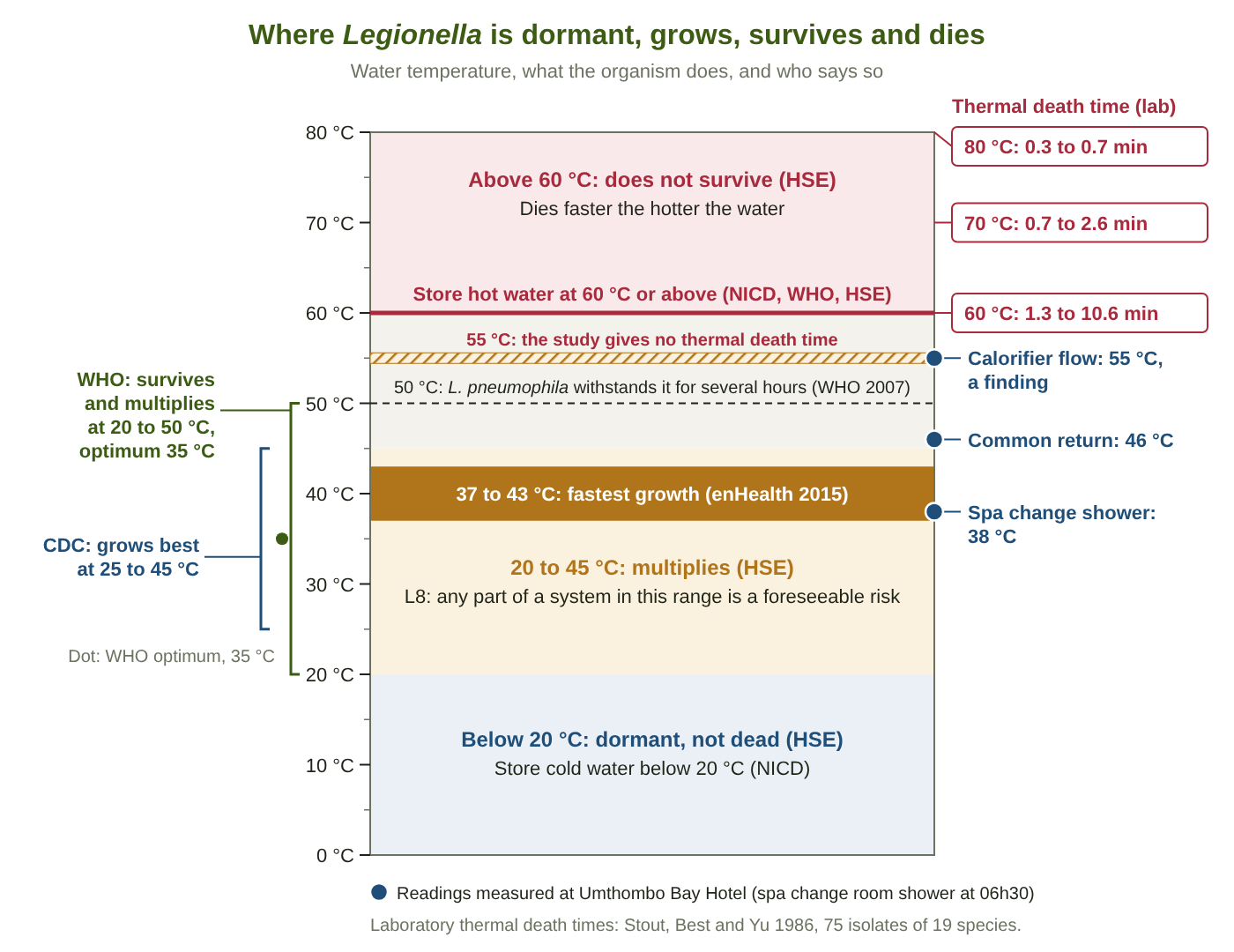
| Below 20 °C | Dormant, not dead. It waits | HSE |
| 20 to 45 °C | Multiplies where there are nutrients. The UK code treats any water in this range as a foreseeable risk | HSE, ACOP L8 |
| Around 35 to 43 °C | Fastest growth: the WHO gives an optimum of 35 °C, Australian guidance 37 to 43 °C | WHO, enHealth |
| 50 °C | Survives for several hours | WHO |
| 60 °C and above | Does not survive. The hotter the water, the faster it dies | HSE |
The practical point is the gap between 45 °C and 60 °C. Water at 50 °C feels hot to the hand and a lot of maintenance teams assume it is safe. It is not a killing temperature. WHO puts the top of the growth range at 50 °C, and any stagnant or dirty part of the system runs cooler than the flow.
What temperature kills Legionella, and how fast?
In laboratory tests on 75 isolates from 19 species (Stout, Best and Yu, 1986), the thermal death times were 1.3 to 10.6 minutes at 60 °C, 0.7 to 2.6 minutes at 70 °C, and 0.3 to 0.7 minutes at 80 °C. Those are laboratory figures in clean water. In a real system the bacteria sit inside biofilm and inside amoebae, which shelter them, so you never rely on a short burst of heat.
For thermal disinfection of a system, the Australian health and aged care guideline (enHealth, 2015) runs each outlet at 70 °C or above for at least 5 minutes, or 60 °C or above for at least 10 minutes if 70 °C cannot be reached. That is a disinfection procedure with scald controls around it, done by people who know what they are doing, not a setting you leave the geyser on.
What temperature should a geyser or calorifier be set to?
60 °C or above for storage. Every Legionella guideline lands in the same place: the NICD recommends storing hot water above 60 °C and delivering it to taps above 50 °C. The WHO asks for water leaving the heater at or above 60 °C so that hot water stays above 50 °C, and cold water below 25 °C, ideally below 20 °C. The UK’s HSG274 Part 2 asks for stored hot water of at least 60 °C, calorifier flow never below 60 °C, outlets reaching at least 50 °C within one minute (55 °C in healthcare premises) and each circulation return at least 50 °C (55 °C in healthcare).
You may hear someone quote SANS 10252-1, the South African standard for water supply installations in buildings. A note in that standard says hot water temperature should be controlled in the 55 to 60 °C range and that running at 60 to 70 °C makes water more corrosive. That is a design note about pipework, not a Legionella control. The 55 °C bottom end sits below the 60 °C storage figure in every Legionella guideline. For Legionella control, store at 60 °C or above.
Free tool: walk your own site in 20 minutes
The Legionella Water Walk is a free 24-point checklist for hot water, cold water, outlets, cooling towers and records. It ranks what it finds High, Medium or Low and exports the list as a spreadsheet.
Try the free Water Walk, then learn to act on what it finds in Legionella Awareness Training (R799).
Is it safe to turn the geyser down to save electricity?
No. It saves power, but it moves the stored water into the range where Legionella grows.
South African buildings have spent years managing electricity: load shedding, tariff pressure, heat pumps, solar preheating and geyser timers. Each one is sensible on the electricity bill. Each one can push stored water into the growth range without anyone noticing.
- Geysers on timers or switched off overnight. At the hotel case in our courses, the staff change room geysers switch off from 22h00 to 05h00. At 06h30 the spa change room shower runs at 38 °C after a minute. With the element off, every litre drawn overnight and early in the morning is replaced by cold water, so the geyser can sit in the growth range by morning, as it did here.
- Heat pumps set low. Heat pumps are efficient at lower set points, so they get set to 50 or 55 °C. The same hotel’s calorifiers have run at 55 °C since an energy saving drive. Where a heat pump cannot hold 60 °C, the electric element backup should top it up.
- Solar preheat. Solar water that comes in warm and sits in a preheat vessel without ever being raised to 60 °C is warm, stored water. The final heater must bring it up.
- The cool bottom of a horizontal geyser. Stellenbosch University modelling found the lower surfaces of horizontal geysers stay below 45 °C, and the authors concluded that the pipework downstream is where growth is favoured (Stone et al., 2018). Sediment collects at the bottom of the vessel too.
None of this means you cannot save electricity. It means the saving comes from insulation, good loop balancing and a heat source sized to hold 60 °C, not from switching the stored water off or running the whole system at the temperature Legionella likes.
Your artisans read the thermometer. Do they know what the number means?
Legionella Awareness Training teaches the people who set thermostats and take readings the limits, how to take a reading properly and what to report when a geyser runs cool. Four hours on a phone, R799 a person.
How do you prevent scalding without lowering the storage temperature?
This is the argument I hear most often, usually after someone has been hurt. A frail care centre turns its geysers down to 50 °C after a resident is scalded. The scald risk is real and the decision was made with good intent. It is still the wrong fix, because it trades one hazard for another in the most vulnerable people in the building.
The right answer is to store hot water at 60 °C or above and fit thermostatic mixing valves (TMVs) as close to the outlet as possible wherever vulnerable people wash: frail care, children, assisted bathing. The UK guidance calls for type 3 TMVs that are pre-set and fail safe if the cold supply is interrupted, checked at least annually. Fit and test the TMVs first, then raise the storage temperature. Raising it first puts very hot water at the outlets of the people the scald fix was meant to protect. A TMV outlet is mixed down on purpose, so it is not used as a hot sentinel when you check the loop. The healthcare routine is in Legionella in hospitals, clinics and frail care.
What temperature should cold water be to control Legionella?
Cold water should stay below 20 °C, and a cold tap should reach that within two minutes of running. In South Africa the usual culprits are roof tanks in the sun and too much stored water. After the water outages of recent years many buildings added polyethylene tanks that hold two or three days’ supply. The UK guidance says stored cold water should not normally exceed one day’s use (12 hours in healthcare), because water that sits warms and stagnates. Our guide to Legionella in water storage tanks covers JoJo tanks, outages and boreholes.
A 2025 study of residential high-rise buildings in Hillbrow, Johannesburg, found L. pneumophila in 14 of the 15 buildings sampled, all of which used storage tanks, most of them plastic (Buthane et al., Microorganisms, 2025). It does not prove that tanks cause the problem, but it is a strong reason to look inside yours.
How do you check your own hot water system for Legionella?
- Use a calibrated probe thermometer and a timer. Not the dial on the calorifier.
- Read the calorifier or geyser flow and the return on each loop. Flow at least 60 °C, returns at least 50 °C.
- Pick hot sentinel outlets: the nearest to and furthest from the calorifier on each loop. Run the hot tap and record the temperature at one minute. At least 50 °C (55 °C in healthcare).
- Run the cold sentinel taps, nearest to and furthest from the cold water tank, and record them at two minutes. Below 20 °C.
- Write it down at the outlet: date and time, outlet, reading and run time, the limit, pass or fail, what you did, your name.
- Do it monthly, and flush little-used outlets every week, following our Legionella flushing procedure.
Running a hotel or guesthouse? The full routine is in our hotel and guesthouse checklist. When temperatures cannot be held, sampling comes in: see Legionella testing in South Africa.
Enrol in Awareness Training (R799) →Start the Responsible Person course (R2 950) →
Frequently asked questions
What temperature kills Legionella?
Above 60 °C, and faster the hotter the water. In laboratory tests the thermal death times were 1.3 to 10.6 minutes at 60 °C and 0.7 to 2.6 minutes at 70 °C. At 50 °C Legionella pneumophila can survive for several hours.
What temperature should my geyser be set to?
Store hot water at 60 °C or above, so that the tap runs at 50 °C or more within one minute (55 °C in healthcare). Where scalding is a concern, fit a thermostatic mixing valve at the outlet rather than turning the geyser down.
Is 55 °C hot enough to control Legionella?
Not for storage. Every Legionella guideline asks for stored hot water at 60 °C or above. 55 °C is the healthcare figure for outlets and returns, not for the calorifier or geyser itself.
Can Legionella grow in cold water?
Below 20 °C it is dormant rather than dead. Cold water that warms above 20 °C, in roof tanks in summer or pipes running beside hot pipes, enters the growth range. Keep cold water below 20 °C and storage to no more than a day’s use.
Is it safe to switch my geyser off at night to save power?
No. With the element off, every litre drawn overnight and early in the morning is replaced by cold water, and the vessel can fall into the growth range before it reheats. Hold it at 60 °C around the clock. If a timer is fitted, reprogramme it so the geyser holds 60 °C, then check the first water of the morning at the outlets.
Does a heat pump control Legionella?
Only if it holds the stored water at 60 °C or above. Heat pumps are often set lower for efficiency, so the electric element backup should raise the water to 60 °C.
How often should hot water temperatures be checked?
Calorifier flow and return, and hot and cold sentinel outlets, monthly under HSE HSG274. Little-used outlets are flushed weekly.
Four hours, then your team checks the water properly
The temperature numbers, the right way to take a reading, the flushing routine, what to report and to whom, and a walkround of a full hotel case built from real audit patterns. Built on the OHS Act and the HBA Regulations, 2022.
Enrol in Awareness Training (R799) →Responsible Person course (R2 950)Self-paced, works on a phone. HPCSA CPD accredited. Certificate on passing.