
Transition to ISO 14001:2026
About Course
Early access: Module 1 is open now
This course opens in stages. Module 1 is available from the day you enrol. The remaining modules, the knowledge checks, the final assessment and the certificate are released as each one is completed and reviewed, and they are included in the price you pay today. New modules appear in your dashboard as they are released.
Transition to ISO 14001:2026
| Course code | Price | Duration | Level |
|---|---|---|---|
| FS58 | R1 950 | About 8 hours, self paced | Intermediate |
About this course
Your ISO 14001:2015 certificate has a date on it, and the fourth edition has put a clock beside that date. ISO 14001:2026 was published in April 2026 and cancels and replaces the 2015 edition and its 2024 climate change amendment. Certification bodies expect a three year transition, which puts the end of the period at about 30 April 2029. Your certification body will set its own cut-off dates inside that window.
Most of the fourth edition will not change what you do on Monday. Some of it will. This course sorts every change into no action, confirm or build, so you spend your time on the seven or so items that need real work, such as the new risks and opportunities sub-clause, planning of changes, environmental conditions in your context analysis, emergency situations determined with your aspects and the documented audit programme, and you skip the rest with a clear conscience and a reason on file.
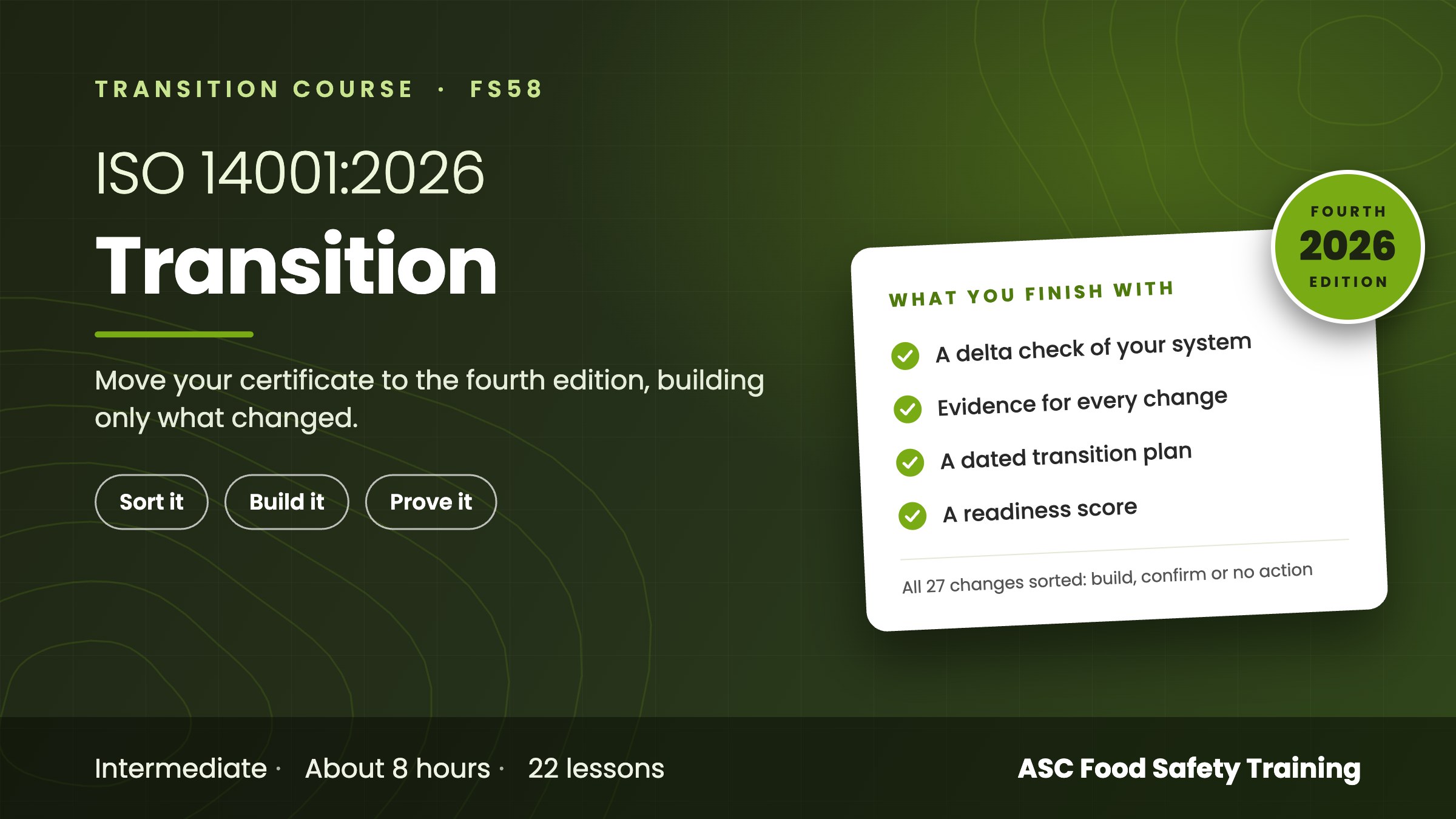
You finish with a delta check of your own system against the 2026 text, an evidence position on every change, a dated action plan and a readiness score you can take into the transition audit.
Who it is for
Sites that already hold an ISO 14001:2015 certificate and have to move it. SHEQ and environmental managers, EMS coordinators, internal auditors and consultants who already run a working system.
What you finish with
You finish with a delta check of your own system against the 2026 text, an evidence position on every change, a dated action plan and a readiness score.
Curriculum
4 modules, 22 lessons and sittings.
Module 1: The fourth edition, and what it obliges you to do
- Lesson 1.1: What was published, and what it replaces
- Lesson 1.2: The transition dates, and how certification bodies apply them
- Lesson 1.3: Reading the changes: no action, confirm or build
- Lesson 1.4: The new and deleted terms in clause 3
- Lesson 1.5: Available as documented information: the end of maintain and retain
- Lesson 1.6: Setting up your transition file and delta check
Module 2: The builds, clause by clause
- Lesson 2.1: Environmental conditions in 4.1, beyond the climate change sentence
- Lesson 2.2: Interested parties, compliance obligations and life cycle scope (4.2 and 4.3)
- Lesson 2.3: Aspects under normal, abnormal and emergency conditions (6.1.2)
- Lesson 2.4: The new risks and opportunities register (6.1.4 and 6.1.5)
- Lesson 2.5: Planning of changes (6.3)
- Lesson 2.6: Externally provided processes, products and services (8.1)
Module 3: Updating the system people actually use
- Lesson 3.1: Audit objectives and a documented audit programme (9.2.2)
- Lesson 3.2: Management review inputs and results (9.3)
- Lesson 3.3: Continual improvement and the end of 10.3
- Lesson 3.4: Procedures, cross references and the manual you may not need
- Lesson 3.5: Telling people what changed: awareness and competence for the transition
Module 4: Proving the transition
- Lesson 4.1: An internal audit against the 2026 text
- Lesson 4.2: The management review that closes the transition
- Lesson 4.3: What the transition audit looks like
- Lesson 4.4: Building the evidence pack
- Lesson 4.5: Your readiness score and the last thirty days
How you are assessed
Each module ends with a knowledge check drawn from a question bank, and there is a final assessment. The pass mark is 70 percent, with three attempts on each, and the feedback on a failed attempt names the lesson to go back to.
What you need
A phone, tablet or laptop with an internet connection. You do not need a site of your own: every practical task runs on a case site with the data supplied and a model answer, or on your own site if you have permission to use its information. You will find it useful to have your own licensed copy of ISO 14001:2026, which is sold by ISO and through national standards bodies such as the SABS. The course paraphrases the requirements and does not reproduce the standard.
Certificate
On passing you receive an ASC Food Safety Training certificate of completion that names the course, the code and the date, with a verification code an employer can check.
ISO 14001:2026 is a standard published by ISO. This course is an independent training product and is not approved or endorsed by ISO or by any certification body.
See all four ISO 14001:2026 courses and which one fits your job at ascfoodsafetytraining.com/iso-14001/.
Course Content
Module 1: The fourth edition, and what it obliges you to do
-
Lesson 1.1: What was published, and what it replaces
-
Lesson 1.2: The transition dates, and how certification bodies apply them
-
Lesson 1.3: Reading the changes: no action, confirm or build
-
Lesson 1.4: The new and deleted terms in clause 3
-
Lesson 1.5: Available as documented information: the end of maintain and retain
-
Lesson 1.6: Setting up your transition file and delta check
Module 2: The builds, clause by clause
Module 3: Updating the system people actually use
Module 4: Proving the transition
Student Ratings & Reviews
