
In a factory, allergen control is a system. In a restaurant, a canteen, a deli counter or a catering kitchen, it is a conversation, followed by about ninety seconds of decisions made while three other things are burning.
That is not an excuse for weaker control. It is a reason to design controls that survive a Friday night rather than ones that only work when the kitchen is calm.
1. The request is written down, not remembered
Take the request properly and repeat it back. Find out which allergen, not merely that there is one, because “I’m allergic” and “I’m allergic to celery” lead to completely different dishes. Write it on the ticket so it travels with the order, and make sure the kitchen sees it before the pan goes on rather than after.
A verbal relay from server to pass to chef fails the moment one of the three is replaced mid-shift. A written note on the ticket does not. Four habits make the difference:
- Ask, do not wait to be told. Many guests will not volunteer an allergy unless prompted, particularly when ordering for the table.
- Name the allergen on the ticket, not the phrase “allergy”. The kitchen cannot cook against a category.
- Repeat it back at the table, and again when the plate is delivered. The second repetition catches the plate that went to the wrong seat.
- Escalate once. One named person on each shift owns allergen orders and can stop one going out.
2. The answer comes from a specification, not a memory
You cannot answer an allergen question from recollection of a supplier’s recipe. Suppliers reformulate without telling the front of house, and the person who knew what was in the marinade is off today.
What you need is a dish specification, current, and reachable during service by whoever is answering. A folder in the office that nobody opens at 19:30 is not a control.
| Field | Why it is there |
|---|---|
| Dish name, as it appears on the menu | So the server searching under the menu name finds it |
| Every component, including sauces, dressings, oils, garnishes and coatings | The garnish and the dressing are where undeclared allergens live |
| Allergens present, by name | Not “contains allergens”. Which ones |
| Cooking method and equipment used | Shared fryer, shared grill, shared toaster. This drives what you can honestly promise |
| Substitutions permitted, and the allergens they change | Prevents an improvised swap creating a new risk |
| Supplier and product code for bought-in components | So a reformulation can be traced back to every dish it affects |
| Version and date, and who approved it | So you know whether you are reading the current one |
3. Separation happens in space, or in time
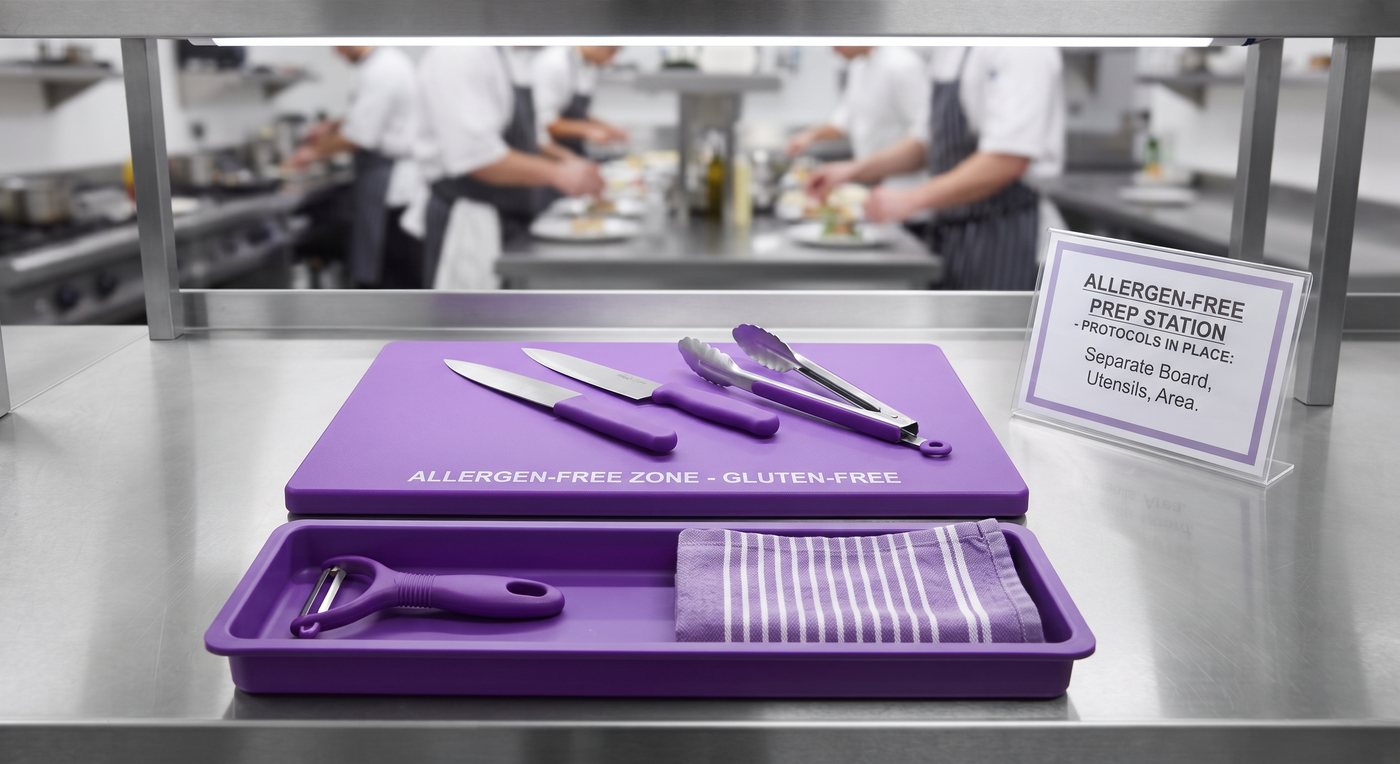
A dedicated allergen-free prep area with its own board, utensils and containers is the ideal. Most kitchens do not have the bench space for it.
The workable alternative is separation by time: prepare the allergen-free dish first, on a freshly cleaned surface, with clean hands and clean equipment, before the line gets loud. Sequencing costs nothing but planning, and it is the control that most often survives a real service.
Alongside it, the storage discipline that prevents the problem arising: allergen-containing materials stored low and sealed so nothing can spill onto anything beneath them; decanted products labelled with what they are and what they contain; flour and nuts treated as the powders they are, because powders travel further than anyone expects.
4. Some equipment cannot be made safe, and saying so is the control
A fryer shared between battered fish and chips cannot produce a gluten-free portion of chips. A flour-dusted pizza bench cannot produce a gluten-free base. A toaster that has handled bread all day cannot toast a gluten-free roll. A grill that has cooked buttered items cannot produce a dairy-free steak without a dedicated section and a clean.
Know which of your equipment falls into that category, write it on the dish specification, and say so at the point of order. One lost sale is a rounding error. One anaphylactic customer is a life, a licence and a reputation.
5. Buffets and counters need an owner
Self-service is the hardest environment in the trade, because the control passes to the customer. Tongs migrate. A serving spoon crosses two trays. A dish card ends up beside the wrong tray after a refill.
- One utensil per dish, physically attached or positioned so it cannot reach the next tray.
- Covers and sneeze guards in place, and dish cards that name allergens rather than dish poetry.
- Physical separation of the highest-risk items, with allergen-containing dishes placed downstream of the free-from ones so a spill travels away from them rather than into them.
- Refills brought out in a clean container rather than topped up over the old product, so a contaminated tray is not perpetuated all service.
- Somebody whose actual job it is to watch the counter, reset utensils and refill correctly. On a busy line, that is a role, not a favour.
Where the risk cannot be controlled on an open counter, the honest answer is to serve the allergen-free version from the kitchen on request, plated, rather than pretending the counter is safe.
6. The information has to leave with the food
At the pass, the allergen order should look different: a flagged plate, a separate tray, a runner who has been told, and hand-to-hand delivery to the person who ordered it, not to the middle of the table where it gets passed around.
For delivery and third-party platforms, the information has to travel on the packaging and in the platform listing:
- Sealed pack, so nobody can open and reassemble it in transit.
- A clear allergen sticker on the outside, naming the allergens rather than referring the customer elsewhere.
- A platform listing that matches today’s recipe, not the one uploaded eighteen months ago. Platform listings are the single most neglected label in food service.
- A note of the allergen request on the order docket so the kitchen, the packer and the driver all see the same thing.
A driver cannot answer a question you did not answer.
Menus, imported products and the fourteen-versus-eight problem
South African law requires eight allergen groupings to be declared on prepackaged food, plus added sulphur dioxide at 10 mg/kg and above. Many hospitality groups build their menu allergen matrix on the European list of fourteen instead, because their imported ingredients arrive labelled to it and their international guests expect it.
Either is defensible; mixing them silently is not. Decide which list your menu matrix works to, apply it to every dish, and say on the menu what the matrix covers. A guest who is allergic to celery or mustard needs to know whether your matrix even looks for it.
When somebody reacts
The person comes first. Call for emergency help immediately. If they carry an adrenaline auto-injector, help them use it without delay, keep them still, and stay with them until help arrives. Do not send them home to see whether it settles, and do not wait for the symptoms to develop further before calling.
Then protect the facts, the same day, while they are fresh:
- Keep the plate and any packaging, bagged and labelled.
- Record what was ordered, what was served, and who prepared it.
- Record what was said at the point of order, and by whom.
- Note who was on shift, and take a statement from each of them while it is fresh.
- Photograph the prep area and the dish specification as it stood that day.
- Notify management and, where required, the local authority.
That record protects the customer and, in practice, protects the business. Memory reconstructed six weeks later protects nobody.
Proving it afterwards
The routine paperwork is what turns a defensible practice into a demonstrable one: current dish specifications, supplier specifications on file, training records showing who was trained and when, cleaning records completed on the day they claim, and a log of allergen requests and how they were handled. An environmental health officer asks for these in roughly that order.
Frequently asked questions
Does a restaurant have to declare allergens if there is no label?
Food sold unpackaged across a counter or at a table is not excused from being honest about what is in it. The customer is relying on what you say, which is why the information has to exist somewhere reachable during service rather than in somebody’s memory.
Can we call anything gluten-free if we use a shared fryer?
No. Oil carries residue between products. If the fryer is shared with battered or crumbed items, the output is not gluten-free, and describing it that way is a misrepresentation with consequences.
What is the single most effective control in a small kitchen?
Sequencing. Preparing the allergen-free dish first, on a clean surface with clean equipment, before the rush. It costs nothing and it works in a kitchen with no spare bench.
How often should allergen training be refreshed?
Annually as a baseline, and immediately for any new starter, any menu change that introduces an allergen, and after any near miss. Keep the training record, because it is the first thing asked for after an incident.
Who should answer an allergen question at the table?
Anybody who can reach the dish specification while standing there. If your process depends on one chef being on shift, it is not a process.
Should our menu matrix use eight allergens or fourteen?
Either is defensible provided it is applied consistently and stated on the menu. South African law requires eight groupings plus sulphur dioxide; many groups work to the European fourteen because of imported ingredients and international guests. What is not defensible is mixing the two without saying so.
What do we do if a customer refuses to say which allergen?
Treat it as the strictest case you can control, tell them plainly what you cannot guarantee, and record the exchange. Guessing at the allergen is the one option that is never available.
Which ASC course covers this
Allergen Management for Food Service, Retail and Catering is a five-hour course built entirely around this environment: taking the request, knowing what is in the food, answering honestly including when the answer is no, the kitchen, the counter, the pass, delivery platforms, and what to do the moment a customer reacts. Nineteen lessons across five modules, with a video opening each one and a certificate on completion.
For kitchen and counter staff who need the short version in plain language, Allergen Awareness for Food Handlers covers the essentials in two hours. Where a group also manufactures or packs, Allergen Management in the Food Supply Chain covers the site-level programme behind the menu.