
Integrated Management Systems: ISO 9001:2026, ISO 14001:2026 and ISO 45001:2018 Understanding and Implementation
About Course
Integrated Management Systems: ISO 9001:2026, ISO 14001:2026 and ISO 45001:2018 Understanding and Implementation
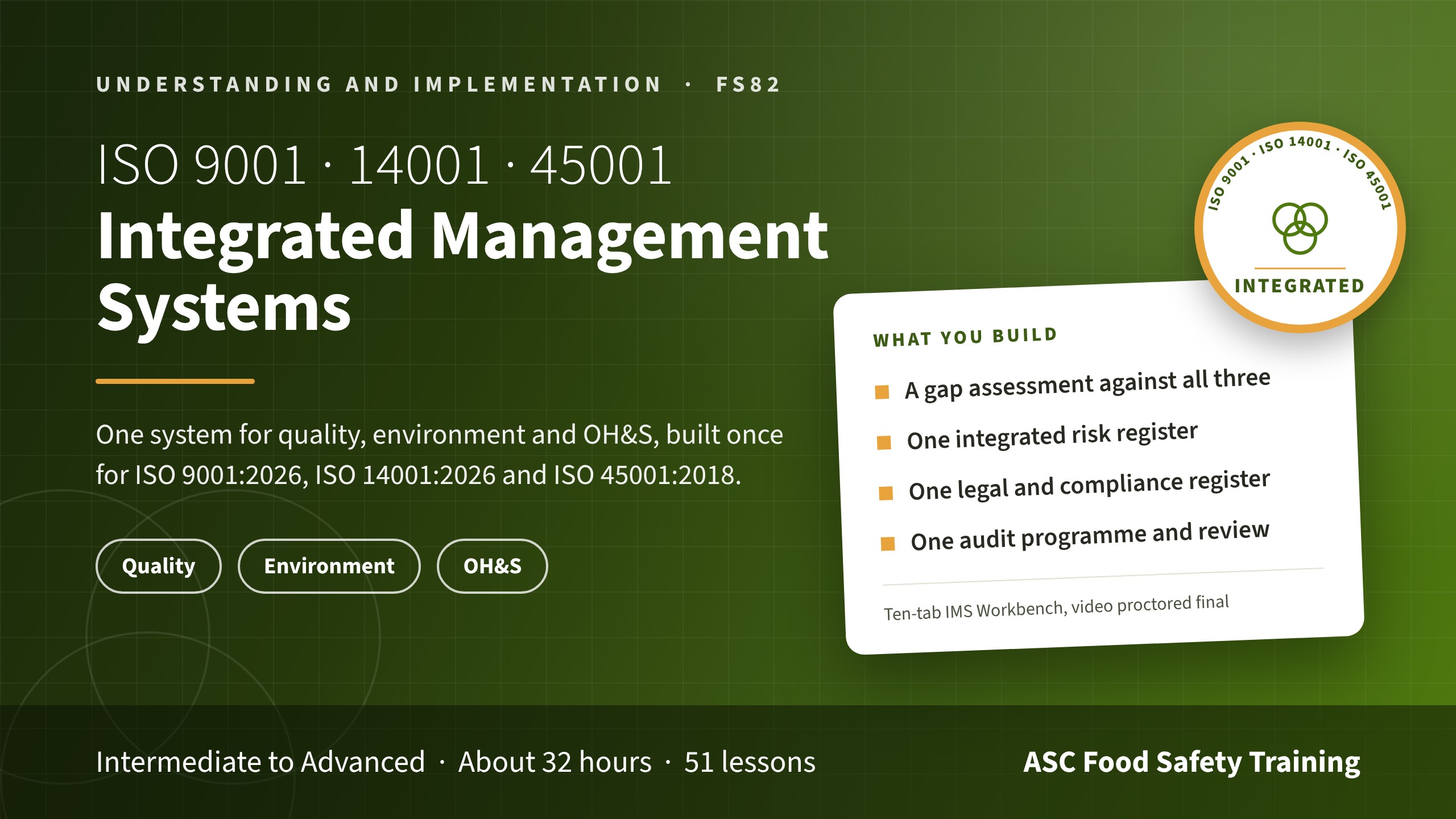
Build one management system that carries ISO 9001:2026, ISO 14001:2026 and ISO 45001:2018 together, with the common requirements built once and each standard’s own requirements kept inside the same processes. You build it on one case site in the ten-tab IMS Workbench, from the integrated gap assessment to the management review pack a combined certification audit will read, and you keep the whole system as one exported workbook. It costs R5 600 less than the three single courses.
| Course code | Price | Duration | Level | Access |
|---|---|---|---|---|
| FS82 | R7 950 | About 32 hours, self-paced online | Intermediate to Advanced | Lifetime |
About this course
A site that adds standards one at a time tends to end up with three systems in one office. The case site in this course starts there. Three signed policies from two managing directors. Four risk lists in three offices. Two partial legal lists and a missing third. An audit programme for food safety and none for the rest. Corrective actions, incidents, complaints and inspector’s notices kept in four places, and the same managers answering for all of it.
This course builds the other way. Every lesson in Modules 1 to 6 shows what the three standards have in common, what only one of them asks for, and how one process carries all of it. Quality risks, environmental aspects and OH&S hazards keep their own methods and criteria inside one register. One policy keeps every commitment each standard requires. One audit programme, one management review and one corrective action process serve all three, and each process owner answers for quality, environment and OH&S in their own process.
It covers everything a good integration course should, from why to integrate and the harmonized structure to the baseline review, the project plan, documentation, policy and objectives, risks, aspects and hazards, controls and emergencies, monitoring, evaluation of compliance, internal audit, management review, corrective action and readiness for a combined certification audit. Then it makes you build the system in a working tool and tests the judgements behind it.
Who it is for
- Quality, SHEQ, environmental and OH&S managers and coordinators who must build or run one system for all three standards.
- Managers of sites that hold one of the three certificates and are adding the other two.
- Sites that run two or three certified systems side by side and want one system instead.
- Consultants who implement integrated systems for South African clients.
- Food sites whose IMS must sit beside FSSC 22000 or another food safety system, with each keeping its own certificate and audits. If the food safety system is still to be built, see Implementation of FSSC 22000 Version 7 (food manufacturing).
Who it is not for
- Someone new to all three standards. The course assumes a working knowledge of at least one of them. Start with the Introduction course for that standard.
- Anyone after an auditor qualification. This is an implementation course and it does not train or qualify auditors. The Internal Auditor course for each standard does that.
- Anyone looking for a template pack. None of the three standards requires a manual or a set number of procedures, and the course will talk you out of buying one.
What you will be able to do
- Run one gap assessment against ISO 9001:2026, ISO 14001:2026 and ISO 45001:2018, and plan the integration project backwards from a combined Stage 2 date.
- Read the three standards side by side on the harmonized structure, including where ISO 45001:2018 numbers a requirement differently.
- Write one context register, one scope and one integrated policy that keeps every commitment each standard requires.
- Build one risk register in which quality risks, environmental aspects and OH&S hazards keep their own methods and criteria, and one legal and compliance obligations register.
- Run one competence, communication and documented information system, one set of operational controls and one emergency plan for people, the environment and continuity of supply.
- Plan combined internal audits, hold one management review and take nonconformities and incidents through one corrective action process with worker participation.
- Prepare a site for a combined certification audit and for the transitions to the 2026 editions.
What you build
The IMS Workbench is one tool in ten tabs, and you use it in the lessons and in the three workshop sittings. Every tab carries the case site’s starting data, which you copy in and then work on. If you have permission to use your own site’s data, you can build your own site instead. Your work saves in the browser as you type, and at the end it exports as one .xlsx workbook with a sheet for each tab, yours to keep and to use on your own site.
| Tab | What you build | Clauses |
|---|---|---|
| 1 Gap assessment | Every harmonized structure clause from 4.1 to clause 10, with a status and evidence for each of the three standards and the ISO 45001 number shown where it differs | 4 to 10 |
| 2 Context and interested parties | Issues marked against the standards they affect, and interested parties with what each requirement becomes in each standard | 4.1, 4.2 |
| 3 Scope, processes and responsibilities | One scope statement, the ISO 9001 applicability decisions, process cards that carry quality controls, aspects and hazards side by side, and one responsibility matrix with the legal appointments | 4.3, 4.4, 5.3 |
| 4 Integrated risk register | Quality risks and opportunities, environmental aspects and OH&S hazards on one page, sharing IDs and owners, each on its own method and criteria | 6.1 in all three |
| 5 Legal and compliance obligations register | One register for statutory and regulatory requirements, compliance obligations, and legal requirements and other requirements, with owners and evaluation frequency | ISO 14001 and ISO 45001 6.1.3 and 9.1.2 |
| 6 Objectives plan | Quality, environmental and OH&S objectives on one plan, each tied to a policy commitment, with indicator, resources, owner, date and how results are evaluated | 6.2 in all three |
| 7 Operational controls and emergencies | Controls by process or area with criteria and records, and emergency scenarios with the response, the drill plan and who is trained | 8.1 in all three, 8.2 in ISO 14001 and ISO 45001 |
| 8 Internal audit programme | A twelve month programme of combined audits, with objectives, criteria and scope for each audit, auditor competence and worker consultation on the programme | 9.2 in all three |
| 9 Management review pack | One agenda that carries every input each standard requires, with a check that shows which inputs are still empty, and the decisions with owners and dates | 9.3 in all three |
| 10 Nonconformity, incident and corrective action record | One record for nonconformities, complaints, environmental incidents and OH&S incidents, taken to root cause, extent and a checked corrective action | 10.2 in all three |
What is inside
Seven modules and 51 lessons. Modules 1 to 6 teach the clauses at implementation depth, every lesson with at least one case pack and most with a side by side table of the three standards. Module 7 is the workshop and the three practical stages. The final assessment closes the course, after the course feedback page.
| Module | Lessons | Lesson time | Workbench tabs |
|---|---|---|---|
| 1 Foundations, the harmonized structure and the integration project | 9 | About 3 hours (179 minutes) | 1 |
| 2 Context, scope, processes and leadership, clauses 4 and 5 | 8 | About 2.75 hours (164 minutes) | 2, 3 |
| 3 Planning, clause 6 | 8 | About 2.75 hours (170 minutes) | 4, 5, 6 |
| 4 Support, clause 7 | 6 | About 2 hours (118 minutes) | 1, 3, 5, 6 |
| 5 Operation, clause 8 | 7 | About 2.5 hours (152 minutes) | 7 |
| 6 Performance evaluation, improvement and certification, clauses 9 and 10 | 8 | About 2.75 hours (166 minutes) | 5, 8, 9, 10 |
| 7 Workshop, practical stages and the golden thread | 5 | About 1.5 hours (82 minutes), plus about 6 hours in the IMS Workbench | 1 to 10 |
Lessons take about 17 hours and the workshop about 6 hours in the IMS Workbench. The scenario checks, games, knowledge checks, case study assessments with their evidence packs, practical stages and the final take about 9 hours. That is about 32 hours in all, or about eight weeks at four hours a week.
Module 1: Foundations, the harmonized structure and the integration project
- 1.1 What an integrated management system is, and what it is not (20 min)
- 1.2 The three standards as they stand in 2026 (20 min)
- 1.3 The harmonized structure and the clause map (22 min)
- 1.4 Reading three standards at once (20 min)
- 1.5 The legal and other requirements layer (20 min)
- 1.6 The integrated gap assessment (22 min)
- 1.7 Planning the integration project (20 min)
- 1.8 The documented information an IMS needs, and what it does not (20 min)
- 1.9 Meet the case site: Mzansi Fresh Meals and its starting point (15 min)
Also in this module, three scenario checks, the game Common, or specific to one standard?, the knowledge check and a case study assessment at an invented engineering works in Ekurhuleni that holds ISO 9001 and is adding ISO 14001 and ISO 45001.
Module 2: Context, scope, processes and leadership, clauses 4 and 5
- 2.1 External and internal issues across quality, environment and OH&S, environmental conditions and the climate change decision (20 min)
- 2.2 Interested parties and their requirements, and what each requirement becomes in each standard (22 min)
- 2.3 One scope or three: boundaries, applicability, life cycle and the people the system covers (20 min)
- 2.4 One set of processes: the integrated process map and process cards that carry all three disciplines (22 min)
- 2.5 Leadership and commitment: the common items and what each standard adds (20 min)
- 2.6 One policy or three: every commitment each standard requires, and a clinic on an integrated policy (20 min)
- 2.7 Roles, responsibilities and authorities: one matrix with the OHS Act appointments (20 min)
- 2.8 Consultation and participation of workers (ISO 45001 5.4), and how a working participation process also serves quality and environment (20 min)
Also in this module, three scenario checks, the game Which clause, which standard?, the knowledge check and a case study assessment on Mzansi’s first context, scope and policy pack.
Module 3: Planning, clause 6
- 3.1 The planning chain in three standards, what feeds 6.1 in each and where each standard puts change (20 min)
- 3.2 Quality risks and opportunities under ISO 9001:2026 6.1.2 and 6.1.3 (20 min)
- 3.3 Environmental aspects and impacts, conditions and significance under ISO 14001 6.1.2 (22 min)
- 3.4 Hazard identification and OH&S risk assessment under ISO 45001 6.1.2, and the hierarchy of controls (22 min)
- 3.5 Designing one integrated risk register that keeps each discipline’s method (22 min)
- 3.6 One legal and compliance obligations register for ISO 14001 6.1.3, ISO 45001 6.1.3 and ISO 9001 statutory and regulatory requirements (22 min)
- 3.7 Planning action and setting integrated objectives under 6.1 and 6.2 (22 min)
- 3.8 One change process for ISO 9001 6.3, ISO 14001 6.3 and ISO 45001 8.1.3 (20 min)
Also in this module, three scenario checks, the game Aspect, hazard or quality risk?, the knowledge check and a case study assessment at an invented paint and coatings manufacturer in Durban that is merging three registers into one.
Module 4: Support, clause 7
- 4.1 Resources: one plan for people, infrastructure, measuring equipment, knowledge and natural resources (20 min)
- 4.2 One competence process: the matrix, legal competence and proof that training worked (20 min)
- 4.3 Awareness: one induction and refresher for all three standards, in the languages people work in (18 min)
- 4.4 Communication: one process for customers, regulators, neighbours, contractors and workers (20 min)
- 4.5 One documented information system: control, external documents, records and retention (20 min)
- 4.6 Clinic: the support evidence pack at Mzansi, line by line (20 min)
Also in this module, three scenario checks, the game Keep, merge or retire this document?, the knowledge check and a case study assessment on Mzansi’s support clinic.
Module 5: Operation, clause 8
- 5.1 Operational planning and control in three standards: criteria, controls and externally provided processes (20 min)
- 5.2 The quality operation inside the IMS: requirements, design, production, release and nonconforming outputs (ISO 9001 8.2 to 8.7) (22 min)
- 5.3 Environmental operational control: effluent, emissions, waste, energy, water, refrigerants, chemicals and the life cycle (22 min)
- 5.4 OH&S operational control: the hierarchy of controls in practice, permits, lockout, machine safety, health and hygiene (22 min)
- 5.5 One procurement, external provider and contractor process: ISO 9001 8.4, ISO 14001 8.1, ISO 45001 8.1.4 and the section 37(2) agreement (22 min)
- 5.6 One emergency preparedness and response plan: ISO 14001 8.2, ISO 45001 8.2, continuity of supply and the ammonia scenario (22 min)
- 5.7 Clinic: an operational control walk on the Mzansi floor through three lenses (22 min)
Also in this module, three scenario checks, the game Which control is strongest?, the knowledge check and a case study assessment at an invented hospital laundry in Gqeberha.
Module 6: Performance evaluation, improvement and certification, clauses 9 and 10
- 6.1 Monitoring, measurement, analysis and evaluation: one performance dashboard for quality, environment and OH&S (22 min)
- 6.2 One evaluation of compliance: ISO 14001 9.1.2 and ISO 45001 9.1.2 (20 min)
- 6.3 The integrated internal audit programme and combined internal audits under ISO 19011:2026 (22 min)
- 6.4 One management review: every input and result of the three standards in one agenda (22 min)
- 6.5 Nonconformity, incidents and corrective action in one process, with worker participation (22 min)
- 6.6 Continual improvement and keeping one system alive (18 min)
- 6.7 Certification of an integrated system: combined audits, Stage 1 and Stage 2, and the transitions (20 min)
- 6.8 Clinic: the integrated management review pack, line by line (20 min)
Also in this module, three scenario checks, the game Monitor, measure, analyse or evaluate?, the knowledge check and a case study assessment on the review pack before Mzansi’s combined Stage 2.
Module 7: Workshop, practical stages and the golden thread
Three sittings in the IMS Workbench build Mzansi’s integrated system tab by tab. A practical stage follows each sitting, and the final assessment closes the course.
- 7.1 Workshop briefing: three sittings, the IMS Workbench, one workbook (12 min)
- 7.2 Sitting 1: gap assessment, context, interested parties, scope, processes and policy, tabs 1 to 3 (20 min, plus about 2 hours in the IMS Workbench)
- 7.3 Sitting 2: the integrated risk register, the legal register, objectives, operational controls and emergencies, tabs 4 to 7 (20 min, plus about 2.5 hours)
- 7.4 Sitting 3: the audit programme, the management review pack and one corrective action, tabs 8 to 10 (20 min, plus about 1.5 hours)
- 7.5 Before the final: the golden thread test (10 min)
- Practical stage 1, Part A, the context and planning registers at Mzansi
- Practical stage 2, Part B, controls, objectives and emergencies
- Practical stage 3, Part C, checks, review and the golden thread
- Final assessment across all modules
How you are assessed
| Assessment | How many | Questions | Time | Attempts |
|---|---|---|---|---|
| Scenario checks | 18, three in each of Modules 1 to 6 | 6 drawn at random from a bank of 8 | 1 minute a question | 3 |
| Games | 6, one in each of Modules 1 to 6 | 10 decision cards drawn from 12 | 45 seconds a card | Unlimited |
| Knowledge checks | 6, one at the end of each of Modules 1 to 6 | 15 drawn at random from a bank of 24 to 27 that covers every lesson in the module | 45 seconds a question | 3 |
| Case study assessments | 6, one per module, each on an evidence pack you read first | 8 drawn from 10 | 15 minutes | 3 |
| Practical stages | 3 in Module 7, set at Mzansi, video proctored | 10 drawn from 14 | 30 minutes | 3 |
| Final assessment | 1, video proctored | 40 drawn from a bank of at least 80 across all modules, none repeated from a module bank | 60 minutes | 3 |
- 70 percent to pass every check, game, case study assessment, practical stage and the final.
- Three attempts on every check, case study assessment, practical stage and the final, with the questions drawn at random from the bank on each attempt. Games allow unlimited attempts.
- R250 to reopen. If you use all three attempts without passing, an R250 fee reopens that assessment.
- Marked automatically the moment you submit. There is no human marker and nothing to upload. The feedback on a failed attempt names the lesson to go back to.
- Locked in order. Each item opens when the one before it is complete, and every check must be passed before you move on.
- Video proctored practical stages and final, so you need a webcam for those four.
When every assessment is passed, ASC issues a Certificate of Achievement with a verification code an employer or client can check. It is evidence of training. It does not certify your organisation and it is not an auditor qualification.
The case site
Mzansi Fresh Meals (Pty) Ltd, Kempton Park, Gauteng, the chilled ready meals plant that ASC’s three single courses use, now building one system for all three standards. It makes 38 products, about 1.2 million meals a month, on a turnover of about R310 million, with 400 employees on two twelve-hour shifts and 60 agency staff from a labour broker, mostly on nights. It runs a 1 800 kg ammonia plant, a diesel boiler, two CIP sets and bulk caustic and acid tanks in the lowest corner of a site whose stormwater runs untreated into a stream. It has held FSSC 22000 since 2020 and holds no other certificate.
The pressure comes from three sides. Retailer A, with 61 percent of the volume, now asks about ISO 9001, ISO 14001 and ISO 45001 by the end of 2027. In 2025 two workers were seriously injured and about 200 litres of caustic reached the stream without being reported. In May 2026 a Department of Employment and Labour inspector issued a contravention notice and a prohibition notice. On 3 November 2026 the board decided to build one integrated system beside FSSC 22000 and to take one combined certification audit in November 2027. You build that system with the same facts in every lesson, tab and assessment.
53 case packs run through Modules 1 to 6, 38 on Mzansi and 15 on sites in other sectors, each with the facts, the tasks and a model answer to check your work against. The other sites include a chemical blender, a civil works contractor, a refrigerated logistics company, a mining contractor’s workshop, a galvanising works, a municipal water works, a bus depot and a hotel group, and the case study assessments add an engineering works, a paint and coatings manufacturer and a hospital laundry. Every site is a training case built from real audit, inspection and incident patterns. No real company is named.
What you need
- A working knowledge of at least one of the three standards. If one is new to you, take its Introduction course first.
- Your own licensed copies of ISO 9001:2026, ISO 14001:2026 and ISO 45001:2018 with Amendment 1:2024. ISO 19011:2026 is recommended for the internal audit lessons. The standards are sold by ISO and through national standards bodies such as the SABS. The course paraphrases the requirements and gives the clause numbers. It does not reproduce the standards.
- A laptop or tablet with an internet connection. The lessons work on a phone, but the registers are easier to build on a bigger screen.
- One device and one browser for the workshop, because the IMS Workbench saves your work in the browser you use. Save a draft file at the end of every sitting.
- A webcam for the three practical stages and the final assessment.
- No site of your own. Every tab carries Mzansi’s data. The practical stages are set at Mzansi, so read its data even if you build your own site.
Price and access
Integrated Management Systems, FS82, R7 950. About 32 hours, Intermediate to Advanced, self-paced, with lifetime access. Seven modules, 51 lessons, the ten-tab IMS Workbench, 53 case packs in the teaching modules, three video proctored practical stages and a video proctored final, and a Certificate of Achievement with a verification code once every assessment is passed. Prices are in rand. For a team, contact ASC about a group arrangement.
This course, or the three single courses?
| This integrated course, FS82 | The three single Understanding and Implementation courses | |
|---|---|---|
| Price | R7 950 | R13 550 in all (R4 800, R4 800 and R3 950) |
| Study time | About 32 hours | About 68 hours (24, 24 and 20) |
| What it teaches | Every clause of the three standards side by side, with the weight on what is common, what differs and how one process carries both | Each standard on its own at full depth, with integration lessons in each |
| Tools | One IMS Workbench in ten tabs for all three | A set of tools in each course for its own standard |
| Case site | Mzansi Fresh Meals building one integrated system | Mzansi Fresh Meals and two other case sites, one standard at a time |
| Certificate | One Certificate of Achievement, FS82 | One certificate per course |
Take this course if your job is one system for all three standards. It costs R5 600 less and takes about 36 hours less than the three single courses. The larger saving comes after the course. Three separate systems mean three audit programmes, three management reviews and three corrective action logs, run by the same managers. One integrated system has one of each, and one combined certification audit, in which the certification body decides how far audit time can change with the level of integration. Take the single courses if you answer for one standard, or if you want each standard at full depth on its own before you join them, because they give each standard more lesson time than an integrated course can. All the courses and the free guides for each standard sit at ISO 9001:2026 training, ISO 14001:2026 training and ISO 45001 training.
Free guides
- How to implement ISO 14001:2026: a step by step plan for South African sites
- How to implement ISO 45001: a step by step plan for South African sites
- ISO 14001 legal register for South Africa: building the compliance obligations register and evaluating compliance
- Hazard identification and risk assessment under ISO 45001: HIRA registers that hold up with inspectors and auditors
- ISO 14001:2026 documented information: the full list of what you must have
Questions people ask
What is an integrated management system?
An integrated management system is one set of processes, records and owners that meets the requirements of more than one standard. It has one context register, one policy or a set chosen on purpose, one document control, one competence matrix, one audit programme, one management review and one corrective action process, and each process owner answers for quality, environment and OH&S in their own process. Common requirements are built once. The requirements only one standard has are built inside the same processes, never as a parallel system. It is not one risk method and it is not a certificate.
Can one policy cover ISO 9001, ISO 14001 and ISO 45001?
Yes. None of the three standards requires a separate policy document. What they require is a set of commitments. All three need a policy that fits the purpose and context of the organisation, a framework for objectives, a commitment to the requirements that apply and continual improvement. ISO 9001 5.2.1 adds the strategic direction. ISO 14001 5.2 adds protection of the environment, including prevention of pollution. ISO 45001 5.2 adds safe and healthy working conditions, eliminating hazards and reducing OH&S risks, and consultation and participation of workers. The ISO 45001 commitments to eliminate hazards and to consult workers are the first to fall out when a quality policy is stretched to cover the other two. Lesson 2.6 tests an integrated policy against every commitment by name.
Is there an IMS certificate?
Not from an accredited combined audit. There is no ISO standard for an IMS to certify to. An accredited certification body issues one certificate per standard, each for the scope written on it, even after one combined audit. A site can say it holds ISO 9001, ISO 14001 and ISO 45001 certificates. It cannot say it is IMS certified.
Is PAS 99 still used?
Rarely. PAS 99:2012, BSI’s specification for integrated management systems, was withdrawn on 16 November 2022. In December 2025 BSI in Japan announced that it is ending its PAS 99 audits, because the harmonized structure now does that job, although BSI in the UK renewed a PAS 99 registration, without an accreditation mark, as late as July 2026. This course teaches integration on the harmonized structure and mentions PAS 99 only as history.
What is the harmonized structure, and does ISO 45001 follow it?
The harmonized structure, formerly the high level structure and often called Annex SL, gives management system standards the same clause numbers 1 to 10, common text and common core terms. ISO 9001:2026 and ISO 14001:2026 use the current text. ISO 45001:2018 was built on the 2012 text, so it differs in places. It adds 5.4 on consultation and participation of workers, has no 6.3 and puts change in 8.1.3, and splits clause 10 into three parts. Lesson 1.3 gives the full three-way clause map.
How long does integration take?
It depends on the size of the site, how much already works and how much time the process owners can give it. The case site in this course, a food plant of 400 people that holds one certificate, plans about a year. Its board decided on 3 November 2026, the system goes live in January 2027, the run starts on 1 March 2027 and the combined Stage 2 is in the week of 22 November 2027. Certification bodies usually expect a full cycle of internal audits and at least one management review before Stage 2. The full cycle is their practice, not a requirement of the standards, and ISO/IEC 17021-1 has Stage 1 check that internal audits and management reviews are planned and performed, so it sets the calendar. Lesson 1.7 plans backwards from the Stage 2 date.
Do I need the single courses first?
No. The course assumes a working knowledge of at least one of the three standards. If one of them is new to you, the Introduction course for that standard is the recommended start. The three single Understanding and Implementation courses are an alternative to this course, not a prerequisite.
Will the course help with a combined certification audit?
Yes, as far as a course can. Lesson 6.7 covers combined and integrated audits under Global ACI-TECH-3-008 (formerly IAF MD 11), choosing and briefing a certification body, Stage 1 and Stage 2 for three standards at once, and the transitions. How far audit time changes with the level of integration is the certification body’s decision, so the course gives no figure for it. No course can create your records. Stage 2 needs a running system with internal audits and a management review behind it.
We already hold ISO 9001. How do we add ISO 14001 and ISO 45001?
Start with one gap assessment against all three standards. Then extend the shared processes you already run, such as document control, internal audit, management review and corrective action, so that they carry the environmental and OH&S requirements too. The aspects register, the hazard identification and risk assessment and the legal register are new, and each keeps its own method. The Module 1 case study assessment is set at an engineering works in exactly that position.
Can we keep FSSC 22000 beside the integrated system?
Yes, and the case site does. Mzansi keeps its FSSC 22000 system beside the IMS, with its own certificate and its own audits. The two share document control, internal audit, corrective action and management review, and the food safety hazard analysis stays separate. The course treats FSSC 22000 as the food safety system the IMS sits beside, not as a fourth standard to teach.
Does the course cover South African law?
Yes, the law each standard needs. For the environment that is NEMA, the specific environmental management Acts, the National Water Act, municipal by-laws and permits. For OH&S it is the OHS Act 85 of 1993, its regulations and the COID Act, including the legal appointments and the section 37(2) agreement with contractors. For quality it is the product law the site meets, on the case site R638, the labelling regulations and the Legal Metrology Act 9 of 2014 for the quantity in the pack. One legal and compliance obligations register carries all three disciplines, and one evaluation of compliance tests it. The system shows how legal requirements are determined, applied and evaluated. It does not declare a site legally compliant, and neither does an auditor. It is training, not legal advice.
Does it work outside the food industry?
Yes. The three standards are sector neutral. The case site is a food plant because most of ASC’s delegates work in food, but the worked cases and case study assessments come from engineering, chemicals, paint and coatings, logistics, civil construction, mining contractors, hotels, a hospital laundry and municipal water works. The clauses, the evidence and the auditor’s questions do not change with the sector.
When must certification move to ISO 9001:2026 and ISO 14001:2026?
Under the Global ACI transition documents issued on 4 September 2026, new and initial ISO 14001 certifications are only to the 2026 edition from 31 October 2027, and the transition ends on 30 April 2029. New and initial ISO 9001 certifications are only to the 2026 edition from 31 March 2028, and that transition ends on 30 September 2029. Confirm the dates with your own certification body. Lessons 1.2 and 6.7 place a site in each transition.
What happens when ISO 45001 is revised?
The draft revision, ISO/DIS 45001, went to a ballot that closed in September 2026, and publication is expected in 2027. A draft is never audit criteria. Until a new edition is published, ISO 45001:2018 with Amendment 1:2024 is the standard sites are certified to, no transition applies, and it is what this course teaches.
Does an integrated management system need a manual?
No. None of ISO 9001:2026, ISO 14001:2026 and ISO 45001:2018 requires a manual or a set number of procedures. Each requires a defined list of documented information, such as the scope, the policy, the objectives and the records of competence, internal audits and management reviews, plus whatever the site decides it needs. A short IMS overview with a cross reference sheet helps the auditor of each standard find the evidence. Lesson 1.8 builds the documents map for all three.
About the trainer
ASC Food Safety Consultants write and review every course in this catalogue. The practitioners who wrote this one implement and audit management systems on South African sites: food manufacturing, packhouses, catering and retail supply. Every clause reference was checked against the published text of ISO 9001:2026, ISO 14001:2026 and ISO 45001:2018 with Amendment 1:2024, and the course was reviewed by a panel of ASC practitioners before it was published. No individual is named, because the course is ASC’s work and ASC stands behind it. ASC works from offices in Johannesburg, Cape Town and Gqeberha and has more than 400 Google reviews across them.
ISO 9001:2026, ISO 14001:2026, ISO 45001:2018 and ISO 19011:2026 are standards published by ISO. This course is an independent training product and is not approved or endorsed by ISO or by any certification body.
Enrol
Integrated Management Systems: ISO 9001:2026, ISO 14001:2026 and ISO 45001:2018 Understanding and Implementation, FS82, R7 950. About 32 hours, self-paced online, Intermediate to Advanced, with lifetime access. One course, one IMS Workbench and one exported workbook for all three standards, R5 600 less than the three single courses. For a team, contact ASC about a group arrangement.
Enrol now, or read the free guides first at ISO 9001:2026 training, ISO 14001:2026 training and ISO 45001 training.
Course Content
Module 1: Foundations, the harmonized structure and the integration project
-
Lesson 1.1: What an integrated management system is, and what it is not
-
Lesson 1.2: The three standards as they stand in 2026
-
Scenario check 1.1: one system, three outcomes, three editions
-
Lesson 1.3: The harmonized structure and the clause map
-
Game: Common, or specific to one standard?
-
Lesson 1.4: Reading three standards at once
-
Lesson 1.5: The legal and other requirements layer
-
Scenario check 1.2: the clause map, the words and the legal layer
-
Lesson 1.6: The integrated gap assessment
-
Lesson 1.7: Planning the integration project
-
Lesson 1.8: The documented information an IMS needs, and what it does not
-
Scenario check 1.3: the gap assessment, the project and the documents
-
Lesson 1.9: Meet the case site: Mzansi Fresh Meals and its starting point
-
Module 1 knowledge check
-
Module 1 case study evidence: the integration starting pack at Thembeka Engineering Works
-
Module 1 case study assessment: the integration starting pack at Thembeka Engineering Works
Module 2: Context, scope, processes and leadership, clauses 4 and 5
Module 3: Planning, clause 6
Module 4: Support, clause 7
Module 5: Operation, clause 8
Module 6: Performance evaluation, improvement and certification, clauses 9 and 10
Module 7: Workshop, practical stages and the golden thread
Course feedback and final assessment
Student Ratings & Reviews
