
Home / Food storage and distribution / Dry goods storage and stacking
Dry stores · Pests and mould · Stacking under GSR 8
At a glance
- Floor and walls no direct contact, R638 reg 8(1)
- Lighting at least 200 lux artificial, reg 5(3)(b)(ii)
- Aflatoxin only a laboratory test shows it
- Maize weevil breeds inside whole kernels, not meal
- Cans bulging, blown, leaking or badly damaged may not be sold, reg 7
- Chemicals kept from food under R638 regs 5(2)(b) and 10(11)
- Stacking GSR 8: six conditions, top tier first
- Unsupported stacks stepped back at least every fifth tier
A pallet of maize meal can stand against a damp wall in Pinetown through a wet week in February and look fine from the aisle. Pull it out and the bottom bags are soft, stained and smell of a wet cellar. Behind it there are droppings. Nobody noticed because nobody had a reason to look.
This is the dry store in the Mzansi Fresh Meals case study we use in the Food Storage and Distribution course, and every QA officer who reads it has a version of their own. R638 sets the legal floor for a dry store. The stacking rules come from the OHS Act, and most food people have never read them.
What does R638 say about storing dry goods?
Regulation 8(1) of R638 says food that is stored or displayed may not be in direct contact with a floor, ceiling, wall or any ground surface. Regulation 8(2) wants shelves and containers clean and free of dust. That covers a bag of sugar exactly as it covers a tray of chicken.
In practice it means pallets or racking for everything, and a clear gap between stock and the walls. The law gives no width for that gap. Make it wide enough for a cleaner with a broom and for the pest controller to reach the stations, then paint it on the floor so the forklift drivers can see it.
Two other parts of R638 help in a dry store. Regulation 5(3)(b)(ii) asks for daylight or artificial lighting of at least 200 lux, and you will not find weevils on a dark bottom shelf. Regulation 5(3)(b)(i) allows natural ventilation if the openings are at least 5% of the floor area and placed for cross-ventilation. A sealed, still store at the coast holds the damp. Regulation 10(3) puts the duty for pest control on the person in charge.
Which hazards actually spoil dry goods?
Moisture and mould
Water gets in from roof leaks, rising damp, wet pallets and condensation, and warmth does the rest. Corrugated cartons pick up moisture from humid air and lose much of their stacking strength, so the damp that starts mould also crushes the bottom tier.
The serious one is aflatoxin. Aspergillus flavus can produce aflatoxins in damp maize and peanuts, and the toxin cannot be seen, smelled or cooked out, even in maize that looks clean. Only a laboratory test shows it. That is why the soft bags in the Mzansi case go to the quarantine cage and are written off, and why the rest of the pallets along that wall are held until QA is satisfied.
Stored-product insects
Each pest has its own menu, and knowing it tells you where to look.
| Insect | What it attacks | Where to look first |
|---|---|---|
| Maize weevil | Breeds inside whole kernels, not in milled meal | Whole maize and other whole grain stock |
| Flour beetles | Meal and flour | Torn bags, spillage under racking, pallet tops |
| Bean bruchids | Beans | Sugar beans and other dried legumes |
| Cigarette and drugstore beetles | Spices | Spice cartons, dried herbs, seasoning stock |
All of them multiply faster when it is warm, so a Durban summer moves them along quicker than a Highveld winter. Very high temperatures, such as a closed van in the sun, stop their development rather than speed it, which is no comfort for the food in the van. Infestation usually arrives on incoming stock and spreads from one pallet, so inspect on receipt and keep stock moving.
Taint, damage and cans
Flour and rice take up smells. A jerry can of forklift diesel next to the rice will be found by a customer before your QA team finds it. Packaging is the dry good’s only barrier, and regulation 7(4) requires prepacked food in a container that protects it under normal handling. Tines through a bag are not normal handling.
Cans have their own rules under regulation 7. A can may not be sold if it bulges, or one end bulges when the other is pressed, if it is blown or releases gas when opened (aerated drinks and gas preservatives aside), if it is so rusted, dented or damaged that it may contaminate or spoil the food, or if it leaks or has leaked and been resealed. Look hard at the seams. A dent on the flat body of the can worries me far less than one on the rim.
FEFO, chemicals and allergens
Pick by first expired, first out. FIFO only works when suppliers deliver in date order, and they seldom oblige. Stock that turns quickly is also your cheapest insect control, so watch for slow lines sitting at the back of a top beam.
Chemicals, lubricants and fuel stay out of the food store. People often cite the Regulations for Hazardous Chemical Agents, 2021 for this, but those regulations deal with the chemical itself: risk assessment, safety data sheets, labels, training, and containers that cannot be mistaken for food or drink. The duty to keep chemicals away from food comes from R638. Regulation 5(2)(b) requires food to be protected against chemical contamination, regulation 10(11) bars any condition that may contaminate food, and on the truck regulation 13(1)(b)(ii) bars poison or harmful substances travelling with food. The usual offender is something small, like a spray bottle left on a beam or a degreaser on a pallet top.
Allergens in a dry store are a spill problem. Sealed packs do not cross-contact each other. Torn bags do. Give allergen lines fixed, labelled locations low in the racking and write down how a spill is cleaned. A BRCGS Storage and Distribution site needs that clean-up procedure documented and verified as effective.
Run the dry store like an auditor would
Module 3 of the Food Storage and Distribution course covers dry goods hazards, receiving, FEFO, chemicals, allergens and loading. Module 6 covers facilities, stacking and racking, with the Mzansi Fresh Meals Pinetown DC as the worked case. 11 hours online, R1,795.
How high can you stack? General Safety Regulation 8
Stacking law sits in the OHS Act, which is why food people tend to skip it. General Safety Regulation 8 allows stacking in tiers only when all six conditions are met.
| GSR 8 condition | On the warehouse floor |
|---|---|
| (a) Done by or under the personal supervision of a person with specific knowledge and experience | Name the people who may build and supervise stacks. A casual on day two does not decide how high the sugar beans go. |
| (b) Base level and able to bear the weight | No stacks on broken floor, drain covers or dock leveller plates. |
| (c) Lower tiers able to bear the weight above | Damp cartons at the coast fail here first. |
| (d) Every article in a single tier of the same size, shape and mass | No heavy maize meal bags in the same tier as light spice cartons. |
| (e) Pallets and containers in good condition | Broken boards and missing blocks take the pallet out of use. |
| (f) Any support structure structurally sound | Racking undamaged, assembled correctly and anchored. |
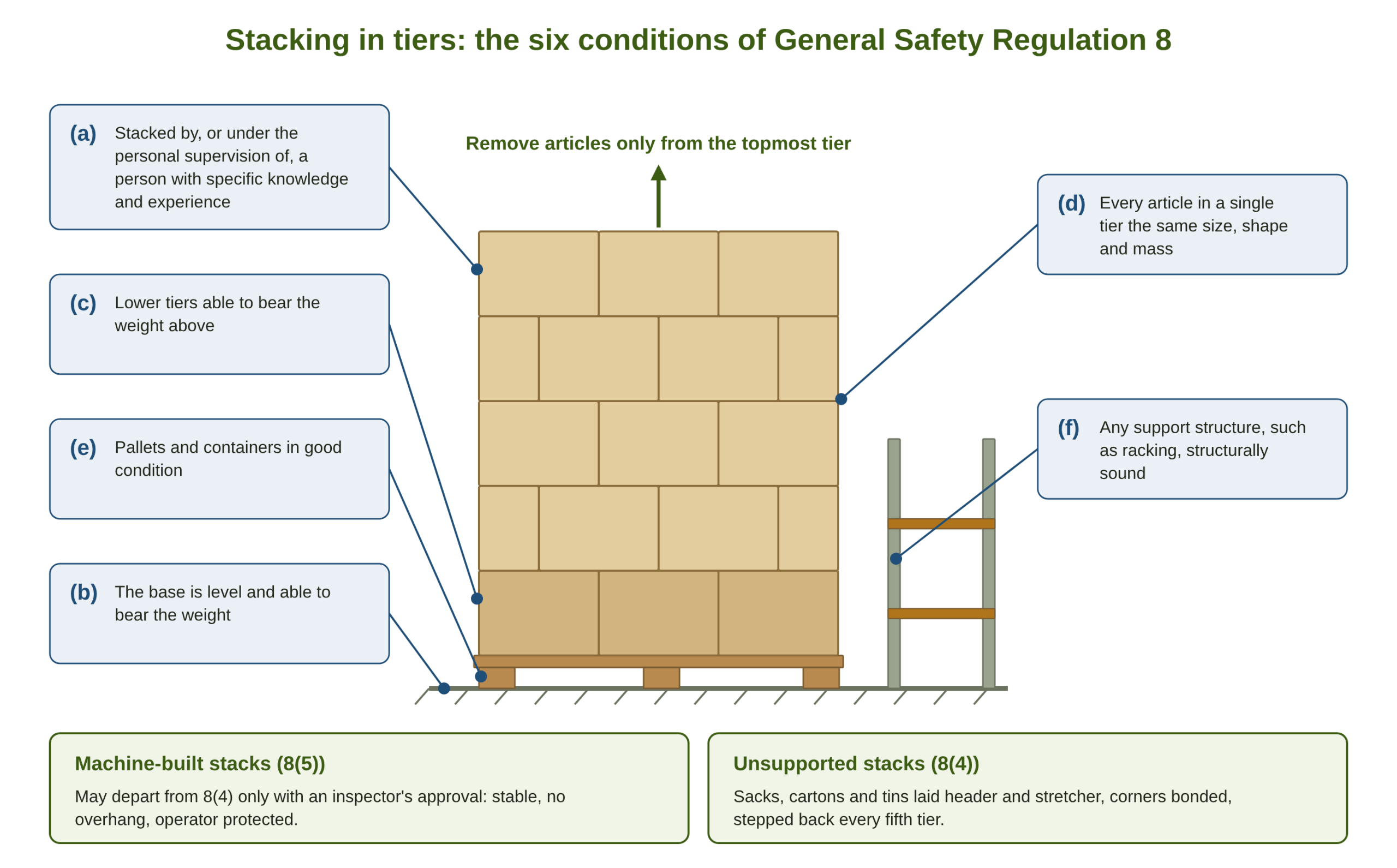
Articles come off the topmost tier only. The picker who pulls a bag from waist height because it is easier is taking support out from under everything above it. A stack in danger of collapsing is taken down at once and safely, and nobody lets passing forklifts, machinery or people put a stack at risk. People working on stacks stay out of reach of dangerous machinery.
The regulation sets no tier count. What regulation 8(4) does control is the shape of an unsupported stack. Unless a stack is held up by something else, sacks, cases, cartons and tins are laid header and stretcher fashion with the corners bonded, and stepped back by half the depth of one container at least every fifth tier. Straight vertical sides are allowed only for regular containers where the total height is no more than three times the smaller dimension of the base. Free-standing stacks built by machine may depart from that only with an inspector’s approval, and only if they are stable, do not overhang and the operator is safe from falling articles.
Whoever builds those machine stacks needs the right ticket. Driven Machinery Regulation 18(11) requires the operator to be trained for that particular type of lifting machine, and a reach truck is not a counterbalance truck. The 2024 code of practice for lift truck training adds a valid certificate of competence and a carry card.
A ten-minute dry store walk
- Walk the wall line. Look behind the pallets nearest the walls for damp marks, droppings and webbing.
- Check the floor gap is still there and still clean.
- Pick ten cans at random and check the seams, ends and rust.
- Smell the store. Trace any diesel, chemical or musty smell to its source.
- Look at the top beam for date codes that should have gone out last month.
- Look at one block stack from the side. Is it bonded and stepped, and is the bottom tier dry and square?
If your store is moving towards certification, the pest side gets heavier. BRCGS Storage and Distribution expects trend analysis of pest findings and an annual in-depth survey by a pest control expert. The Introduction to BRCGS Storage and Distribution Issue 4 course walks through what the auditor will ask for, and our warehouse food safety audit guide covers the rest of the site.
Dry goods rarely travel alone. For what happens when they share a route with chilled stock, read choosing and loading food delivery vehicles. For why the same dry store behaves differently in Durban and Johannesburg, read coastal versus inland cold chains.
Frequently asked questions
How far from the wall should food be stored in a warehouse?
R638 regulation 8(1) says stored food may not touch a floor, ceiling, wall or any ground surface, but it does not set a distance. Leave a gap wide enough to clean along the wall and for the pest controller to reach the monitoring stations, mark it on the floor and check it on every walk. Stock pushed against a damp wall is where mould and rodents start.
Can you dry out damp maize meal and still sell it?
No. Damp maize can carry aflatoxins from Aspergillus flavus, and aflatoxin cannot be seen, smelled or cooked out, even in maize that looks clean. Drying removes the water but leaves any toxin. Quarantine wet or stained bags and write them off, hold the rest of the batch, and let QA send samples for a laboratory test if there is any doubt.
How high can you stack pallets or cartons in South Africa?
General Safety Regulation 8 sets no tier count. It sets six conditions, including a competent supervisor, a level base, lower tiers able to bear the load and tiers of the same size, shape and mass. Unsupported stacks of sacks, cartons or tins are bonded header and stretcher fashion and stepped back at least every fifth tier.
Where should cleaning chemicals be stored in a food warehouse?
In a separate store away from food. R638 regulations 5(2)(b) and 10(11) require food to be protected against chemical contamination. The Regulations for Hazardous Chemical Agents, 2021 add safety data sheets, labelling, training and containers that cannot be mistaken for food or drink. Keep spray bottles and fuel off the food racking completely.
What is the difference between FIFO and FEFO?
FIFO, first in first out, picks the stock that arrived first. FEFO, first expired first out, picks the stock with the earliest date on the pack. FEFO is safer for food because deliveries do not always arrive in date order. Fast turnover also gives stored-product insects less time to build up in a pallet.
Start the course (R1,795) →Compare the coursesOnline, self-paced, works on a phone. Certificate on passing.
Sources
- R638 of 22 June 2018, Regulations Governing General Hygiene Requirements for Food Premises, the Transport of Food and Related Matters (Government Gazette 41730), regulations 5, 7, 8, 10 and 13
- Occupational Health and Safety Act 85 of 1993, General Safety Regulations, regulation 8 (stacking of articles)
- Driven Machinery Regulations, 2015, regulation 18(11), and the National Code of Practice for the Training Providers of Lifting Machine Operators, 2024 (GN 5588)
- Regulations for Hazardous Chemical Agents, 2021
- BRCGS Global Standard for Storage and Distribution, Issue 4