
Home / Guides / Coastal versus inland cold chain
Cold chain · Climate · Durban to the Highveld
The numbers at a glance
- Johannesburg about 1,750 m above sea level
- Air pressure about 82 kPa inland, about 101 kPa at the coast
- Difference roughly 19% lower on the Highveld
- Route end the Highveld, around 1,500 to 1,750 m
- Chilled 4 °C or 5 °C by food type, at either end (R638 Annexure E)
- Frozen -18 °C usual specification, -12 °C legal floor for most frozen food
- Validation warmest and coolest months (BRCGS sites)
- Law the same R638 in Durban and Midrand
One load, two docks
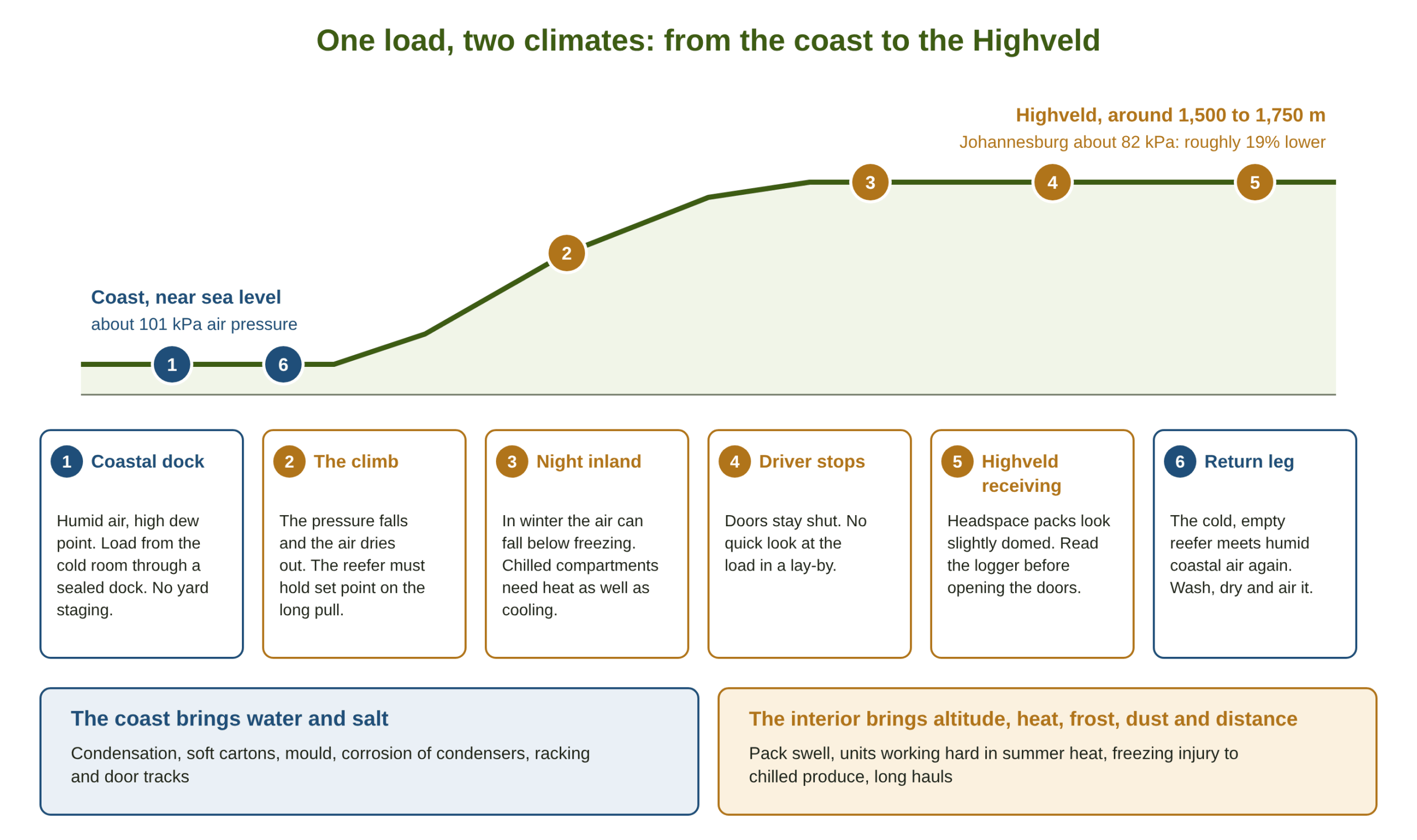
Take a pallet of chilled ready meals leaving the Pinetown DC on a February afternoon. The cold room is at its set point and the product is cold. The air on the dock is hot and heavy. By the time the pallet reaches the back of the truck, the shrink wrap is beaded with water and the bottom cartons look darker than the top ones.
The same truck backs onto a dock in Midrand at five the next morning. If it is July there may be frost on the yard, and the air is dry enough to crack your lips. The cartons that were wet in Pinetown are dry now. Some of the packs have a slight dome to them. And if the unit was set to cool only, the logger may show the compartment dropping below its set point somewhere after midnight on the climb.
The law is the same at both ends. Annexure E of R638 does not change with altitude, and a chilled meal has to be 5 °C or colder in Durban and in Johannesburg. What changes is the air around the product, and that drives a different set of problems at each end of the N3. R638 food temperatures for storage and transport covers the limits themselves.
The coast: dew point and condensation
When warm, humid air meets a surface colder than its dew point, water condenses on that surface. Coastal air in KwaZulu-Natal is humid for much of the year and its dew point is high. Anything cold that meets it sweats. That means cartons wheeled out of a chiller, the floor just inside a freezer door, the inside of a reefer when the doors open, and the evaporator coil every time warm air rushes in.
Inland in winter the picture flips. The Highveld air is cold and dry with a low dew point, and the same carton at the same temperature often stays dry.
A wet dock floor is a slip hazard, and section 8 of the OHS Act puts that on the employer. The wet cartons do more damage. Water on packaging carries dirt into the cold store. It softens board. It gives mould a start on dry goods stored nearby. Ice builds up around freezer doors and on the floor at the threshold, which is a forklift hazard and a sign that warm, wet air is getting in.
What works at the coast is mostly about keeping cold product away from outside air.
- Load straight from the cold room into a pre-cooled vehicle through a sealed dock. A pallet that waits in the yard for its truck is collecting water.
- Keep cold room and reefer doors closed between movements. Strip curtains and fast doors earn their cost in Durban.
- Pick to the dock in small batches, not a whole truck’s worth at once.
- Keep dry goods away from the chiller doors and the condensation zone. Dry goods storage and stacking deals with damp and mould in detail.
Soft cartons and leaning stacks
Corrugated board absorbs moisture from humid air and loses a large part of its compression strength. A carton specified and tested somewhere dry may not stand up to a few weeks in a coastal warehouse, especially at the bottom of a stack or next to a chiller door.
Regulation 8 of the General Safety Regulations has a few things to say about this. The lower tiers must be able to bear the weight placed on them. A stack that is in danger of collapsing must be dismantled immediately and safely. Unless a stack is otherwise supported, tiers of cartons are laid header and stretcher fashion with the corners bonded and stepped back at least every fifth tier. A cold store supervisor in Durban should walk the stacks looking for bulging bottom cartons and a lean, and should know that the height which was fine in winter may be too high in a humid summer.
Salt on the air
The Western Cape coast has winter rain, wind and salt-laden air. Gqeberha and East London are humid and windy. Salt and damp attack steel. Condenser coils on the roof and on reefer units corrode, racking uprights rust at the base, and dock door tracks start to stick.
Some of that is maintenance. Some of it is law. R638 regulation 5(3)(a) wants surfaces in food handling areas rust-free and cleanable, and regulation 13(2) asks for a rust-free, smooth, non-absorbent interior in any freight compartment carrying food that is not in sealed liquid-proof, dustproof packaging. A rusting reefer floor at the coast is a hygiene finding as well as a repair. A condenser with its fins eaten by corrosion is also why the unit struggles on the next hot afternoon.
Altitude and pack swell
Johannesburg and much of Gauteng sit at about 1,750 m. Air pressure there is roughly 82 kPa, against about 101 kPa at sea level, so about 19% lower. A pack sealed at the coast with gas in the headspace will swell slightly by the time it reaches the Highveld. Trays with film lids, bags of salad and pouches with a modified atmosphere all do it to some degree.
Most of the time it is a cosmetic change. The trouble starts when a receiving clerk in Midrand sees domed packs, thinks of blown cans and spoilage gas, and rejects a good load. Regulation 7(1) of R638 deals with bulging cans, and a film lid lifting at altitude is something else. Brief your Highveld receiving teams on what a normal altitude dome looks like for each product, and get the product owner’s view on what is acceptable. A pack that leaks, or one swollen well beyond the rest of the load, goes on hold.
Highveld winter: frost, dry air and dust
The interior has cold, dry winters with frost, a large swing between day and night temperatures, and low humidity. Summer brings thunderstorms. In the dry months, dust blows across yards and into open dock doors.
For refrigeration, the surprise is that cold can be the problem. On a frosty night the air outside a chilled compartment can drop below its set point. A unit that only cools will let the compartment follow the night down, and lettuce, dairy and fresh produce along the walls can freeze. Multi-temperature units need to heat as well as cool, and someone needs to read the logger for low readings as well as high ones.
Dust matters wherever food is not sealed. R638 regulation 7(4) wants prepacked food in a dustproof, liquid-proof container, and regulation 13(2) wants freight compartments carrying unpacked food dustproof. On the Highveld that means dock seals that fit, doors kept shut and trucks washed out after a dusty yard.
Heat and distance in the interior
The Lowveld, Limpopo and the Northern Cape see very high summer temperatures. Refrigeration units on long routes there run hard all day, and any weakness shows up on the logger. A reefer holds product at the temperature it was loaded at. It has little spare capacity to pull warm stock down, so stock goes onto the truck already at its temperature. Pre-cool the vehicle and load from the cold room, at the coast and inland.
Distance adds its own risk. A long route means more stops and more door openings, and it means drivers who want to check the load in a lay-by in the midday sun. On a sealed reefer load the doors stay shut until the receiving dock. Power is the other inland worry. Load shedding and outages put cold rooms at risk wherever you are. A closed, full cold room holds temperature longer than an empty or frequently opened one, so keep doors shut during an outage. When the cold chain breaks covers what to do once a reading goes out.
Coast and inland side by side
| Hazard | Coast (Durban, Richards Bay, Cape Town, Gqeberha) | Inland (Gauteng Highveld and the interior) | What the site does |
|---|---|---|---|
| Condensation | High dew point most of the year. Cold product, floors and open reefers sweat | Low dew point in winter. Less sweating | Sealed docks, no yard staging, doors kept shut, small pick batches |
| Packaging strength | Corrugated board takes up moisture and loses compression strength | Board stays drier | Check bottom tiers, lower stacks in humid months, apply GSR 8 |
| Corrosion | Salt-laden air on the Western Cape and Eastern Cape coasts | Less of an issue | Inspect condensers, racking feet, door tracks and reefer floors |
| Air pressure | About 101 kPa | About 82 kPa in Johannesburg, roughly 19% lower | Brief receiving teams on normal pack swell |
| Cold nights | Mild | Frost in winter, big day and night swing | Units that heat and cool; read loggers for low readings |
| Heat | Hot, humid summers in KwaZulu-Natal | Very high summer heat in the Lowveld, Limpopo and Northern Cape | Pre-cool vehicles, load at temperature, service units before summer |
| Dust | Less common | Dry season dust | Dock seals, closed doors, dustproof compartments |
Prove it works in both seasons
A temperature map done in a mild April tells you very little about a Durban February or a Highveld July. BRCGS Storage and Distribution expects stores and vehicles to be validated, by temperature mapping or trials, to show they hold temperature in the warmest and coolest months. Do the summer run when the dock is at its worst, and the winter run on a route with a night inland. For a site without certification the same exercise answers the question an inspector or a customer will ask after a complaint.
The course case study on the N3
The Food Storage and Distribution course follows Mzansi Fresh Meals, a fictional ready meal maker with its DC in Pinetown. Module 5 takes its outsourced reefer from the humid coast up the N3 to Midrand. Learners decide where the load picks up water, why packs arrive domed, what the logger should show after a frosty night and what the receiving clerk should do with each finding. Because that reefer carries perishable food for Mzansi, it needs its own Certificate of Acceptability under regulation 3(1)(a) of R638. Choosing and loading food delivery vehicles goes into that.
Module 5: inland versus coastal
Climate, humidity and temperature are a full module in the Food Storage and Distribution course, with the N3 case and diagrams like the one above. 11 hours, 9 modules, online, R1 795.
Frequently asked questions
Why do cartons get wet when they come out of a cold room?
Warm, humid air that touches a surface colder than its dew point leaves water on that surface. Coastal air in Durban or Richards Bay has a high dew point, so cold cartons, cold dock floors and opened reefers sweat. Inland in winter the air is dry and its dew point is low, so the same carton at the same temperature often stays dry.
Does altitude affect packaged food in transport?
Yes, a little. Johannesburg sits at about 1,750 m, where air pressure is roughly 82 kPa against about 101 kPa at sea level, about 19% lower. A pack sealed at the coast with gas in the headspace will swell slightly by the time it reaches the Highveld. Brief receiving teams on what a slightly domed pack looks like and judge each one against the product specification.
Why do cartons collapse in humid warehouses?
Corrugated board takes up moisture from humid air and loses a large part of its compression strength. A stack that stood straight on the Highveld can lean or crush at the coast. Under the General Safety Regulations the lower tiers must be able to bear the weight above them, and a stack in danger of collapsing must be taken down immediately and safely.
Do refrigerated trucks need heating in winter?
On the Highveld they can. Winter nights bring frost and the air can drop below the set point of a chilled compartment. The unit then has to add heat to hold the chilled product at its set point, or produce and dairy near the walls may freeze. Check that multi-temperature units can heat as well as cool, and read the logger for low readings as well as high ones.
Should a cold store be temperature mapped in summer and winter?
On a BRCGS Storage and Distribution site, yes. The scheme expects stores and vehicles to be validated by temperature mapping or trials to show they hold temperature in the warmest and coolest months. In practice that means a mapping run in high summer and another in mid winter, and a fresh look after any change to the building, racking or refrigeration.
Train the people who run both ends of the route
Nine modules from cold chain and dry goods to vehicles and health and safety, built on R638, with a three-sitting workshop and a risk assessment assignment on the Pinetown case study.
Start the course (R1 795) →Compare storage and distribution coursesOnline, self-paced, works on any phone. 70% to pass each assessment, three attempts. Certificate on passing.