
Home / Food storage and distribution / Food delivery vehicles
Fleet · R638 vehicles · Loading and road law
At a glance
- Vehicle counts as food premises under R638
- Outsourced, perishable own CoA, reg 3(1)(a)
- Own vehicle, prepacked certified CoA copy in the vehicle, reg 14(6)(a)
- Thermometer readable at all times, reg 6(5)(a)
- Meat exclusive-use vehicle, reg 12(4)
- Reefer holds temperature, does not pull down
- Load securing NRTR 246
- PrDP goods vehicle above 3,500 kg
At one Gauteng depot I found chilled yoghurt going out in a curtain-side. The reefer was late, the customer was shouting and the curtain-side was standing at dock 4. Nobody meant to break a rule. Dispatch simply did not know what a curtain-side can and cannot carry.
Most vehicle problems I see start in the dispatch office, before a wheel turns. Get the vehicle and the loading right there and the temperature you dispatched is the temperature that arrives.
Is a delivery vehicle food premises under R638?
Yes. R638 defines food premises to include a vehicle, and defines “handle” to include transport. So the rules you apply in the warehouse go out on the road with the load.
The certificate of acceptability catches people out. Regulation 3(1)(a) requires a valid CoA, and that expressly includes an outsourced vehicle used to transport perishable food on behalf of a person in charge of food premises. If you use a contract reefer to Midrand, the operator needs its own CoA. Ask for a copy and check the registration numbers on it against the truck at your dock.
Your own vehicles are different. Under regulation 14(6)(a), a vehicle you use to transport prepacked food from your own premises does not need its own CoA, as long as a certified copy of the premises CoA is in the vehicle. When the copy is not in the cab, the exemption falls away, and that is the first thing an environmental health practitioner who stops the truck will ask for.
Three more provisions come up on every fleet audit. Regulation 6(5)(a) requires a chiller or freezer used to transport perishable food to have a thermometer that reflects the temperature of the refrigerated area at all times and can be read unhampered. Regulation 10(8) wants freight compartments clean and free of unnecessary items. Regulation 13 does the rest.
What does regulation 13 require of the freight compartment?
Regulation 13(1) bars food on any part of a vehicle that is not clean enough to prevent chemical, physical or microbiological contamination, and bars carrying food with waste or contaminated food, poison or any harmful substance, a live animal, or anything else that may contaminate or spoil it. That last part is wider than people think. A pallet of returns, a drum of degreaser or the driver’s wet tarpaulin all count.
Where food travels unpacked, meaning not in liquid-proof, dustproof sealed containers, regulation 13(2) asks more of the compartment. The interior must be smooth, rust-free, non-toxic, non-absorbent, easy to clean, with no open joints or seams and no more than 100 viable micro-organisms per cm² on analysis. It must be dustproof, and it may not carry people or anything that could contaminate the food at the same time. Regulation 13(3) keeps non-prepacked food off the floor and off any surface that can be walked on.
Meat vehicles
Regulation 12(4) adds its own rules for meat and meat products. The vehicle is for the exclusive use of meat and meat products. From abattoir to processor or retailer the compartment is lined with impervious, jointless material that is easy to clean and disinfect, and carcasses hang from a crossbeam on stainless steel hooks so that no part touches the floor. No tarpaulins or cloths in or on the vehicle. Meat products go in impervious containers with tight lids. The vehicle is clean when loaded and washed after delivery, with hot water and detergent if needed, and disinfected where necessary. Where a single-use vehicle is not available, or is impracticable for small quantities, regulation 12(5) allows the best available method.
Which vehicle for which food?
| Vehicle | Suitable for | Not suitable for |
|---|---|---|
| Insulated body, no refrigeration | Short trips with product loaded at temperature | Long or multi-drop chilled routes, warm product |
| Refrigerated body with a transport refrigeration unit | Chilled and frozen food loaded at temperature | Pulling down warm product, overfilled bodies |
| Multi-temperature with bulkheads | Frozen and chilled on the same route, in separate compartments | Raw above ready-to-eat, bulkhead out of position |
| Eutectic plate vehicle | Short urban multi-drop routes | Long hauls, days longer than the plates hold |
| Hot-holding van or insulated hot boxes | Short catering deliveries, food out at 60 °C or hotter | Long journeys, chilled food in the same box |
| Closed box van | Dry goods, cans, ambient packed food | Chilled, frozen or hot food |
| Curtain-side | Palletised ambient dry goods | Temperature-sensitive food, loose cartons |
| Flat-deck with tarpaulin | Poor for food; avoid | Almost all food |
| Bulk tanker | Liquid food in a dedicated food tank (Codex CXC 47-2001 is the reference code) | Tanks with non-food or unknown previous loads |
| Bakkie with canopy | Short ambient runs; small chilled orders in pre-chilled boxes under tight control | Routine chilled or frozen distribution |
Three questions settle most choices. What is the product’s Annexure E category, and was it at that temperature when it left the store? (Our R638 food temperatures guide sets out the five lines.) How long is the route, and how many times will the doors open? What else is on the truck? Raw meat, chemicals, returns and waste all limit what may ride with them.
The bakkie question comes up every week. In the Mzansi Fresh Meals case, both trucks have gone and a Westville customer is short of ready meals. The bakkie can do it only if the meals leave the chiller at 5 °C or colder in pre-chilled boxes, go direct, are probed at dispatch and arrival, the route time has been proved in the hottest month, and the certified CoA copy is in the cab. Otherwise the order waits.
Choose, check and load the right vehicle
Module 7 of the Food Storage and Distribution course covers vehicle types, CoA and regulation 13, cleaning and pre-trip checks, pre-cooling, airflow loading and the road traffic rules for consignors, with Mzansi Fresh Meals’ fleet as the case. 11 hours online, R1,795.
Why won’t a reefer cool down warm product?
A transport refrigeration unit is sized to remove the heat that leaks in through the walls, floor and doors. That is about all it does. Load chilled meals that have stood on the dock until they are warm and the unit blows cold air over the outside of the cartons for hours while the cores barely move. When I investigate a warm load, this is usually the cause.
So the product goes on at its required temperature, into a body that has been pre-cooled to its set point. An insulated body without a unit works the same way, only slower. Insulation slows the rate of change in both directions.
How do you load a refrigerated truck for airflow?
Cold air leaves the evaporator at the front, runs along the ceiling, drops at the rear doors and comes back along the floor to the return opening under the unit. Block any part of that loop and the air takes a shortcut.
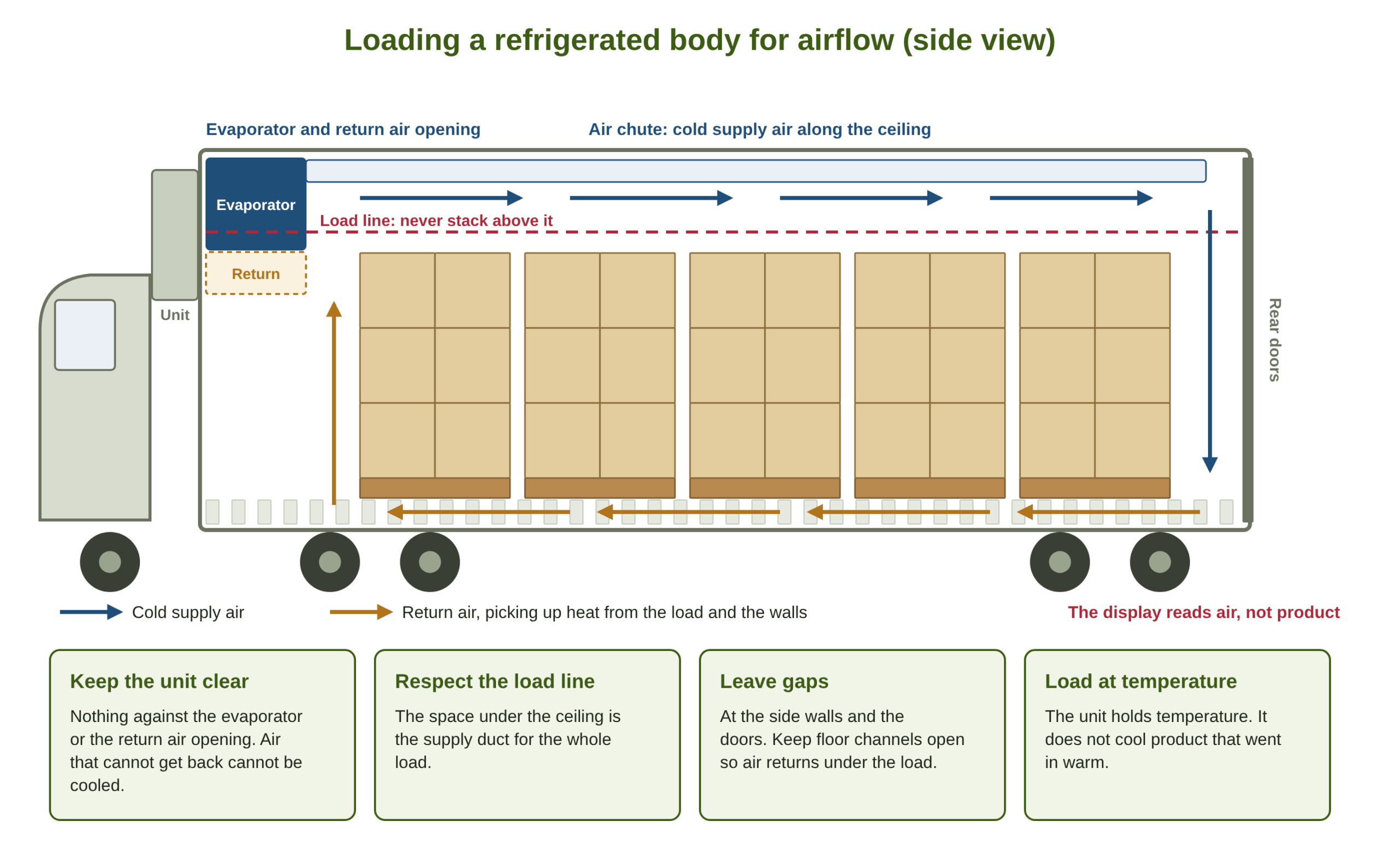
- Respect the load line. Nothing stacked into the air chute under the ceiling.
- Keep the front clear so air can get back to the evaporator. Pallets jammed against the front wall under the unit close the return.
- Leave gaps at the walls and doors, and keep the floor channels clear of loose cartons and shrink wrap.
- Put the logger where trouble would show up, towards the front and top of the load.
The course case shows what happens when this goes wrong. A contracted reefer leaves Pinetown with the front pallets stacked to the ceiling to fit an extra pallet and two pallets pushed against the front wall. The logger by the doors reads -20 °C the whole way. At Midrand the front top cartons read -9 °C between packs and the rear pallets -19 °C. The air short-circuited round the back of the load, and the logger was in the one place that could not see it. For what happens next to those cartons, read handling temperature excursions and power failures.
What does road traffic law require of the consignor?
The National Road Traffic Act 93 of 1996 and its regulations put duties on you as consignor as well as on the operator and driver.
- NRTR 246. Goods safely contained within the body or securely fastened so they cannot be dislodged or spilled, and not obscuring the driver’s view. Straps, load bars or bracing on every load, and re-secured after each drop.
- NRTR 247. Nobody rides in the goods compartment with goods unless a partition separates them.
- NRTR 330A. Consignor and consignee may not offer or accept goods in a vehicle that is overloaded or not loaded per the regulations, and the consignor must get a written statement of the vehicle’s payload and load distribution from the operator.
- NRTR 330B and 330C. The consignor keeps records of the mass consigned, and there is a declaration of the goods and a written agreement with the operator that includes loading instructions.
The driver of a goods vehicle with a gross vehicle mass above 3,500 kg needs a professional driving permit (NRTR 115). Keep a copy of each driver’s PrDP on file, with the casual relief drivers included.
Approving a haulier
Before you sign, ask for the CoA, the vehicle list with registration numbers, cleaning records, refrigeration service records and a logger download from a recent trip. Give them a day. If they cannot find their own records in a day now, they will not find them after an incident. Keep distribution records for at least six months after the shelf life of the product (regulation 10(16)).
A certified site goes further. BRCGS Storage and Distribution expects hauliers approved by a documented risk-based process, a register that includes the irregular ones you call in at peak season or for breakdowns, and a performance review at least once a year. Vehicles have to be validated to hold temperature in the warmest and coolest months, and the N3 in January is a different test from the N3 in July. Our coastal versus inland guide explains why. If your operation falls under FSSC 22000 Category G, the FSSC 22000 Version 7 for Transport and Storage course covers what ISO 22002-5:2025 asks of transport.
Frequently asked questions
Does a delivery vehicle need a certificate of acceptability?
It depends who owns it. Under R638 regulation 3(1)(a), an outsourced vehicle transporting perishable food on behalf of a person in charge of food premises needs its own valid CoA. Under regulation 14(6)(a), your own vehicle transporting prepacked food from your premises does not, provided a certified copy of the premises CoA is kept in the vehicle.
Can you transport meat with other food in the same vehicle?
Not under regulation 12(4) of R638, which requires a vehicle for the exclusive use of meat and meat products, with no other food, uncleaned offal, hides or contaminating material on board. Regulation 12(5) allows the best available method where a single-use vehicle is not available or is impracticable for small quantities, so document why and how you control the risk.
Can a refrigerated truck cool down warm food?
Not in any useful time. A transport refrigeration unit is built to remove the heat that leaks into the body. It will not pull warm product down. Warm cartons stay warm at the core while the air around them reads cold. Load chilled and frozen food at its required temperature into a body that has been pre-cooled to its set point.
What licence do you need to drive a refrigerated delivery truck?
The driver of a goods vehicle with a gross vehicle mass above 3,500 kg needs a professional driving permit (PrDP) under regulation 115 of the National Road Traffic Regulations. Keep a copy of each driver’s PrDP on file, relief drivers included, and look at it before a new driver takes a truck out.
Who is responsible for securing a load on a truck?
The driver and operator must keep goods safely contained or secured under NRTR 246, but the consignor carries duties too. Under NRTR 330A you may not offer goods in a vehicle that is overloaded or not loaded per the regulations, and you must get the vehicle’s payload and load distribution in writing from the operator.
Start the course (R1,795) →Compare the coursesOnline, self-paced, works on a phone. Certificate on passing.
Sources
- R638 of 22 June 2018 (Government Gazette 41730), regulations 3, 6, 10, 12, 13 and 14
- National Road Traffic Act 93 of 1996 and National Road Traffic Regulations, 2000, regulations 115, 246, 247 and 330A to 330C
- Codex CXC 47-2001, Code of Hygienic Practice for the Transport of Food in Bulk and Semi-packed Food
- BRCGS Global Standard for Storage and Distribution, Issue 4
- ISO 22002-5:2025, Prerequisite programmes on food safety, Part 5: Transport and storage