
Home / Guides / Legionella in water storage tanks
Legionella · Water storage tanks · Outages and boreholes
Key facts
- Stored volume no more than one day’s use (HSG274 Part 2)
- Healthcare no more than 12 hours’ use
- Cold water below 20 °C (NICD, HSE)
- Cold taps below 20 °C within two minutes
- Tank inspection at least once a year
- Tank temperature once a year, in summer
- Hillbrow, 2025 L. pneumophila in 14 of 15 high-rises sampled
- Dirty tank do not climb in, report it
Train the people who go up to the roof
Legionella Awareness Training teaches maintenance, caretaking and estate staff what a sound tank looks like, how to take a cold water temperature properly, and what to report and to whom. Four hours on a phone, R799.
Can Legionella grow in a water storage tank?
Yes, when the conditions are right. Legionella lives naturally in fresh water in low numbers, so a tank does not create it. What a tank can do is give it what it needs to multiply: water that warms into the growth range from about 20 °C, water that stands long enough for any disinfectant to fade, and sediment, scale and biofilm that shelter it. The CDC and HSE both name stagnation, sediment and biofilm as growth factors. Then the tank feeds every shower in the building, and showers make the spray people breathe.
When I walk a building, the tank tells me a lot about the whole system. A cracked lid, a dead pigeon or a layer of silt on the floor means nobody has looked inside for a long time, and the same is usually true of the rest of the cold water.
What did the Johannesburg high-rise study find?
Buthane et al. (Microorganisms, 2025) sampled residential high-rise buildings in Hillbrow, Johannesburg, and found L. pneumophila in 14 of the 15 buildings sampled. All the buildings used storage tanks, and 93 percent of them were plastic.
Read that carefully. The study does not show that plastic tanks cause Legionella. Plastic was simply the most common tank in those buildings. What it shows is that the organism was found in almost every building that relied on stored water. The controls that matter are the same for any tank: how long the water stands, how warm it gets, and what gets in.
How much water should a storage tank hold?
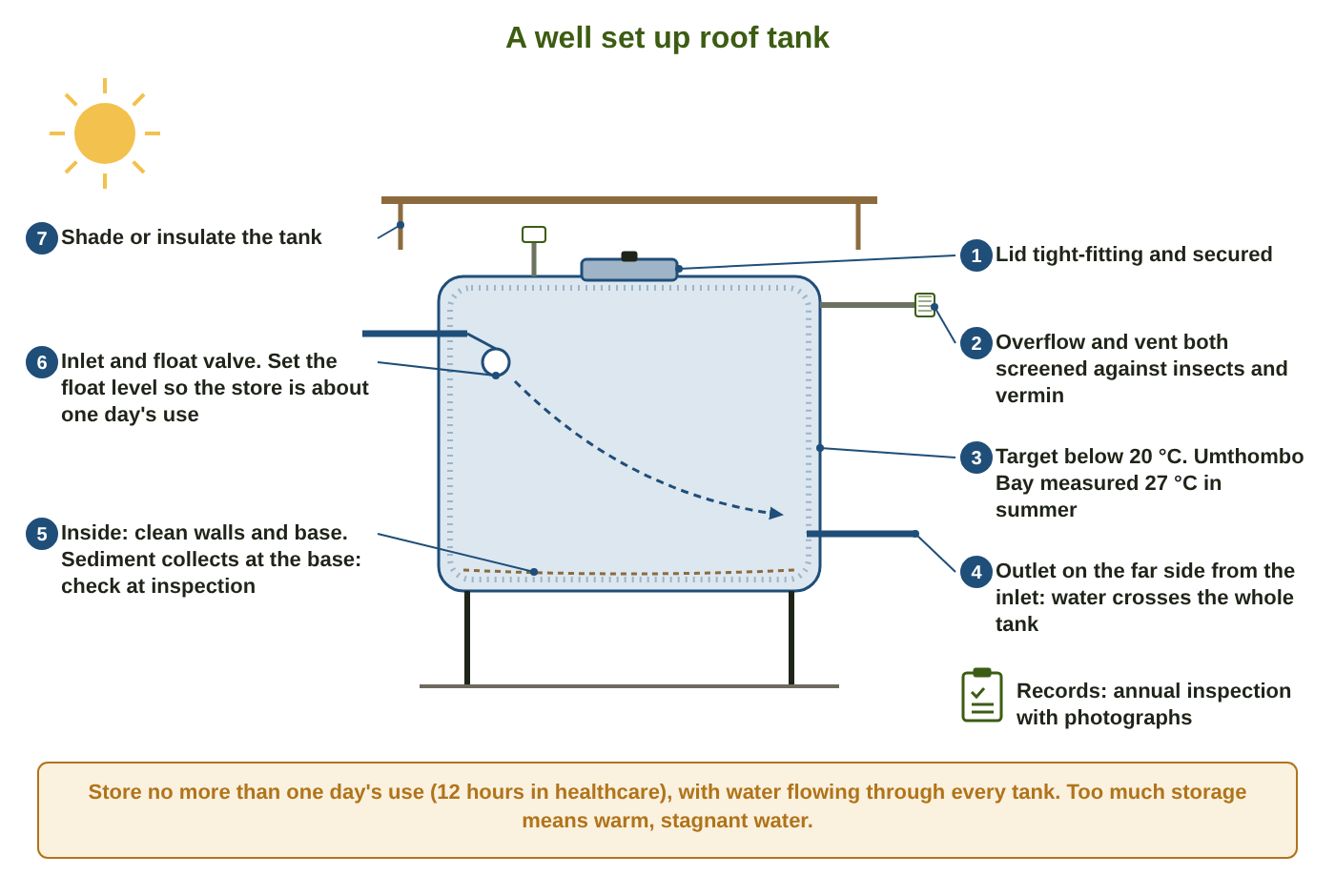
HSE’s HSG274 Part 2 says stored cold water should be kept to a minimum and should not normally exceed one day’s use, or 12 hours in healthcare. That is guidance, not South African law, but it is the benchmark a competent person works to.
South Africa pulls the other way, because outages push buildings to store more. At Umthombo Bay Hotel, the hotel case in our courses (a training scenario built from real audit patterns), two 10 000 litre polyethylene tanks went onto the roof after the 2023 water outages. In winter low season they hold about two days of the hotel’s use, and in summer the tank water has measured 27 °C. Both numbers are a problem: double the recommended storage, and water well inside the growth range.
You can keep outage resilience and still control the risk:
- Match stored volume to real use. Lower the float valve level on every tank so the stored volume matches about one day’s use and water still flows through each tank, entering and leaving on opposite sides.
- Never isolate a full tank and leave it standing. A tank taken out of service is drained fully, and cleaned and disinfected before it is refilled and returned to service. No tank sits full on standby waiting for the next outage.
- Shade or insulate tanks that stand in full sun.
- Measure the tank temperature once a year in summer, and the cold taps nearest and furthest from the tanks every month: below 20 °C within two minutes.
The NICD recommends storing cold water below 20 °C, and the WHO says below 25 °C and ideally below 20 °C. The hotel side of this is in our hotel and guesthouse checklist.
Free tool: take the Water Walk up to your tanks
The cold water section of the free Legionella Water Walk checks stored volume, lids, screens and inspection records, and reads your tank and cold tap temperatures against the 20 °C limit. It ranks what it finds and exports the list.
Try the free Water Walk, then learn to act on what it finds in Legionella Awareness Training (R799).
What should a water tank inspection check?
HSG274 Part 2 sets cold water tank inspection at least once a year, with the tank temperature taken in summer. I add an inspection after any outage and whenever someone reports a damaged lid. Here is the checklist I use, done from the hatch.
| Check | What good looks like | If not |
|---|---|---|
| Lid | Fitted, tight, not cracked | Close the hatch if safe, report at once, replace the lid |
| Vents and overflow | Screened against insects and birds | Fit or replace the screens |
| Water surface | Clear, no scum, slime, debris, insects or dead animals | Do not touch it. Photograph and report the same day |
| Tank floor | No sediment, sludge or rust visible | Book a clean by trained people |
| Walls and fittings | No slime or corrosion | Book a clean by trained people |
| Tank water temperature | Below 20 °C, taken once a year in summer | Shade, insulate, reduce stored volume |
| Stored volume | No more than one day’s use, 12 hours in healthcare | Lower the float valve, review how the tanks are used |
| Flow through | Water flows through every tank, none standing full on standby | The responsible person decides on re-plumbing, or has the idle tank drained fully, cleaned and disinfected before it is refilled. Never leave a full tank isolated |
| Cold taps downstream | Below 20 °C within two minutes, nearest and furthest | Find the heat gain: sun, oversized storage, pipes near hot pipes |
| Record | Date, name, photographs, date of last clean | Start a tank log today |
Your caretaker is the first to see a cracked lid
Legionella Awareness Training teaches the people who go up to the roof what a sound tank looks like, how to take a cold water reading properly and what to report the same day. Four hours on a phone, R799 a person.
What should you do after a water outage?
When supply comes back after an outage or a municipal interruption, the water may be dirty and the sediment in the tanks stirred up. Before people shower:
- Look into the tanks from the hatch for silt, discoloured water and debris.
- Flush outlets that stood unused during the outage, with the spray kept low. Our flushing procedure guide has the steps and a log.
- Check cold and hot temperatures at the nearest and furthest outlets.
- Report anything unusual. The responsible person decides on cleaning, disinfection or sampling.
Load shedding adds its own stagnation, because booster and circulation pumps stop and water stands still. And the NICD’s review of notified cases notes that buildings closed for long periods, such as during the COVID-19 lockdown, raise the risk in water systems. The principle is the same every time: Legionella does best in water that stands still.
Are borehole and tank systems a Legionella risk?
At Sinethemba Care Centre, the frail care case in our courses, the municipal supply is backed up by a borehole and three plastic storage tanks because of supply interruptions. Two of the tank lids are cracked. I see the same set-up at clinics, schools, lodges and farms.
Borehole water has not been through a municipal treatment works, so unless your site treats it, there may be no disinfectant in it at all. Legionella occurs naturally in fresh water, including water in soil, and once it reaches a warm tank with sediment it can multiply. A potable water certificate for the borehole does not settle the question, because what grows in the tank afterwards depends on time, temperature and cleanliness. R638 requires food premises to use potable water complying with SANS 241, and it does not mention Legionella, so a food business on borehole water needs both.
ASC treats a care centre as healthcare: 12 hours’ storage, not a day. See our guide to Legionella in hospitals and frail care.
How should a water tank be cleaned?
HSG274 sets the inspection. Cleaning follows what the inspection finds: sediment, slime, debris or contamination mean a clean and disinfection.
- Never climb in. Entering a tank is confined space work for trained people with the right equipment.
- Use a contractor with a written method statement: how the tank is isolated, drained and cleaned, the disinfectant, its strength and contact time, how the water is disposed of, and how the tank is flushed before it goes back into use.
- Ask for photographs before and after, and keep them with the record.
- Never mix an acid cleaner or descaler with bleach. Together they release chlorine gas.
- No compressed air. The HBA Regulations prohibit compressed air to remove hazardous biological agents from surfaces (regulation 13).
If a tank has been badly contaminated, the responsible person decides whether the water can be used meanwhile and whether to sample. Our Legionella testing guide covers how.
Who should look after the tanks?
The person on the roof is usually a maintenance artisan, caretaker or general hand. Under the HBA Regulations, 2022 they must be trained before possible exposure, with a refresher every year or at intervals the health and safety committee or representative recommends. The decisions about storage volume, plumbing, cleaning contracts and sampling belong to the person appointed to manage Legionella. Our guides on who is responsible for Legionella and the Legionella risk assessment cover that role.
A neglected tank feeds every tap and shower below it, and everyone who stands under them. Section 9 of the OHS Act makes those people, residents, guests and patients included, your responsibility.
What your team walks away with from Awareness Training
- The four conditions that make Legionella a risk, and how to break each one
- The temperature numbers that matter, and how to take a reading properly
- A flushing and showerhead routine, and the tank and eyewash checks
- What to report, to whom, and what never to do on your own
- The Water Walk checklist with an exportable findings list
- A dated certificate on passing. HPCSA CPD accredited
Four hours that cover every tank, tap and shower
Self-paced on a phone, no classroom day and no travel. Three attempts at every test, instant feedback, and a certificate on passing.
Frequently asked questions
Can Legionella grow in a JoJo tank?
It can grow in any storage tank, plastic or otherwise, when water stands too long, warms above 20 °C and collects sediment or biofilm. Keep stored volume to no more than one day’s use, shade the tank, keep the lid tight and the vents screened, and inspect it at least once a year.
Do plastic water tanks cause Legionella?
Nothing in the evidence says so. In the 2025 Hillbrow study, all the buildings used storage tanks and most were plastic, simply because that was the most common type. What drives growth in any tank is standing time, warm water above 20 °C, and sediment, slime or debris getting in.
How often should a water storage tank be inspected and cleaned?
HSE HSG274 Part 2 sets an inspection at least once a year, with the tank temperature taken in summer. Cleaning follows what the inspection finds: sediment, slime, debris or contamination mean a clean and disinfection by trained people, because entering a tank is confined space work.
How much water should a storage tank hold?
Normally no more than one day’s use, and no more than 12 hours’ use in healthcare, according to HSE HSG274 Part 2. Where outages make extra storage necessary, make sure water flows through every tank in normal use. Never isolate a full tank and leave it standing.
What temperature should water in a storage tank be?
Below 20 °C. The NICD recommends storing cold water below 20 °C, and cold taps should run below 20 °C within two minutes. Legionella is dormant below 20 °C and multiplies between about 20 and 45 °C, so a tank in full sun needs shade or insulation.
Is borehole water safe from Legionella?
Not automatically. Legionella occurs naturally in fresh water, and untreated borehole water may carry no disinfectant. Once it sits in a warm tank with sediment, it can multiply. Treat a borehole and its tanks like any other cold water system: limit storage, keep it cool and clean, and inspect yearly.
What should we do after a water outage?
Look into the tanks for silt and debris, flush outlets that stood unused with the spray kept low, check hot and cold temperatures at the nearest and furthest outlets, and report anything unusual to the responsible person, who decides on cleaning, disinfection or sampling.
Control the water before it reaches the shower
Four hours for the people who check the tanks and taps. Ten hours for the person who decides what happens when they find a problem.
Enrol in Awareness Training (R799) →Responsible Person course (R2 950)Self-paced, works on a phone. HPCSA CPD accredited. Certificate on passing.
Sources and further reading
- Buthane et al. (2025), Legionella in Hillbrow high-rise buildings
- HSE HSG274 Part 2: hot and cold water systems
- NICD recommendations for Legionnaires’ disease
- NICD Public Health Bulletin (2020): notified Legionnaires’ disease
- WHO fact sheet: legionellosis
- CDC toolkit for building water management programmes
- Regulations for Hazardous Biological Agents, 2022