
Home / Food storage and distribution / Cold chain excursions and power failures
Cold chain · Excursions · Power failures and records
At a glance
- Four steps hold, assess, decide, record
- Surface rule no more than 2 °C warmer than the core limit
- Refreeze surface not above 5 °C, reg 8(5)(a), not fish
- Frozen fish follows NRCS VC 8017
- Thawing for processing core not above 5 °C, at most 10 hours, reg 8(6)
- Frozen core probe 4 mm drill, read after two minutes
- Records at least 6 months after shelf life, reg 10(16)
- BRCGS sites never less than one year
The power goes at 14:10 on a Tuesday. The generator coughs and does not start. Nobody has tested it for four months. By 16:15, when the power comes back, the frozen store display has gone from -22 °C to -15 °C, and somebody has opened the door four times to pick a Midrand order because the truck was waiting.
That is the power failure exercise in the Mzansi Fresh Meals case study in our Food Storage and Distribution course, and parts of it will be familiar to anyone who ran a cold store through load shedding. In my experience more product is lost after an excursion to panic and guesswork than to the temperature itself.
What counts as a temperature excursion?
Any time product, or the equipment holding it, is outside its required temperature. A cold room display drifting up, a logger alarm on the N3, a delivery that fails its receiving check, a chiller door left open over lunch. Treat them all the same way.
The required temperature comes from Annexure E of R638 and from your specification, whichever is stricter. The legal floor for most frozen food is -12 °C, while ice cream, sorbet and frozen fish need -18 °C or colder, and almost every specification asks for -18 °C anyway. Our guide to R638 food temperatures covers the five Annexure E lines and the 2 °C surface rule in detail.
Hold, assess, decide, record
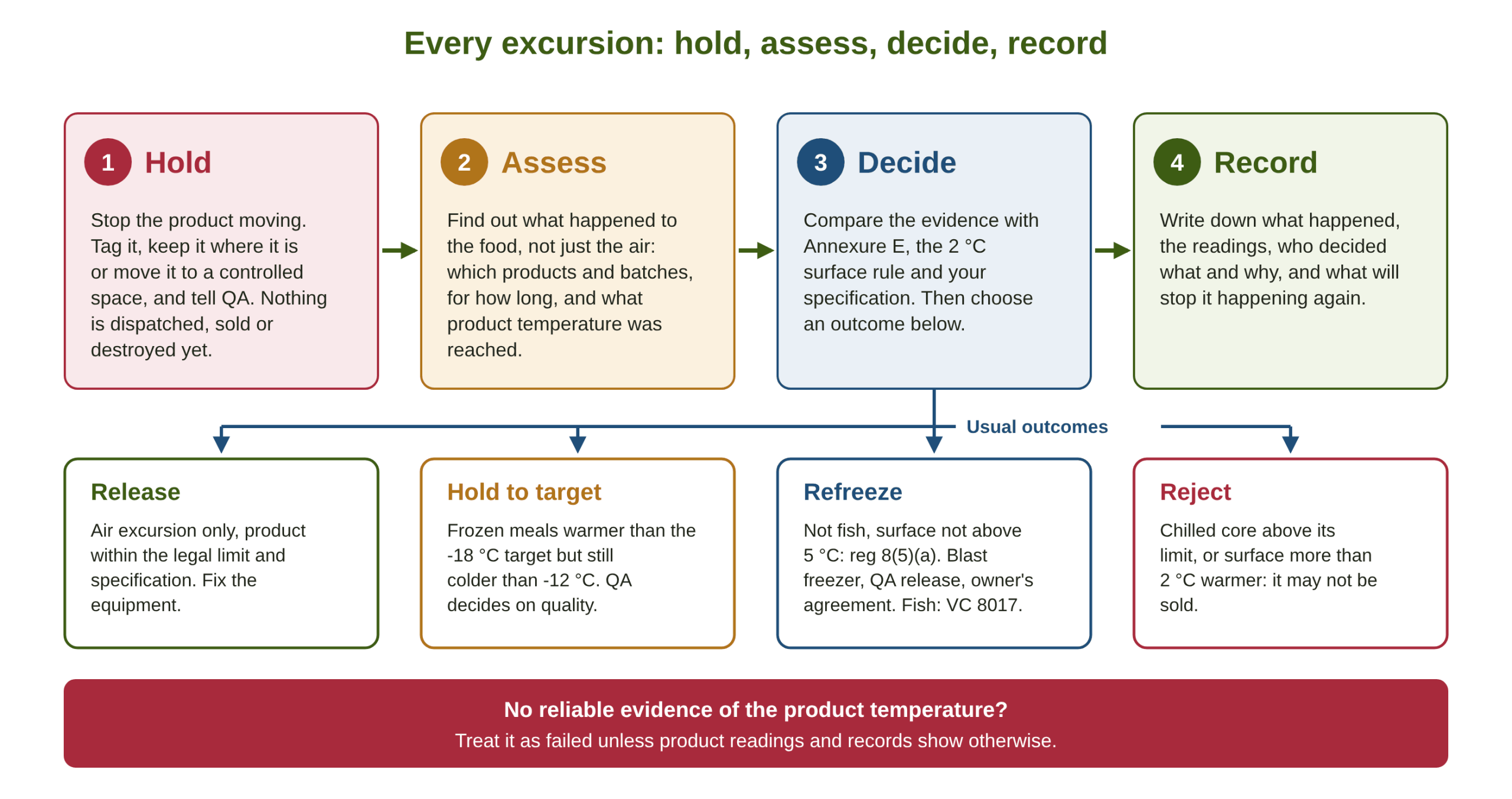
Hold
Stop the product moving. Tag it, keep it where it is or move it to a controlled space, and tell QA. Nothing is dispatched, sold or destroyed yet. Holding product while QA decides is never the wrong call.
Assess
Find out what happened to the food, not only to the air. Six questions do most of the work:
- Which Annexure E line does each product fall under?
- What is the product temperature now, measured by the Annexure G method, and how does the surface compare with the 2 °C rule?
- How long was it out of control? A gap in the logger record is time nobody can account for.
- Is it ready-to-eat, where Listeria monocytogenes is the worry, or raw and going to be cooked?
- For frozen food that thawed, did the surface stay at 5 °C or colder? Is it fish?
- What do the specification and the customer contract say, on top of the law?
Measure properly. Annexure G starts with a probe between two packs for at least one minute, without taking the food out of the store where you can. If that reading fails or is in doubt, go to the surface or the core. For a frozen core, drill to the centre with a sterilised stainless steel bit of about 4 mm, insert a sterilised probe and read after two minutes.
Decide
Outside the four exemptions in regulation 8(4)(b), R638 gives no time allowance for chilled or frozen product above its limit in storage or transport. Those exemptions cover food sold straight to the consumer within four hours of preparation, venison, raw meat (not poultry) and fish on a delivery of no more than one hour, and a validated maturation or manufacturing step. None of them covers stock sitting in a DC.
| What you find | Usual decision |
|---|---|
| Air excursion only, product readings within the legal limit and the specification | Release, fix the equipment, record |
| Frozen ready meals warmer than the -18 °C target but still frozen and colder than -12 °C | Hold until back at target, QA decides on quality, then release |
| Frozen food (not fish) thawed, surface not above 5 °C | Regulation 8(5)(a) allows refreezing. Use a blast freezer, with QA release and, for someone else’s stock, the owner’s written agreement |
| Frozen fish or seafood partly thawed | Hold and decide under NRCS VC 8017 |
| Chilled product above its Annexure E limit at the core, or surface more than 2 °C warmer | May not be sold. Reject or destroy |
| No reliable evidence of what the product reached | Treat as failed unless readings and records can show otherwise |
Refreezing needs care. Regulation 8(5)(a) lets you refreeze food marketed as frozen that has thawed, provided its surface temperature has not gone above 5 °C and it is handled under good manufacturing practice. It excludes frozen fish and seafood, which follow the NRCS compulsory specification VC 8017. Thawing for further processing is a separate rule: under regulation 8(6) the core may not go above 5 °C, thawing takes no more than 10 hours, run-off is drained and chilling starts straight away.
If the stock belongs to a client, it is not your call alone. Under BRCGS Storage and Distribution, the product owner is told about any incident that may affect safety or quality, and decisions on excursions, concessions, destruction, rework or return to stock are made with the owner’s permission and to the owner’s requirements. Put that in the storage contract before the first outage.
Record
Write down what happened, the readings, who decided what and why, and what will stop it happening again. If affected product has already shipped, use the traceability and recall procedure required by regulation 10(18), and report any recall to the local inspector and the National Directorate: Food Control. A BRCGS certified site also tells its certification body within three working days.
Work the Mzansi power failure yourself
Lesson 2.4 of the Food Storage and Distribution course gives you the full outage data for the frozen store and both chillers and asks you to make the call on each product group, then compares your answer with a model one. 11 hours online, R1,795, certificate on passing.
What should you do when the power fails at a cold store?
Keep the doors shut. A closed, full cold room holds its temperature longer than an empty one or one that people keep opening. Every opening during an outage lets warm air into a room that has no refrigeration and shortens the time you have.
The night supervisor who opens the freezer every fifteen minutes to see if it is still cold means well and is doing the most damage. Read the room display, which regulation 6(5)(a) requires to show the temperature at all times and be readable unhampered, or read a logger, without opening the door. Stop loading and picking from the affected rooms. Note the time, record the displays at intervals, call maintenance and QA. Measure product once the power is back.
In the Mzansi exercise, when the power returns the frozen ready meals at the door end read -13 °C between packs. That is colder than the -12 °C floor, but only just, and well short of -18 °C, so QA takes core readings, holds the stock until it is back at target and decides on quality. The hake near the door reads -15 °C at the surface. That is more than 2 °C warmer than its -18 °C line, so it may not be sold as it stands and the decision goes through VC 8017.
What to set up before the next outage
- Test the standby generator under load on a written schedule, record each test, and know exactly which rooms it covers.
- Fit temperature alarms that reach someone who can act, at night and over weekends. BRCGS Storage and Distribution expects recording equipment with suitable alarms, or recorded manual checks typically every four hours or often enough to intervene before product goes out of limits.
- Write a breakdown plan for vehicles. The driver keeps the doors closed, records the unit display and phones dispatch. Dispatch sends a pre-cooled vehicle, and product is measured at the transfer.
- Check thermometers. A certified site keeps its reference thermometer calibrated and traceable to a national standard, and tells the product owner if faulty equipment affected released stock.
- Agree the excursion rules with every client whose stock you hold.
The weak points are almost always at the handovers, such as the dock, door openings on a multi-drop route and the outsourced leg. Our guide to choosing and loading food delivery vehicles covers the truck side, including why a reefer will not pull warm product back down.
How long must you keep temperature records?
R638 regulation 10(16) requires records of processing, production and distribution for at least six months after the shelf life of the product. That is the legal minimum. BRCGS Storage and Distribution sets a minimum of never less than one year, so a certified site keeps whichever period is longer. For frozen meals with a long shelf life, that is a long time, so keep logger downloads electronically with a backup.
The incident record from an outage is what an auditor will ask to see. Our post on the BRCGS Storage and Distribution audit grade explains how findings like an untested generator affect the result, and the BRCGS Storage and Distribution Issue 4 for Management course covers what managers sign off.
Frequently asked questions
What should you do if a cold room loses power?
Keep the doors shut, note the time and read the room display or logger without opening the door. Stop picking and loading from that room, call maintenance and QA, and record the displays at intervals. Once power is back, measure product temperature by the Annexure G method, then hold, assess, decide and record for every affected product.
Can you refreeze food that has thawed?
Under R638 regulation 8(5)(a), food marketed as frozen that has thawed may be refrozen if its surface temperature has not exceeded 5 °C and it is handled under good manufacturing practice. Frozen fish and seafood are excluded and follow NRCS VC 8017. In a DC, refreeze in a blast freezer, with QA release and, for a client’s stock, the owner’s written agreement.
Is there a time allowance for chilled food above 5 °C?
Not for stock in a store or on a truck. R638 has four narrow exemptions in regulation 8(4)(b): food sold to the consumer within four hours of preparation, venison, raw meat (not poultry) and fish on a delivery of no more than one hour, and validated maturation or manufacturing steps. Outside those, chilled food warmer than its Annexure E limit at the core may not be sold.
How long must cold chain temperature records be kept?
R638 regulation 10(16) requires distribution records to be kept for at least six months after the shelf life of the product. Sites certified to BRCGS Storage and Distribution must keep records for never less than one year, so they keep whichever period is longer. Store logger downloads electronically with a backup.
Who decides what happens to a client’s stock after a temperature excursion?
The product owner, with you. A storage or transport company should tell the owner about any incident that may affect safety or quality, and under BRCGS Storage and Distribution decisions on excursions, concessions, destruction, rework or return to stock are made with the owner’s permission and to the owner’s requirements. Agree this in the contract before it happens.
Start the course (R1,795) →Compare the coursesOnline, self-paced, works on a phone. Certificate on passing.
Sources
- R638 of 22 June 2018 (Government Gazette 41730), regulations 6, 8 and 10, Annexures E and G
- NRCS compulsory specification VC 8017 for frozen fish and frozen marine molluscs
- BRCGS Global Standard for Storage and Distribution, Issue 4
- Codex CXC 8-1976, Code of Practice for the Processing and Handling of Quick Frozen Foods