
Home / Guides / R638 food temperatures
R638 · Cold chain · Storage and transport
The numbers at a glance
- Law R638 of 22 June 2018, regulation 8(4) and Annexure E
- Frozen -18 °C ice cream, sorbet, frozen fish; -12 °C other frozen food
- Chilled 4 °C raw fish, offal, poultry, milk; 5 °C other perishable food
- Hot 60 °C or hotter
- Surface no more than 2 °C off the core limit
- Exemptions four, in regulation 8(4)(b)
- Probing Annexure G: one minute between packs, two minutes in a drilled frozen core
- Records six months after shelf life; one year minimum on a BRCGS site
Run your stores and fleet to R638
The Food Storage and Distribution course spends a full module on frozen, chilled and hot distribution, with probing practice and a case study DC in Pinetown. 11 hours, online, R1 795.
Where the temperatures come from
R638 is the Regulations Governing General Hygiene Requirements for Food Premises, the Transport of Food and Related Matters, published on 22 June 2018 in Government Gazette 41730. It replaced R962 of 2012. A lot of people still file it as a kitchen regulation. The definitions say otherwise. To “handle” food includes to store and transport it, and a “vehicle” includes a truck, a train, a boat and an aircraft. So the cold store in Pinetown, the reefer climbing the N3 and the hot-box van doing lunch drops in Umhlanga are all handling food under the same rules.
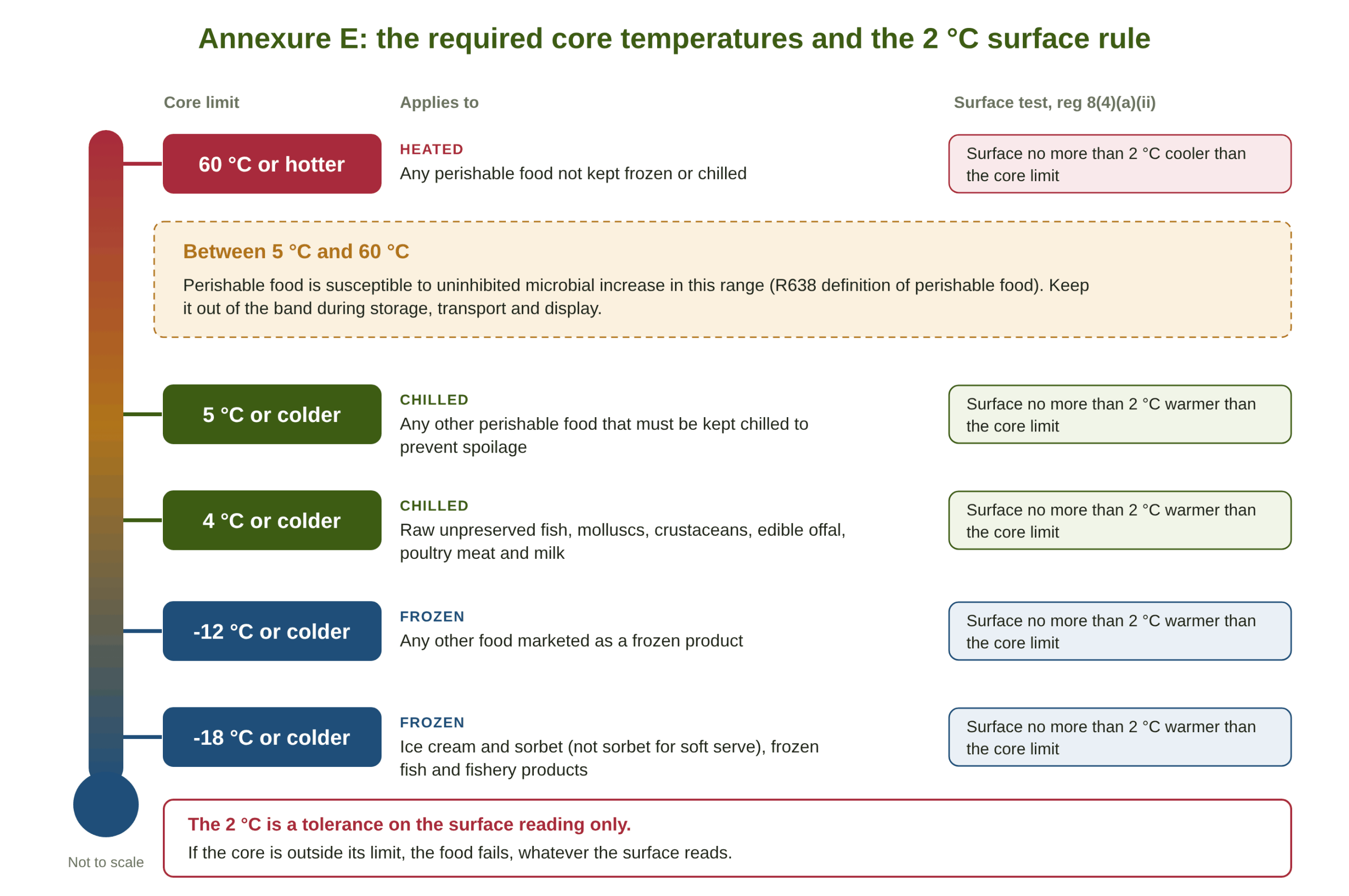
Regulation 8(4)(a)(i) says food listed in Annexure E must, during storage, transport or display, be kept at the core temperature that Annexure E gives for it. The only allowance is the time the food needs to cool down or heat up in line with good manufacturing practice. Contravening R638, or allowing someone else to, is an offence under regulation 15.
Annexure E, line by line
| Category | Food | Required core temperature |
|---|---|---|
| Frozen | Ice cream and sorbet (excluding sorbet for soft serve), frozen fish and fishery products | -18 °C or colder |
| Frozen | Any other food marketed as a frozen product | -12 °C or colder |
| Chilled | Raw unpreserved fish, molluscs, crustaceans, edible offal, poultry meat and milk | 4 °C or colder |
| Chilled | Any other perishable food that must be kept chilled to prevent spoilage | 5 °C or colder |
| Heated | Any perishable food not kept frozen or chilled | 60 °C or hotter |
Poultry and milk sit on the 4 °C line with raw fish and offal. Put chicken portions into a chiller of yoghurt and cooked meats and the room has to meet 4 °C, unless you already run it colder for everything. Salmonella and Campylobacter do not grow at chill temperatures, but they survive. With raw poultry in a mixed load the danger is drip onto ready-to-eat food, so it goes low and away from anything that will not be cooked.
Chilled ready meals, salads and cooked meats are on the 5 °C line. Listeria monocytogenes can grow slowly at chill temperatures, which is why chilled ready-to-eat food depends on temperature and shelf life together. Pseudomonas and the other spoilage organisms also grow in the cold and decide how long the product lasts. A pallet that spent a day at the top of its limit gave them a day of growth, even if every reading passed.
R638 defines perishable food as food that is open to uninhibited microbial increase between 5 °C and 60 °C. Hot food has to stay above that band. Clostridium perfringens and Bacillus cereus multiply in cooked food held warm, and Staphylococcus aureus from hands can produce a heat-stable toxin in food left in the band. A hot-box van that leaves at 60 °C and arrives lukewarm has carried the food straight through it.
The gap between -12 °C and -18 °C
Ask anyone in cold chain and they will tell you frozen food must be at -18 °C. The law is softer. Annexure E puts only ice cream, sorbet and frozen fish and fishery products at -18 °C. Frozen vegetables, chips, pies and burger patties are “any other food marketed as a frozen product”, with a legal floor of -12 °C.
Customers work to a different number. Codex CXC 8-1976, the code of practice for quick frozen foods (revised 2008), expects quick frozen food to be kept at -18 °C or colder right through the cold chain, and most retailer and product specifications copy it. BRCGS Storage and Distribution sets no product temperature of its own. The auditor checks you against the product owner’s specification and the law, so on a certified site the specification usually decides.
On the sites I advise we set it up the same way each time. -18 °C is the operating target and the alarm sits close to it. -12 °C is the legal line for that category. If a load of frozen pies reads somewhere between -12 °C and -18 °C at the core, the product owner gets a phone call and makes the decision, and that call is written down. The load still meets R638. It fails the customer’s specification, and the customer decides what happens to it.
The 2 °C surface rule
Regulation 8(4)(a)(ii) is the rule inspectors and receiving clerks actually use. Frozen or chilled food may not be sold if its core is warmer than the Annexure E figure, or if its surface is more than 2 °C warmer than that required core temperature. Hot food works in reverse. A core below 60 °C fails, and so does a surface more than 2 °C below 60 °C.
The 2 °C is a tolerance on the surface reading only. It gives you nothing on the core. On a dock its value is speed. A surface reading between packs takes a minute and the truck keeps moving. When the surface is outside the tolerance, or you doubt it, you go to the core.
The four exemptions, and the one people stretch
Regulation 8(4)(b) lists four situations where the Annexure E temperatures do not apply.
- Perishable food sold directly to a consumer, or eaten on the premises, within four hours of being processed or prepared.
- Venison, for up to 8 hours after the animal was killed, with the surface no warmer than 25 °C.
- Whole freshly caught or harvested raw fish, molluscs or crustaceans, and raw meat, edible offal or the carcasses of cattle, sheep, goats, pigs, horses, mules, donkeys, rabbits or ostriches after slaughter, while being transported for no more than one hour during delivery, with the surface no warmer than 25 °C.
- Food exposed to higher temperatures during a maturation period or as part of a manufacturing process, in line with good manufacturing practice.
The third one gets stretched. It covers a delivery of up to one hour. A carcass truck stuck outside Harrismith for an afternoon is well past it. Read the species list too. Poultry is not on it, so a bakkie of chickens from a small abattoir has no one-hour allowance and sits on the 4 °C line from the start.
The four-hour exemption is for food sold to a consumer or eaten on the premises. A DC sells to neither, so ready meals waiting on a warm dock before dispatch get no four-hour grace.
Taking the reading: Annexure G
Regulation 8(7) brings in Annexure G, the code of practice for measuring food temperature.
- Measure the food where it is, as far as practicable. Carrying a case out of the freezer to a desk in the sun to probe it measures the desk.
- For prepacked food, put the probe between two or more packs, or against the outer surface of a single pack, for at least one minute.
- If that reading fails, or you doubt it, take a surface or core reading.
- For a frozen core, drill to the estimated centre with a sterilised stainless steel bit of about 4 mm, insert a sterilised probe and read after two minutes. For chilled or hot food, push a sterilised probe into the estimated centre.
- Work aseptically, keep chemicals away, and damage the packaging as little as you can.
The one-minute wait is where receiving goes wrong. A clerk with a queue of trucks at the gate wants a number before the probe has settled, and that number is mostly the air in the dock.
R638 defines a thermometer as an instrument whose combined accuracy and sensor is approximately 1 °C. Regulation 6(5)(a) requires one in every chilling and freezer facility used to store, display or transport perishable food, reflecting the temperature of the refrigerated area at all times and placed so it can be read without obstruction. Regulation 6(5)(b) says the same for heating apparatus used to store, display or transport heated perishable food. Under 6(5)(c) the monitoring may be done by the best available method, and for a fleet that usually means loggers. A BRCGS site also needs its reference thermometer calibrated and traceable to a recognised national standard.
The records that prove it
Regulation 10(16) asks for records of processing, production and distribution, kept for at least six months after the shelf life of the product. For frozen stock with a long shelf life that runs a long way. A BRCGS Storage and Distribution site keeps records for a period that reflects shelf life and customer or legal requirements, and never less than one year. Where the two differ, keep the longer.
For temperature, BRCGS expects recording equipment with suitable alarms, or recorded manual checks typically every 4 hours or often enough to act before product goes out of limits. It also wants stores and vehicles validated by temperature mapping or trials in the warmest and coolest months. Durban in February and the Highveld in July both count, and coastal and inland sites behave very differently.
A receiving record worth having shows the vehicle registration, the logger reading on arrival, each probe reading with the method used, who took it and what was decided. If you accepted a load near the line, write down why and who agreed. When a reading is out, handling a temperature excursion follows its own steps: hold, assess, decide, record.
How the course case study sets its limits
The course follows Mzansi Fresh Meals, a fictional ready meal maker with its own DC in Pinetown. Its multi-temperature trucks carry stock in separate compartments, each held to its own Annexure E line. The hot-box vans work to 60 °C at the customer’s door. The bakkie carries the same legal limits as the big trucks whenever perishable food is on it. The reefer to Midrand is outsourced, and because it carries perishable food on Mzansi’s behalf it needs its own Certificate of Acceptability under regulation 3(1)(a). Choosing and loading delivery vehicles covers that in more detail.
Frequently asked questions
What temperature should frozen food be stored at in South Africa?
Annexure E of R638 puts ice cream, sorbet (except sorbet for soft serve) and frozen fish and fishery products at -18 °C or colder. Any other food marketed as frozen has a legal floor of -12 °C. Codex CXC 8 and most customer specifications expect -18 °C for quick frozen food, so run your stores at -18 °C and treat -12 °C as the legal line for that category.
What temperature must chilled food be kept at under R638?
Raw unpreserved fish, molluscs, crustaceans, edible offal, poultry meat and milk must be at 4 °C or colder. Any other perishable food that must be chilled to prevent spoilage must be at 5 °C or colder. The limits apply in storage, transport and display, and the surface may not read more than 2 °C warmer than the required core temperature.
What is the hot holding temperature in R638?
Perishable food that is not kept frozen or chilled must be held at 60 °C or hotter during storage, transport and display. It may not be sold if the core is below 60 °C or the surface is more than 2 °C below that. Heating apparatus used to store, display or transport heated perishable food needs a thermometer under regulation 6(5)(b).
How long must food temperature and distribution records be kept?
Regulation 10(16) of R638 requires records of processing, production and distribution to be kept for at least six months after the shelf life of the product. A site certified to BRCGS Storage and Distribution keeps records for at least one year, and longer where shelf life or customer requirements call for it. Keep whichever period is longer.
Does a refrigerated delivery vehicle need a thermometer?
Yes. Regulation 6(5)(a) applies to any chilling or freezer facility used to transport perishable food, so the compartment needs a thermometer that shows its temperature at all times and can be read without obstruction. Under 6(5)(c) the monitoring may be done by the best available method, which on most fleets means a data logger whose readings are downloaded and kept.
Get the temperatures right on every dock and every truck
Nine modules, 27 lessons, 14 diagrams and a three-sitting workshop built on R638, with the Pinetown case study from cold room to customer.
Start the course (R1 795) →Compare storage and distribution coursesOnline, self-paced, works on any phone. 70% to pass each assessment, three attempts. Certificate on passing.