
Implementing ISO 20001:2026 Food Loss and Waste Management Systems
About Course
If a retailer asks whether your site plans to align with ISO 20001, you need a scored gap list and a dated plan, not a guess. This course builds both with you, clause by clause, in about eight hours online.
Advanced, Level 4. Eight modules and 31 lessons, all on a phone. One graded assignment and a QR verified Certificate of Achievement. R1 795 until 31 December 2026, then R2 495.
What is ISO 20001:2026?
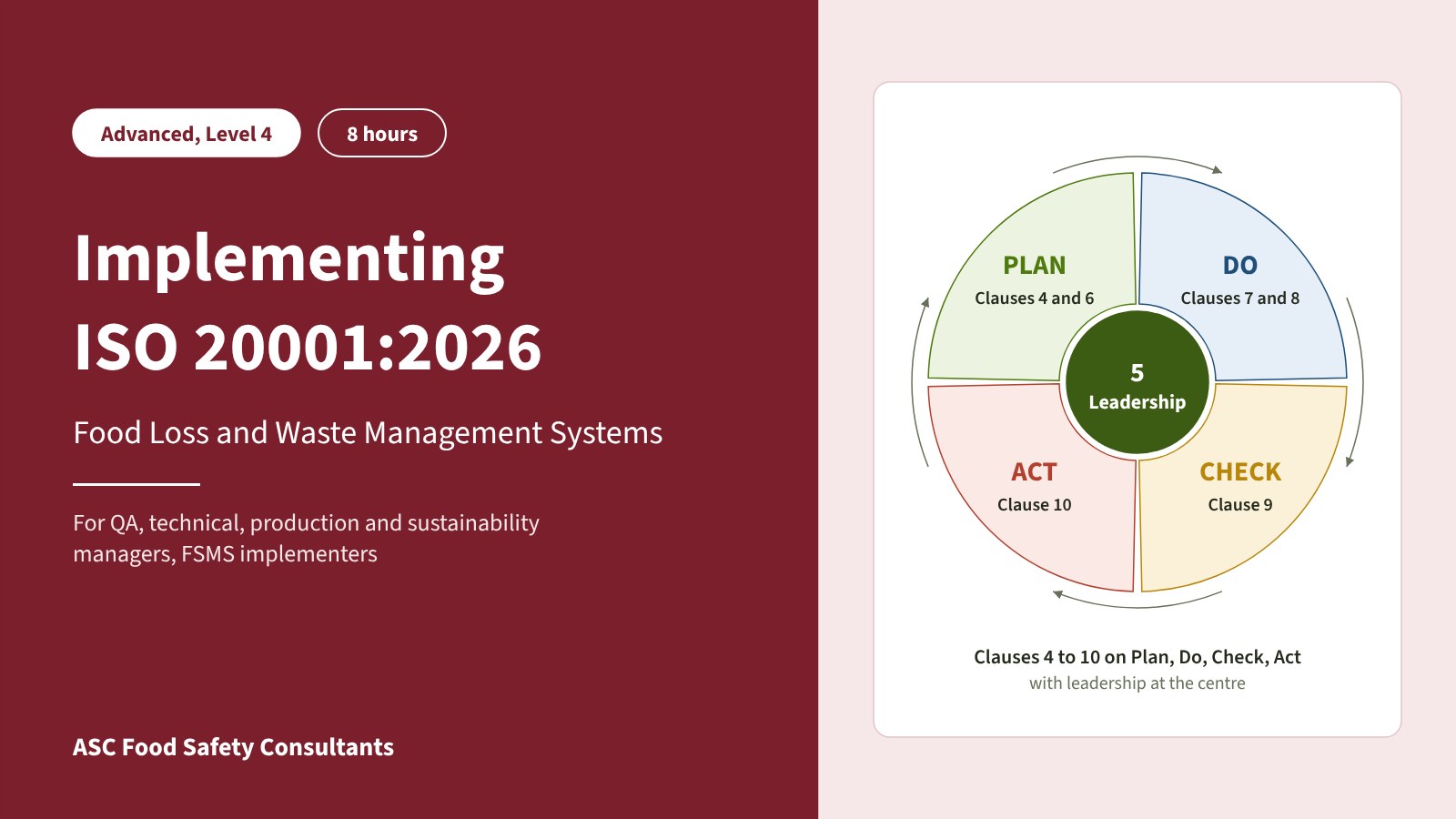
ISO 20001:2026 is the international management system standard for food loss and waste. ISO published it on 29 September 2026. It sets requirements for any organisation in the food supply chain, from farms and food manufacturers to retailers, food service and food charities, to plan, run and improve a system that prevents and minimises food loss and waste in its own operations and its supply chain. It is built on the ISO Harmonized Structure, so clauses 4 to 10 follow the same pattern as the ISO 22000 system an FSSC 22000 site already runs.
Why build a system if you already measure food loss and waste?
Your baseline, your objectives and your surplus routes are the content of a food loss and waste programme. ISO 20001:2026 adds the system around them: a defined scope, named interested parties, leadership that signs, communication along the supply chain, contractors you have verified, internal audits, management review and corrective action. Without that system the numbers you worked hard for drift the moment a feed contract lapses or the person who built the spreadsheet goes on leave.
What does the case study show?
The course runs on Mzansi Fresh Produce, the Tzaneen fruit and vegetable processor from the three earlier ASC food loss and waste courses, with a 1 104 t baseline and a seven objective register. It is a training scenario built from real audit patterns. Its largest retailer has asked whether it plans to align with ISO 20001. You run the gap assessment, find that the site scores 29 out of 84, and build the plan that aims to take it to 80 percent or more by June 2027, with no item left at zero.
The gaps cost money and credibility. The site pays R494 520 a year in landfill gate fees. Its feed contractor’s paperwork covers 4 310 t and the feedlot confirms 3 460 t, so 850 t of reported diversion is unexplained. A diversion figure of 89.58 percent went to the retailer, and only 66.86 percent can be verified on the evidence the site holds. At R1 795 the course costs less than two days of that site’s landfill gate fees.
What does it give employers and QA managers?
- A gap assessment you can take to management review. The ISO 20001 gap assessment tool scores every Harmonized Structure clause and food loss and waste topic, builds the gap list and exports the workbook.
- One system, not two. The course shows exactly where food loss and waste joins the context register, audit programme, management review and CAPA system you already run for ISO 22000 or FSSC 22000.
- Honest about certification. What ISO 20001 allows today, why ISO 20020 for certification bodies matters while it is still a draft, and what you can credibly tell a retailer now.
- Clause 2.5.16 and ISO 20001 side by side. Where they overlap, where they do not, and how to map one set of records to each without claiming that one satisfies the other.
- Written by an auditor. Mthokozisi Nkosi, ASC’s founder and an FSSC 22000 and BRCGS lead auditor, built it from the gaps he finds on site. He also wrote the three earlier ASC food loss and waste courses.
- Team rates. For five or more learners, contact ASC for a team rate and one invoice.
What exactly do you get?
- 31 lessons in eight modules: the standard and the South African context, one module for each of clauses 4 to 10, and a three sitting workshop
- The ISO 20001 gap assessment tool. It scores 28 items across clauses 4 to 10 and the food loss and waste topics, builds the gap list with owners and dates, and exports an xlsx workbook
- A scope and interested parties builder, and a clause sorting activity
- The surplus disposition tool, hotspot ranker, objectives builder and mass balance calculator from the earlier courses, loaded with the case study numbers
- 29 diagrams and case study packs with model answers in every module
- Seven knowledge checks, six timed games, a final assessment and one practical assignment marked against a published rubric
- A Certificate of Achievement, Advanced Level 4, with a QR code anyone can verify
How long does it take, and how is it assessed?
About eight hours in total, in short lessons on any phone. You can stop and continue later. 70 percent to pass every quiz, game, the final assessment and the assignment, with three attempts each. No employer needed: every tool loads the case study numbers, and the assignment accepts either the case study or your own site.
How does ISO 20001 relate to FSSC 22000 clause 2.5.16?
FSSC 22000 is the GFSI benchmarked scheme that has written a dedicated food loss and waste requirement, clause 2.5.16. It asks for a documented policy and objectives, controls on donated products, management of surplus meant for animal feed or food, and compliance with applicable legislation. ISO 20001 is a full management system for food loss and waste, with leadership, planning, support, operation, internal audit, management review and corrective action. The two overlap heavily. Neither replaces the other, and meeting one does not mean you meet the other.
Where does this course fit with the other ASC food loss and waste courses?
It is Course 4 in the ASC food loss and waste training programme. Food Loss and Waste Essentials trains the floor to classify what comes off each station. Measuring Food Loss and Waste builds a defensible baseline. Reducing Food Loss and Waste for Sustainable Manufacturing turns that baseline into a policy, objectives and safe surplus routes. This course puts a management system around all of it. Start here if you already own a baseline and objectives. If your floor staff cannot yet classify what they throw away, start with Essentials.
ISO 20001 is copyright. This course teaches the system and the method and does not reproduce the standard. Buy your own copy from ISO or your national standards body. ASC is not affiliated with ISO.
ISO 20001 course questions people ask
What is ISO 20001:2026?
ISO 20001:2026 is the international management system standard for food loss and waste, published by ISO on 29 September 2026. It sets requirements for any organisation in the food supply chain to plan, run and improve a system that prevents and minimises food loss and waste, including quantifying and reporting excess food and food loss and waste and working with its supply chain.
Who is this ISO 20001 course for?
QA and technical managers asked to align a site with ISO 20001, production and sustainability managers who own food loss and waste targets, FSMS implementers and consultants, and managers of food banks and redistribution organisations. It is an Advanced Level 4 course for someone who already runs or audits a food safety management system and now has to add food loss and waste to it.
Does ISO 20001 replace FSSC 22000 clause 2.5.16?
No, and neither one satisfies the other. Clause 2.5.16 asks an FSSC 22000 site for a food loss and waste policy and objectives, controls on donated products and on surplus meant for animal feed, and legal compliance. ISO 20001 is a complete management system for food loss and waste. They overlap heavily. The course shows where they meet, how to keep one set of records that you can map to each, and where each asks for something the other does not.
Can we be certified to ISO 20001 in South Africa yet?
The standard allows certification by an external body or a self-declaration of conformity. ISO 20020, the requirements for bodies that audit and certify food loss and waste management systems, is still a draft. Check with SANAS and your certification body whether accredited ISO 20001 certification is available before you pay for it. A self-assessment backed by an internal audit and a management review is a credible step today.
Is an online ISO 20001 company certificate worth having?
Ask three questions first: was your site audited, by whom, and is that body accredited for ISO 20001. A certificate issued from a form and a company name is not evidence that your site runs a food loss and waste management system.
How long does the course take?
About eight hours, across 31 lessons in eight modules, including the knowledge checks, games, final assessment and assignment. It is self paced and works on a phone, so you can stop and continue later without losing a production day.
What exactly do I get?
31 lessons, 29 diagrams, an ISO 20001 gap assessment tool that scores 28 items and exports an xlsx workbook, a scope and interested parties builder, a clause sorting activity, the surplus disposition tool, hotspot ranker, objectives builder and mass balance calculator, case study packs with model answers, seven knowledge checks, six timed games, a final assessment, one practical assignment and a QR verified Certificate of Achievement at Advanced Level 4.
Is it worth it if we are already FSSC 22000 certified?
Yes, because most of the system already exists. An FSSC 22000 site already runs a context and interested parties analysis, an internal audit programme, management review and corrective action. The course shows how to add food loss and waste to each of them, so you extend one system instead of starting a second. The gap assessment and implementation plan you build go straight onto the agenda of your next management review.
Will it work in my plant if we do not process fruit and vegetables?
Yes. The requirements of ISO 20001 are generic and written for any organisation in the food supply chain, of any size. The case study is a fruit and vegetable processor, but the method is the same for a bakery, a meat plant, a dairy or a distribution centre. The tools take your own data, and managers of food banks get a redistribution organisation variant in the lessons on interested parties, scope, donation and the gap assessment.
Do I need my own copy of the standard?
Not to complete the course. You do need it before you write procedures against ISO 20001, because the course teaches the system and the method and refers you to your own copy for the exact wording of the food loss and waste requirements. Buy it from ISO or your national standards body.
Do I need to work at a food factory to complete it?
No. Every activity and tool runs on the course case study, and the assignment accepts either the case study or your own site.
Which ASC food loss and waste course should I take first?
If your line staff cannot classify what comes off their station, start with Food Loss and Waste Essentials. If you need a defensible baseline, take Measuring Food Loss and Waste. If you have a baseline and need to reduce it, take Reducing Food Loss and Waste for Sustainable Manufacturing. Take this course when you need to put a management system around that work, for example when a customer asks about ISO 20001. None of the earlier courses is a formal prerequisite, and Module 6 recaps the measurement method.
What does the course cost, and are there team rates?
R1 795 per learner until 31 December 2026, then R2 495. No VAT is charged, so the price shown is the price paid. For five or more learners, contact ASC for a team rate and one invoice.
Course Content
Start here
-
Welcome, and how this course works
Module 1: ISO 20001 and the food loss and waste landscape
Module 2: Context and scope (clause 4)
Module 3: Leadership (clause 5)
Module 4: Planning (clause 6)
Module 5: Support (clause 7)
Module 6: Operation (clause 8)
Module 7: Performance evaluation and improvement (clauses 9 and 10)
Module 8: Workshop: the gap assessment and the implementation plan
Course assessment and feedback
Student Ratings & Reviews
