
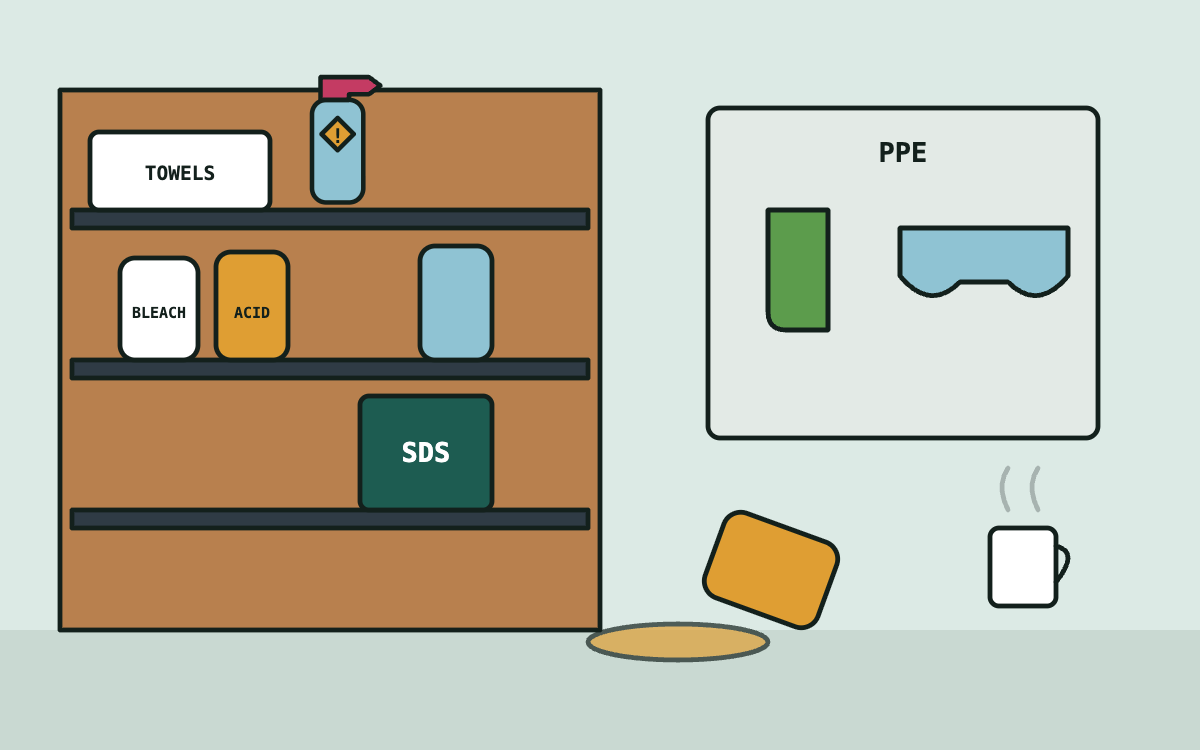
A housekeeper runs out of toilet cleaner halfway through a floor, tops up the bottle with bleach from the trolley, and a minute later is coughing in a closed bathroom. Nobody was careless on purpose. The label on the trolley bottle had worn off months ago, the safety data sheet was in the office, and nobody had ever shown her which products must never meet.
Cleaning and laundry chemicals in a guesthouse, lodge or hotel fall under the Regulations for Hazardous Chemical Agents, 2021, made under the Occupational Health and Safety Act 85 of 1993. The employer must keep a current safety data sheet (SDS) for every hazardous product, keep every container labelled, assess the risks at least every two years, train staff before they use the chemicals and provide the protective equipment the SDS calls for. Staff must never mix products: bleach with an acid releases chlorine gas, and bleach with ammonia releases chloramine gas.
Chemical Safety for Housekeeping and Laundry teaches housekeeping, laundry and cleaning staff to read labels and SDSs, dilute and store products correctly and deal with spills and splashes: about 2⅔ hours online, R450, picture-based, with a proctored final assessment and a certificate. It is one of four courses in the Hospitality Short Courses Bundle (R1 260 instead of R1 800).
Chemical safety in housekeeping: the key facts
| The law | Regulations for Hazardous Chemical Agents, 2021 (the HCA Regulations), published on 29 March 2021 under the Occupational Health and Safety Act 85 of 1993. They replaced the Hazardous Chemical Substances Regulations, 1995 |
|---|---|
| What counts | Any chemical classified as hazardous under the Globally Harmonized System (GHS): bleach, toilet and descaling acids, oven cleaners, degreasers, drain openers, and many laundry detergents and disinfectants |
| Training | Before any employee is, or may be, exposed (reg 3) |
| Risk assessment | Immediately, then at intervals not exceeding two years, and sooner if it may no longer be valid (reg 5) |
| Safety data sheets | 16 sections. Supplied with the product when it is first supplied to the workplace, available to every worker who uses it, reviewed by the manufacturer or importer at least every five years (reg 14A) |
| Labels | Every container stays correctly labelled, including spray bottles and buckets filled from a bulk container (reg 14B) |
| Misleading claims | Labels may not describe a hazardous product as “non-toxic”, “non-harmful” or similar (reg 13) |
| Records | Risk assessments and monitoring records are kept for at least 30 years (reg 9) |
| Waste | Chemical waste is classified and disposed of as waste, and recycled where possible (reg 15). Never poured onto the ground |
| Never mix | Bleach + acid = chlorine gas. Bleach + ammonia = chloramine gas |
Do the HCA Regulations apply to cleaning chemicals in a guesthouse?
Yes. The regulations apply to every workplace where employees use or may be exposed to a hazardous chemical agent, and most professional cleaning, laundry and kitchen chemicals are classified as hazardous. A small property with two housekeepers has the same duties as a hotel, scaled to the size of the risk.
What changes with size is the paperwork, not the principle. A guesthouse does not need a consultant’s binder. It needs a list of the products it actually uses, a current SDS for each, a short written risk assessment, labelled containers, the right gloves and eye protection, and staff who have been shown how to use all of it.
What is a safety data sheet, and which sections matter most?
A safety data sheet is the supplier’s technical document for a product. Every SDS has the same 16 sections in the same order, so once staff know where to look they can find first aid, PPE or spill instructions for any product in seconds.
| Section | What it tells you | When you need it |
|---|---|---|
| 2. Hazard identification | The hazards, signal word and pictograms | Before first use |
| 4. First-aid measures | What to do for eyes, skin, swallowing or breathing it in | After a splash or exposure. Take the SDS or label to the clinic |
| 6. Accidental release measures | How to clean up a spill | After a leak or spill |
| 7. Handling and storage | How to store it and what to keep it away from | Setting up the chemical store |
| 8. Exposure controls and PPE | Gloves, eye protection, ventilation | Choosing PPE |
| 13. Disposal considerations | How to dispose of the product and empty containers | Clearing out old stock |
Keep the SDS file where the chemicals are used or stored, not locked in the office. If a supplier cannot give you an SDS for a hazardous product, change supplier.
What must be on a chemical label, and what about spray bottles?
A GHS label shows the product name, a signal word (“Danger” or “Warning”), hazard pictograms, hazard statements, precautionary statements and the supplier’s details. When a product is decanted into a spray bottle or bucket, the new container must be labelled for that product too.
Unlabelled spray bottles are the most common chemical finding in accommodation. Buy printed secondary labels from the supplier, or print them from the SDS, and replace them when they wear. Never decant a chemical into a food or drink container: cold drink bottles filled with cleaning products are a known cause of accidental poisoning.
Which cleaning chemicals must never be mixed?
Never mix chlorine bleach with acids or with ammonia. Bleach and an acidic toilet cleaner or descaler release chlorine gas; bleach and an ammonia-based cleaner release chloramine gas. Both damage the lungs, and in a small, closed bathroom they reach harmful levels quickly.
| Combination | What happens | Where it happens |
|---|---|---|
| Bleach + acid toilet cleaner or descaler | Chlorine gas | Toilets and showers, when one product is used after another without rinsing |
| Bleach + ammonia-based cleaner | Chloramine gas | Glass and surface cleaning, topping up a bottle with “whatever is left” |
| Two different drain openers | Violent reaction, heat and splashing | Blocked basins, when the first product “did not work” |
The rule for staff is simple: one product at a time, rinse between products, and never top up a bottle with a different product. Sections 7 and 10 of each SDS list incompatible materials, and the chemical store should keep them on separate shelves so that a leak cannot bring them together.
What protective equipment do housekeeping and laundry staff need?
Whatever section 8 of the SDS specifies. For most cleaning chemicals that means chemical-resistant gloves, usually nitrile or rubber, and eye protection when handling concentrates or anything that can splash. Ventilation comes before masks: open windows and use extraction first.
- Replace torn gloves at once, and wash and dry hands after taking them off.
- Use goggles or a face shield when diluting concentrates or cleaning above head height.
- If an SDS calls for respiratory protection, the employee must be trained and the mask must fit. A paper dust mask does not protect against chemical vapours.
- Staff may not eat, drink or smoke while using chemicals, and hands are washed before breaks.
How should cleaning chemicals be stored?
In their original, labelled containers, in a locked and ventilated store, off the floor, away from food and guest areas, with incompatible products apart. Concentrates go on low shelves so they are never lifted above head height.
Dosing systems for laundry and dishwashing reduce handling, but the concentrate drums still need the same care. Check them for leaks, keep the spill kit next to them, and make sure the person changing a drum wears the PPE the SDS requires.
What should staff do after a splash, spill or exposure?
- Eyes: rinse immediately with clean running water and keep rinsing, then follow section 4 of the SDS and get medical help.
- Skin: remove contaminated clothing and rinse with plenty of water.
- Swallowed: do not make the person vomit, because that can cause more burns. Follow the SDS and get medical help at once.
- Breathed in: move the person to fresh air, keep others out of the area and get help.
- Spills: follow section 6 of the SDS, use absorbent from the spill kit, bag and label the waste, and never hose concentrate into a drain.
- Always: take the label or SDS to the clinic and report the incident to your supervisor.
What are the employer’s and employees’ duties?
The employer provides information, training, safe products and systems, PPE, washing facilities and a risk assessment. Employees follow the instructions and training, use the PPE provided, and report spills, damaged containers, missing labels and any symptoms such as skin rashes, burns or breathing problems.
A supervisor’s chemical safety checklist
- A list of every chemical in use, with a current SDS for each hazardous product, kept where the chemicals are.
- A written risk assessment, reviewed at least every two years and whenever products or methods change.
- Every container labelled, including spray bottles and buckets.
- Staff trained before they first use a product, with a signed record.
- Gloves and eye protection matching section 8 of each SDS, in good condition.
- A locked, ventilated store with incompatible products separated.
- Dilution instructions posted where products are mixed, with measuring jugs or dosing units.
- A spill kit and clean water for eye rinsing within reach of the store and the laundry.
- Out-of-date and unlabelled products removed and disposed of as the SDS directs.
Frequently asked questions
Do the HCA Regulations apply to ordinary cleaning products?
Yes, when the products are classified as hazardous under the Globally Harmonized System, which covers most bleaches, acids, oven cleaners, degreasers, drain openers and many detergents and disinfectants used at work.
How often must a chemical risk assessment be reviewed?
At intervals not exceeding two years under regulation 5 of the Regulations for Hazardous Chemical Agents, 2021, and immediately if there is reason to believe it is no longer valid, for example after a change of products or methods.
Must spray bottles be labelled?
Yes. When a chemical is decanted into another container at the workplace, the employer must ensure the new container is correctly labelled for that chemical.
What happens if you mix bleach and toilet cleaner?
Most acid toilet cleaners react with chlorine bleach to release chlorine gas, which damages the lungs. Never mix products; use one at a time and rinse between them.
Where should safety data sheets be kept?
Where the chemicals are used or stored, so that the people using them can read them. Staff should know that section 4 covers first aid, section 6 spills and section 8 protective equipment.
How long must chemical risk assessment records be kept?
At least 30 years for assessment and monitoring records under regulation 9 of the Regulations for Hazardous Chemical Agents, 2021.
Which ASC course covers this
Chemical Safety for Housekeeping and Laundry takes staff through a real chemical store: reading labels and pictograms, finding answers in an SDS, diluting and decanting, storage, PPE, spills and splashes, and their own duties under the 2021 regulations. Four short modules with picture-based quizzes and a proctored final assessment, R450, with a certificate on completion.
It is part of the Hospitality Short Courses Bundle with Guest Data Protection (POPIA), Fire Safety and Evacuation for Accommodation and Food Safety for Caterers and Events, all four for R1 260. For new housekeeping and support staff, Guesthouse Support Staff Essentials covers the wider job. See the full guesthouse compliance checklist, and more courses for accommodation and food service on the Hospitality and Foodservice Training page.
Sources
- Regulations for Hazardous Chemical Agents, 2021, Department of Employment and Labour
- Occupational Health and Safety Act 85 of 1993, Department of Employment and Labour
- Globally Harmonized System of Classification and Labelling of Chemicals (GHS), UNECE