
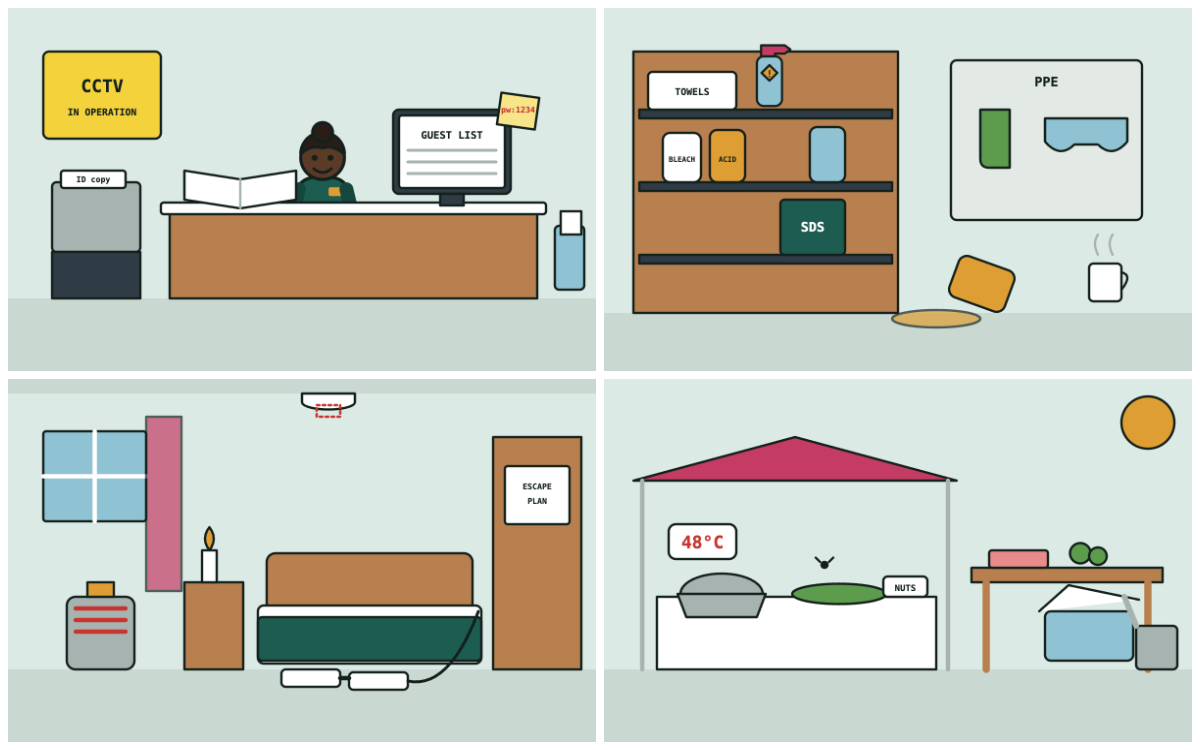
Most guesthouse owners find out what they were supposed to have in place on the day somebody asks for it: an environmental health practitioner at the breakfast kitchen, a fire safety inspector at the front door, an insurer after a claim, or a guest who wants to know what happened to the copy of their ID. The requirements are not exotic. They are spread across several laws, and each one comes down to a written procedure, trained staff and a record you can show.
A South African guesthouse that employs staff and serves food must cover five core areas: food hygiene under R638 (including a Certificate of Acceptability for the kitchen), guest information under POPIA, cleaning chemicals under the Regulations for Hazardous Chemical Agents, 2021, fire safety under the OHS Act, building regulations and municipal by-laws, and first aid under the General Safety Regulations. For each area, you need a named person responsible, trained staff and records an inspector can see.
ASC’s Hospitality Short Courses Bundle covers four of the training requirements in one enrolment: POPIA at the front desk, chemical safety for housekeeping and laundry, fire safety and evacuation, and food safety for caterers and events. All four for R1 260 instead of R1 800, a 30% saving, each with a proctored final assessment and a certificate.
Guesthouse compliance in South Africa: the key facts
| Food hygiene | R638 of 2018: Certificate of Acceptability for the kitchen, a trained person in charge, trained food handlers, temperature control and records |
|---|---|
| Guest information | POPIA (Act 4 of 2013): registered Information Officer, minimal collection, security safeguards, operator contracts, breach reporting, marketing consent |
| Cleaning chemicals | Regulations for Hazardous Chemical Agents, 2021: safety data sheets, labels, risk assessment every two years, training before use, PPE |
| Fire | OHS Act, SANS 10400-T and municipal by-laws: extinguishers serviced yearly to SANS 1475-1 by SAQCC Fire-registered people, escape routes, evacuation plan and drills |
| First aid | General Safety Regulations, reg 3: a first aid box where more than 5 employees work; a trained first aider where more than 10 do |
| Health and safety representatives | OHS Act section 17: required where an employer has more than 20 employees at a workplace |
| Injury on duty | Register with the Compensation Fund under COIDA if you employ staff |
| Food waste | Not a licence condition, but a direct cost: date marks, stock rotation, safe reuse and donation |
What does a guesthouse need for food safety?
If you prepare or serve food, including breakfast, R638 applies. The kitchen needs a Certificate of Acceptability from the local authority’s environmental health department, the person in charge must be trained in food safety, and that person must make sure every food handler is trained. Keep temperature, cleaning and training records.
At a guesthouse the food handlers are usually the owner, the breakfast cook and whoever serves or clears breakfast, plus any housekeeper who stocks minibars or delivers trays. Buffet breakfasts are where most findings happen: eggs, dairy, cold meats and cooked food sitting at room temperature through a long service. For the details, see R638 training for restaurant, hotel and guesthouse staff and the R638 temperature limits.
What does POPIA require from a guesthouse?
A registered Information Officer (by default the owner), guest information collected only for a clear purpose and kept secure, written contracts with booking platforms and other operators, marketing only with consent (and checked against the National Consumer Commission’s opt-out registry), and every security compromise reported to the Information Regulator through its eServices Portal.
The front desk is where most of it happens: ID copies, registration cards, card details, WhatsApp messages and CCTV. See POPIA for guesthouse and hotel front desks.
What do the chemical regulations require?
A current safety data sheet for every hazardous cleaning and laundry product, every container labelled (including spray bottles), a written risk assessment reviewed at least every two years, staff trained before they use the chemicals, and the gloves and eye protection the SDS specifies.
See chemical safety in housekeeping and laundry.
What fire safety must a guesthouse have?
Fire extinguishers and blankets of the right type, serviced at least once a year by a SAQCC Fire-registered technician; smoke detectors tested monthly; escape routes that are clear and signed; exit doors that open from the inside without a key; an evacuation plan with an assembly point; a guest register for the roll call; and drills with staff. Your local fire department confirms what your building needs.
See guesthouse fire safety, including the load-shedding risks.
The guesthouse compliance checklist
| Area | Have in place | Evidence to keep | Training |
|---|---|---|---|
| Food hygiene (R638) | CoA for the kitchen; trained person in charge; clean, pest-free kitchen; hot food at 60 °C or above, chilled food at 5 °C or below (4 °C for raw fish, poultry, offal and milk) | CoA displayed in a conspicuous place (or a copy available on request where display is impractical); temperature logs; cleaning schedule; pest control reports; training certificates | R638 food handler and person in charge; Guesthouse Support Staff Essentials |
| Guest information (POPIA) | Registered Information Officer; privacy notice; minimal forms; locked storage; operator contracts; breach procedure | Information Officer registration; privacy notice; consent records for marketing; breach log | Guest Data Protection (POPIA) |
| Cleaning chemicals (HCA Regulations) | SDS for every hazardous product; labelled containers; locked store; gloves and eye protection | Chemical list and SDS file; risk assessment (reviewed every two years); training records | Chemical Safety for Housekeeping and Laundry |
| Fire | Serviced extinguishers and blankets; smoke detectors; clear, signed escape routes with emergency lighting where required; evacuation plan; assembly point | Service certificates; monthly check records; drill records; escape plans; gas installation certificate | Fire Safety and Evacuation for Accommodation |
| First aid | First aid box (more than 5 employees); trained first aider on site (more than 10 employees) | First aid certificates; box checklist; incident register | An accredited first aid provider |
| Events and functions | Transport and buffet temperature control; allergen labels; leftovers policy | Probe records; time logs; allergen information for each dish | Food Safety for Caterers and Events |
| Food waste | Stock rotation; date checks; recipe cards; safe reuse and donation rules | Waste measurements; donation records | Food Loss and Waste in Foodservice and Hospitality |
| Employer registrations | Compensation Fund (COIDA); health and safety representative where more than 20 employees | Registration letters; appointment letters |
If you host functions, see food safety for caterers and events; to cut what the kitchen throws away, see best before vs use by in hospitality kitchens.
Depending on what you offer, you may also need a liquor licence from your provincial liquor authority, municipal zoning or business approvals, and pool safety measures. Tourism grading through the Tourism Grading Council of South Africa is voluntary.
Which staff need which training?
| Role | Essential | Also useful |
|---|---|---|
| Owner or manager | R638 person in charge; POPIA; fire safety | Everything the team does, so you can check it |
| Front desk and reservations | POPIA; fire safety (evacuation and roll call) | Guesthouse Support Staff Essentials |
| Housekeeping and laundry | Chemical safety; fire safety | Guesthouse Support Staff Essentials; R638 food handler if they handle trays or minibars |
| Breakfast and kitchen | R638 food handler; fire safety (pan and fryer fires) | Food loss and waste; chemical safety |
| Events and functions | Food safety for caterers and events; R638 food handler | Food loss and waste |
| Night staff and security | Fire safety and evacuation | POPIA (CCTV and the register) |
How much does it cost to train a guesthouse team?
ASC’s four hospitality short courses cost R450 each, or R1 260 together in the Hospitality Short Courses Bundle, a 30% saving on R1 800. Guesthouse Support Staff Essentials is R799 and Food Loss and Waste in Foodservice and Hospitality is R649. All are online and self-paced, with picture-based quizzes, a proctored final assessment and a certificate on completion.
| Course | Price | Time online |
|---|---|---|
| Guest Data Protection (POPIA) for Front Desk and Reservations | R450 | About 2¾ hours |
| Chemical Safety for Housekeeping and Laundry | R450 | About 2⅔ hours |
| Fire Safety and Evacuation for Accommodation | R450 | About 2⅔ hours |
| Food Safety for Caterers and Events | R450 | About 2¾ hours |
| All four: Hospitality Short Courses Bundle | R1 260 (was R1 800) | About 11 hours |
| Guesthouse Support Staff Essentials | R799 | About 5 hours |
| Food Loss and Waste in Foodservice and Hospitality | R649 | About 4 hours |
Frequently asked questions
Does a guesthouse that only serves breakfast need a Certificate of Acceptability?
Yes. R638 applies to any premises where food is prepared or served, including a guesthouse kitchen that only cooks breakfast. The CoA is issued by the local authority’s environmental health department.
Does POPIA apply to a small guesthouse?
Yes. POPIA has no size exemption. A guesthouse that records guests’ names, contact details, ID numbers or card details must have a registered Information Officer and must protect that information.
How often must a guesthouse service its fire extinguishers?
At least once a year, by a technician registered with SAQCC Fire working to SANS 1475-1, and after any use. Check each extinguisher monthly between services.
Do cleaning chemicals in a guesthouse need safety data sheets?
Yes, for hazardous products. The Regulations for Hazardous Chemical Agents, 2021 require a current safety data sheet to be available to the staff who use each hazardous chemical, and every container to be labelled.
When does a guesthouse need a trained first aider?
Under regulation 3 of the General Safety Regulations, a first aid box is required where more than five employees work, and a trained first aider where more than ten employees work.
What is included in the Hospitality Short Courses Bundle?
Four online courses: Guest Data Protection (POPIA) for Front Desk and Reservations, Chemical Safety for Housekeeping and Laundry, Fire Safety and Evacuation for Accommodation, and Food Safety for Caterers and Events. The bundle costs R1 260 instead of R1 800.
Which ASC courses cover this
The Hospitality Short Courses Bundle covers POPIA, chemicals, fire and event catering for R1 260. Guesthouse Support Staff Essentials gives new support staff the whole job in one course, and Food Loss and Waste in Foodservice and Hospitality cuts what the kitchen throws away. For R638 certificates, see Regulation R638 training, and for everything else for accommodation and food service, the Hospitality and Foodservice Training page. Training a larger team? Contact ASC about group enrolment.
Sources
- R638 of 22 June 2018: general hygiene requirements for food premises, Government Gazette 41730
- Protection of Personal Information Act 4 of 2013, South African Government
- Regulations for Hazardous Chemical Agents, 2021, Department of Employment and Labour
- Occupational Health and Safety Act 85 of 1993, Department of Employment and Labour
- SAQCC Fire