
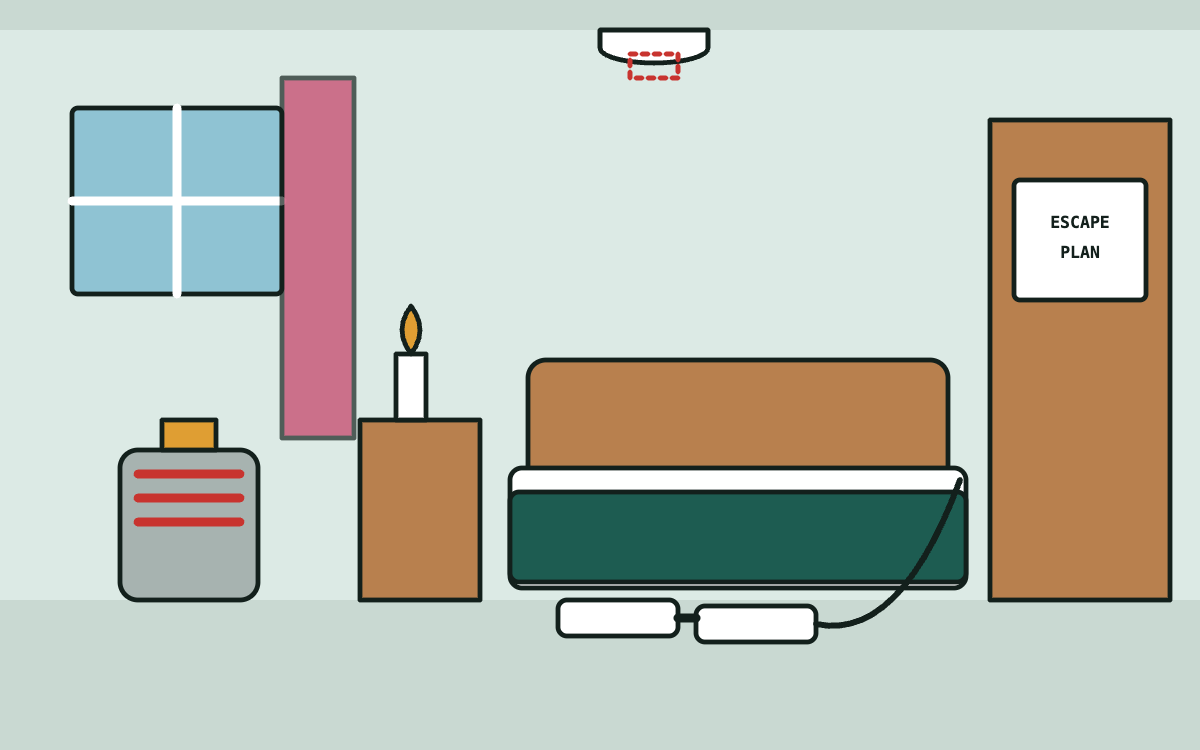
It is 02:15, the power has been off for three hours, and the smoke detector in Room 6 is sounding. A guest lit a candle on the bedside table and fell asleep. The night porter now has to wake nine rooms of sleeping guests in the dark, get them all out, and prove at the gate that nobody is still inside. What happens in the next four minutes was decided months earlier, by what the staff were trained to do.
Fire safety in a South African guesthouse comes from the Occupational Health and Safety Act, the National Building Regulations (SANS 10400-T covers fire protection) and your municipality’s fire safety by-laws. In practice it means the right extinguishers, serviced every year by a SAQCC Fire-registered person to SANS 1475-1; escape routes that are clear and signed; an up-to-date guest register for the roll call; regular evacuation practice; and strict rules for candles, gas, generators and heaters during power cuts.
Fire Safety and Evacuation for Accommodation trains every member of staff, including night staff, to prevent fires, use extinguishers and fire blankets, and evacuate guests: about 2⅔ hours online, R450, picture-based, with a proctored final assessment and a certificate. It is one of four courses in the Hospitality Short Courses Bundle (R1 260 instead of R1 800).
Guesthouse fire safety: the key facts
| The law | Occupational Health and Safety Act 85 of 1993 and its regulations; National Building Regulations and SANS 10400-T (fire protection); municipal fire safety by-laws, enforced by the local fire department |
|---|---|
| Extinguisher servicing | At least once a year, by a technician registered with SAQCC Fire, to SANS 1475-1. Also after every use |
| Monthly checks | In place and visible, pin and seal intact, gauge in the green, service label current; press the test button on every smoke detector |
| Kitchen fat and oil fires | Fire blanket or wet chemical extinguisher. Never water |
| Escape routes | Clear and signed, with exit doors that open from the inside without a key. Test emergency lighting during power cuts |
| Roll call | The guest register (who is in which room tonight, including children) goes to the assembly point |
| Emergency number | 112 from any cellphone, or the local fire service number on the reception emergency list |
| Generators | Outdoors only, away from windows and doors: exhaust contains carbon monoxide. Refuel only when switched off and cool |
| Gas | Installed and certified by a SAQCC Gas-registered installer; large cylinders stand outdoors (SANS 10087) |
Which laws cover fire safety in a guesthouse?
Three sets of rules overlap. The OHS Act makes the employer responsible for a safe workplace, including fire risk. The National Building Regulations, through SANS 10400-T, set fire protection requirements for buildings, such as escape routes and fire equipment. Your municipality’s fire safety by-laws add local requirements, and the fire department inspects against them.
Because by-laws differ between municipalities, the quickest way to know exactly what your property needs is to ask the local fire safety office and your fire equipment service provider, and to keep their written advice on file. Your insurer will usually want to see the same records after a claim.
Which fire extinguisher is used for which fire?
Dry chemical powder (DCP) is the general-purpose extinguisher in most guesthouses and works on solids, flammable liquids and electrical fires. CO2 is for electrical equipment. Water is for paper, wood and fabric only. Fat and oil fires in the kitchen need a fire blanket or a wet chemical extinguisher.
| Fire | Use | Never use |
|---|---|---|
| Bedding, curtains, paper, wood | Water, foam or DCP | |
| Paraffin, petrol or other burning liquids | DCP is best; foam works; CO2 is rated for liquids but the gas disperses and the fire can re-ignite | Water |
| Electrical equipment, plugs, distribution board | CO2 or DCP, after switching off the power if it is safe to do so | Water, foam |
| Pan or deep-fryer fire | Fire blanket or wet chemical extinguisher, with the heat switched off | Water: it causes a fireball |
| Gas cylinder or appliance | Close the valve if you can reach it safely; evacuate and call the fire brigade |
How many extinguishers you need, and where, is set by SANS 10400-T and your fire department. Ask for it in writing.
How often must fire extinguishers be serviced?
At least once a year, by a technician registered with SAQCC Fire, working to SANS 1475-1. An extinguisher that has been used, even briefly, must be serviced before it goes back on the wall.
Between services, a named person checks every extinguisher and fire blanket monthly and records it: in place and visible, pin and tamper seal intact, pressure gauge in the green, no damage, service label current. Smoke detectors are tested at the same time. A detector with a missing battery protects nobody; the room should not be let until it works.
How do you use a fire extinguisher?
Raise the alarm first, make sure your escape route is behind you, then remember PASS: Pull the pin, Aim at the base of the fire, Squeeze the handle, Sweep from side to side. Only fight a small fire. If it is spreading, or the room is filling with smoke, close the door and get out.
For a pan fire: switch off the heat if you can, cover the pan completely with a fire blanket, and leave it covered until it has cooled. Lifting the blanket to check lets oxygen back in.
What should staff do when the alarm sounds at night?
- Raise the alarm and call 112 or the fire brigade from a safe place. Give the address, what is burning and whether anyone is inside.
- Take the guest register and master keys. The register shows who is staying in which room tonight, including children.
- Knock on every door on the way out and tell guests to leave by the nearest exit. Do not collect belongings.
- Close doors behind you to slow the smoke. Stay low if there is smoke.
- Help guests who need assistance: people with limited mobility, hearing or sight, and families with small children.
- Go to the assembly point and do the roll call against the register. Never go back inside.
- Report to the fire brigade on arrival: who is accounted for, who is missing and where the fire is.
Night shifts are where plans fail, because there are fewer staff and guests are asleep. Every plan should name who calls, who takes the register and who clears each floor, for night staff as well as day staff.
How do you evacuate guests who need help?
Plan it at check-in. Ask discreetly whether a guest would need help in an emergency, allocate ground-floor rooms near an exit where possible, and note the room on the night list. Health information is special personal information under POPIA, so record only what staff need to know.
How do power cuts and load shedding raise the fire risk?
Power cuts bring open flames and fuel indoors. Candles left burning near fabric are a common cause of fires, generators produce carbon monoxide, unflued gas heaters in bedrooms can cause both fire and carbon monoxide poisoning, and inverter batteries need a ventilated space and a qualified installer.
- Candles: offer rechargeable LED lanterns instead. If candles are used, stable holders, away from curtains and bedding, never left burning in an empty room.
- Generators: outdoors, in the open, away from windows and doors. Never in a storeroom, garage or laundry. Refuel only when switched off and cool, and store fuel outside the building.
- Gas heaters: not in rooms where people sleep. Use approved electric heaters at least a metre from bedding and curtains, and never cover them.
- Inverters and batteries: installed by a qualified electrician in a ventilated space, not in an escape route, with nothing stored against them.
- When the power returns: switch heavy appliances back on one at a time, and check that nothing was left on under a cloth or towel.
- Emergency lighting: escape routes should still be lit. Test emergency lights during a power cut, not only on a bright afternoon.
What about the kitchen and the laundry?
Keep a fire blanket beside the stove, never leave a pan or fryer unattended, and clean extraction filters regularly. In the laundry, clean the tumble dryer’s lint filter after every load, let the dryer finish its cool-down cycle, keep the area around it clear and never leave it running overnight with nobody there.
A fire safety routine for small accommodation
| How often | What |
|---|---|
| Every night | Escape routes clear, exit doors unlocked from the inside, fire doors closed, no candles or heaters left on in empty rooms, kitchen equipment off, register up to date |
| Every check-in | Point out the nearest exit, the assembly point and what the alarm sounds like. Escape plan on the back of the room door |
| Monthly | Test smoke detectors; check extinguishers and fire blankets; test emergency lighting; record it |
| At least once a year | Extinguishers and hose reels serviced by a SAQCC Fire-registered technician; evacuation drill with staff (and whenever new staff join); review the fire risk assessment |
Frequently asked questions
How often must fire extinguishers be serviced in South Africa?
At least once a year, by a technician registered with SAQCC Fire, working to SANS 1475-1, and after every use. Staff should also check each extinguisher monthly.
Which fire extinguisher should a guesthouse have?
Most guesthouses rely on dry chemical powder (DCP) extinguishers for general use, CO2 near electrical equipment, and a fire blanket or wet chemical extinguisher in the kitchen. Your fire department and SANS 10400-T determine how many you need and where.
Can water be used on a pan fire?
No. Water on burning oil turns to steam instantly and throws burning oil into the air as a fireball. Switch off the heat and smother the pan with a fire blanket, or use a wet chemical extinguisher.
Where must a generator be placed during load shedding?
Outdoors, in the open, away from windows and doors. Generator exhaust contains carbon monoxide, which can kill without warning. Never run a generator in a storeroom, garage or laundry, and refuel it only when it is off and cool.
What number do you call for a fire in South Africa?
112 from any cellphone connects to emergency services, or call your local fire service number, which should be on the emergency list at reception. Give the address, what is burning and whether anyone is inside.
Why does the guest register matter in a fire?
It is the only reliable way to know who is staying in which room tonight, including children. The person who takes it to the assembly point uses it for the roll call and tells the fire brigade if anyone is missing.
Which ASC course covers this
Fire Safety and Evacuation for Accommodation covers how fires start in guest rooms, kitchens and laundries, candles, gas, generators and heaters during power cuts, choosing and using extinguishers and fire blankets, and evacuating sleeping guests with a roll call at the assembly point. Four short modules with picture-based quizzes and a proctored final assessment, R450, with a certificate on completion.
It is part of the Hospitality Short Courses Bundle with Guest Data Protection (POPIA), Chemical Safety for Housekeeping and Laundry and Food Safety for Caterers and Events, all four for R1 260. See the full guesthouse compliance checklist and every course for accommodation on the Hospitality and Foodservice Training page.
Sources
- Occupational Health and Safety Act 85 of 1993, Department of Employment and Labour
- SAQCC Fire: registration of fire equipment service personnel
- SABS standards store: SANS 10400-T (fire protection), SANS 1475-1 (reconditioning of fire extinguishers), SANS 10087 (LPG installations)