
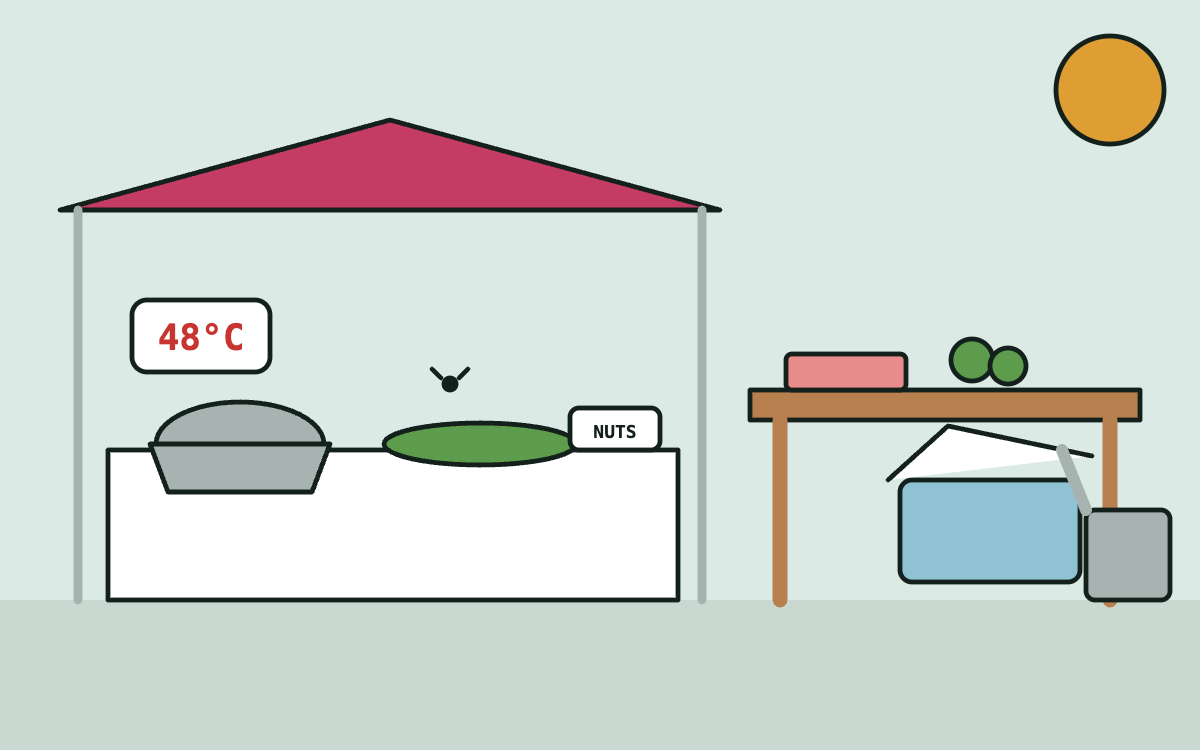
The wedding is on a farm 70 km from the kitchen. Lunch was meant for 13:00; the speeches run long and the buffet opens at 14:40. The coronation chicken has been on the table, in the sun, since 12:30. Is it still safe to serve? At most events nobody can answer that question, because nobody wrote down when the food was made or when it left the fridge.
Event food in South Africa must meet R638 wherever it is served: hot food at 60 °C or above; raw fish, shellfish, offal, poultry and milk at 4 °C or below; other chilled perishables at 5 °C or below; frozen food no warmer than −12 °C (−18 °C for ice cream). R638 lets perishable food be outside those limits only if it is sold directly to the consumer, or eaten on the premises, within four hours of being prepared (reg 8(4)(b)(i)). So at a buffet, keep food hot or on ice wherever you can. Food that is not held at those temperatures should be eaten within four hours of being prepared; log the times, and never serve anything that has spent more than four hours in total between 5 °C and 60 °C.
Food Safety for Caterers and Events teaches event, banqueting and catering staff to plan, pack, transport, serve and clear up safely: about 2¾ hours online, R450, picture-based, with a proctored final assessment and a certificate. It is one of four courses in the Hospitality Short Courses Bundle (R1 260 instead of R1 800).
Event catering food safety: the key facts
| Hot food | Core at least 60 °C (R638 Annexure E) |
|---|---|
| Raw fish, shellfish, offal, poultry, milk | Core no warmer than 4 °C |
| Other chilled perishables | Core no warmer than 5 °C: salads with dressings, cold meats, desserts, dairy |
| Frozen | No warmer than −12 °C; ice cream and sorbet −18 °C |
| R638 four-hour exemption | Perishable food sold directly to a consumer, or consumed on the premises, within four hours of being processed or prepared (reg 8(4)(b)(i)); the four hours run from preparation |
| 2-hour / 4-hour rule | Total time between 5 °C and 60 °C: under 2 hours, use or refrigerate; 2 to 4 hours, use now and never re-chill; over 4 hours, discard (Food Standards Australia New Zealand) |
| Cooling | 60 °C to 21 °C within 2 hours, then to 5 °C within a further 4 hours (FSANZ) |
| Reheating | To at least 74 °C in the centre, once only (good practice) |
| Premises | The kitchen needs a Certificate of Acceptability (CoA) from the local authority; the person in charge must be trained and must ensure every food handler is trained |
| Source | R638 of 22 June 2018 (GG 41730), regs 3, 8, 10 and Annexure E. The 2-hour/4-hour rule and cooling times are from FSANZ; reheating to 74 °C is good practice, not an R638 requirement |
What temperatures does R638 require for event food?
Annexure E of R638 sets core temperatures for food that is stored, transported or displayed: hot food at least 60 °C, raw fish, shellfish, offal, poultry and milk no warmer than 4 °C, other chilled perishables no warmer than 5 °C, and frozen food no warmer than −12 °C, or −18 °C for ice cream and sorbet.
These are core temperatures, taken with a clean, calibrated probe thermometer in the thickest part of the food. A chafing dish that feels hot, or a cooler box full of ice, tells you nothing about the food itself. Probe on arrival, when the buffet opens and at least every hour during service, and write the readings down. For the full table, including the surface limits and exemptions, see R638 temperature requirements explained.
How long can food stay out at a buffet?
No more than four hours in total between 5 °C and 60 °C. R638’s exemption covers perishable food sold directly to, or eaten on the premises by, consumers within four hours of being prepared, so the legal clock starts at preparation. The 2-hour/4-hour rule from Food Standards Australia New Zealand adds a cumulative safety limit: under 2 hours, the food may be used or refrigerated; between 2 and 4 hours, it must be used and cannot go back in the fridge; after 4 hours, it is thrown away.
The time is cumulative. It includes preparation, packing, the journey, setting up and service, so a salad made at 09:00 and left on the bench while the vans are loaded has already used part of its allowance before the guests arrive. That is why the most useful piece of equipment at an event is a timesheet: note when each dish was made and when it left temperature control, and it becomes a simple decision rather than a guess.
| Time | What happened | Clock |
|---|---|---|
| 10:30 | Coronation chicken out of the kitchen fridge, packed into a pre-chilled cooler at 4 °C | Still controlled |
| 12:30 | Unpacked and set on the buffet table, no ice bed, in the sun | Clock starts |
| 14:30 | Two hours out of temperature control | Must be used now; can no longer be re-chilled |
| 16:30 | Four hours | Discard whatever is left |
R638 counts its four hours from when the dish was prepared, not from when it left the cooler, so a dish made at 08:00 is covered by the exemption only until 12:00; after that the law expects it at 5 °C or below. Treat the FSANZ clock as a safety limit, not extra legal time. Better still, keep cold dishes in the closed cooler until just before service, set them on ice in the shade, and put out small bowls that are replaced rather than topped up.
How do you transport hot and cold food safely?
- Hot food goes straight from the oven, well above 60 °C, into pre-heated insulated carriers. If the journey is long, cook and chill in the kitchen and reheat on site instead.
- Cold food must already be at 5 °C or below when it is packed. Chill the cooler box with ice packs an hour before packing: a cooler keeps cold food cold, it cannot cool warm food.
- Raw and ready-to-eat food travel in separate, sealed containers, with raw food below ready-to-eat food. Chemicals travel separately.
- Probe on arrival and record the readings. Food that arrives outside its limit is dealt with at once, not “after the speeches”.
- Keep a copy of the kitchen’s CoA with the vehicle and the event file, so it can be produced if an environmental health practitioner asks.
How should food be cooled and reheated?
Cool cooked food from 60 °C to 21 °C within 2 hours, then to 5 °C within a further 4 hours. Reheat to at least 74 °C in the centre, and only once. Anything reheated and not eaten is thrown away.
These are good-practice limits rather than R638 figures: the cooling times come from Food Standards Australia New Zealand, and 74 °C is the widely used reheating temperature.
Large pots of stew and rice are the classic problem, because the centre stays warm for hours. Divide food into shallow trays, or stand the pot in an ice bath and stir, and never put a whole hot pot straight into the fridge.
Does an event caterer need a Certificate of Acceptability?
Yes. R638 prohibits handling food on premises without a Certificate of Acceptability, and “food premises” includes vehicles, stalls and temporary structures as well as kitchens. The caterer’s kitchen needs a CoA, and a stall or temporary kitchen at an event may need its own: check with the environmental health office of the municipality where the event is held.
R638 also requires a trained person in charge, who must make sure every food handler is trained. At events that includes casual waiting staff and anyone plating or serving food. For the background, see R638 training for restaurant, hotel and guesthouse staff.
How do you handle allergens at a buffet?
Label every dish with its name and the allergens it contains, keep a separate serving utensil for each dish, and never guess. If a guest asks and you are not sure, check the recipe or the ingredient labels, or say you cannot confirm it.
Plan allergen-free dishes in advance, prepare them first, and keep them covered and separate on the buffet so that spoons do not migrate. For the full set of kitchen controls, see allergens in a restaurant kitchen.
What can be done with leftovers after an event?
Food that was on the buffet is not re-served. Surplus that never left the kitchen or the hot box, and stayed at safe temperatures, may be cooled quickly, labelled, refrigerated and used within 3 days, for example for staff meals, reheating it once to 74 °C.
Many caterers also keep a labelled 100 to 200 g sample of each high-risk dish, frozen for at least 72 hours after the event. If guests fall ill, the sample helps the environmental health practitioner find the cause, and can clear your food if it was not to blame. For safe ways to reuse and donate surplus, see best before vs use by in hospitality kitchens.
An event food safety checklist
- Before: confirm guest numbers, the venue’s fridge space and power, and the service times. Plan allergen-free dishes and labels. Calibrate probe thermometers.
- Packing: hot food above 60 °C into pre-heated carriers; cold food at 5 °C or below into pre-chilled coolers; raw below ready-to-eat.
- Arrival: probe and record. Set up hand-washing with soap, water and paper towels before anything is unpacked.
- Service: hot food at 60 °C or above, probed hourly; cold food on ice, in the shade; small batches replaced, not topped up; one utensil per dish; start the clock for anything out of temperature control.
- After: discard buffet food; cool, label and refrigerate untouched surplus; freeze samples; complete the records.
Frequently asked questions
What temperature must hot food be kept at during an event in South Africa?
At least 60 °C at the core, under Annexure E of R638. Probe hot food when the buffet opens and at least every hour during service, and record the readings.
How long can cold food be left out at a buffet?
R638 expects cold food at 5 °C or below unless it is eaten within four hours of being prepared. As a safety limit, never serve food that has spent more than four hours in total between 5 °C and 60 °C, counting preparation, transport and service: under 2 hours it may go back in the fridge; between 2 and 4 hours it must be used and not re-chilled; after 4 hours it must be discarded.
Does R638 have a four-hour rule?
R638 exempts perishable food sold directly to a consumer, or consumed on the premises, within four hours of being processed or prepared from the Annexure E temperature limits (regulation 8(4)(b)(i)); the four hours run from preparation. The widely used 2-hour/4-hour rule comes from Food Standards Australia New Zealand and helps manage that time in practice.
Can a cooler box cool down warm food?
No. A cooler box only keeps cold food cold. Chill food to 5 °C or below in the fridge before packing it, and pre-chill the cooler with ice packs.
How many times can food be reheated?
Once. Reheat to at least 74 °C in the centre, and throw away anything that is not eaten after reheating.
Can buffet leftovers be given to staff or donated?
Not food that was on the buffet. Surplus that stayed in the kitchen or hot box at safe temperatures can be cooled quickly, labelled, refrigerated and used within 3 days, including for staff meals or a controlled donation.
Which ASC course covers this
Food Safety for Caterers and Events follows an event from the planning meeting to the clean-up: R638 temperatures, cooler boxes and hot boxes, loading a vehicle, setting up a buffet in the sun, the 2-hour/4-hour rule, allergens, leftovers and samples. Four short modules with picture-based quizzes and a proctored final assessment, R450, with a certificate on completion.
It is part of the Hospitality Short Courses Bundle with Guest Data Protection (POPIA), Chemical Safety for Housekeeping and Laundry and Fire Safety and Evacuation for Accommodation, all four for R1 260. For the R638 certificates themselves, see Regulation R638 training; to cut what goes in the bin after events, see Food Loss and Waste in Foodservice and Hospitality.
Sources
- Regulations governing general hygiene requirements for food premises, the transport of food and related matters (R638 of 22 June 2018), Government Gazette 41730
- 2-hour/4-hour rule, Food Standards Australia New Zealand
- Food temperature and thermometers, Food Standards Australia New Zealand